
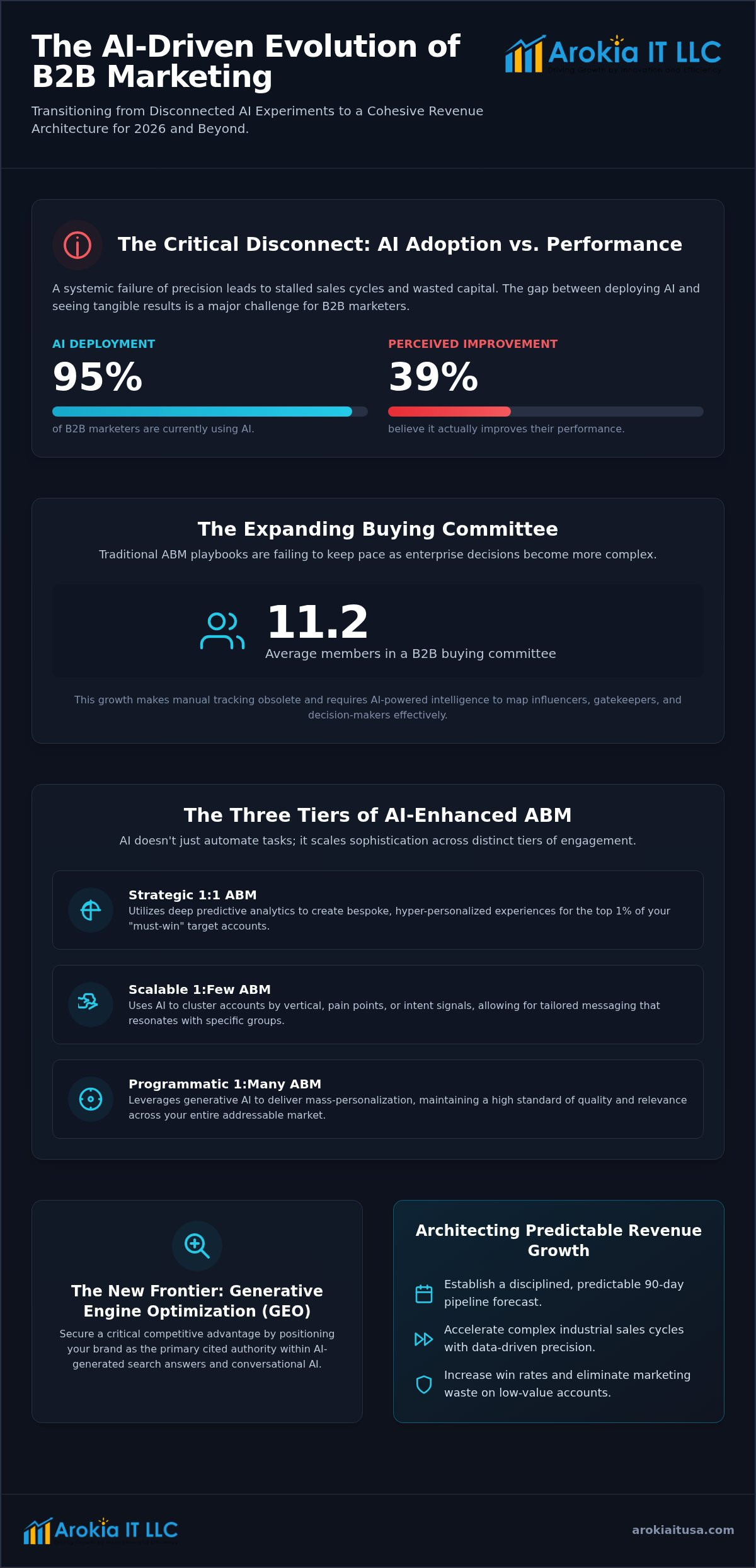
95% of B2B marketers are currently deploying AI, yet only 39% believe it actually improves their performance. This gap represents more than just a missed opportunity; it’s a systemic failure of precision that leads to stalled enterprise sales cycles and wasted capital on low-value accounts. If your current application of ai in account based marketing feels like a sequence of disconnected experiments rather than a cohesive strategy, you’re likely subsidizing your competitors’ market share. True revenue precision requires moving beyond basic automation toward a disciplined architecture that bridges the gap between marketing intent and closed-won deals.
You understand that the traditional ABM playbook is failing to keep pace with the 11.2 members now typical of an enterprise buying committee. This guide promises to solve that misalignment by showing you how to integrate Generative Engine Optimization (GEO) and advanced AI to build a predictable 90-day pipeline forecast. We’ll examine the specific mechanics of shortening complex sales cycles and increasing your authority in AI-driven search results. By the end of this executive briefing, you’ll have a systematic framework to eliminate marketing waste and secure the higher win rates your 2026 revenue targets demand.
Key Takeaways
- Transition from tactical account selection to a systematic revenue architecture by leveraging ai in account based marketing to identify high-propensity targets.
- Accelerate complex industrial sales cycles by using AI to map and influence the expanded 11-member buying committees typical of enterprise deals.
- Secure a competitive advantage through Generative Engine Optimization (GEO), positioning your brand as the primary cited authority within AI-generated search answers.
- Replace surface-level vanity metrics with a disciplined 90-day pipeline forecast to ensure financial predictability and eliminate marketing waste.
- Identify the critical distinctions between traditional branding agencies and technical revenue architecture partners capable of executing high-stakes ABM.
What is AI-Driven Account-Based Marketing? The 2026 Strategic Evolution
Modern marketing isn’t a creative flourish; it’s a financial engine. In 2026, the era of tactical, ad-hoc campaigns has been replaced by a systematic revenue architecture. This evolution marks the end of manual account selection, where gut feelings and static lists once dictated strategy. Today, AI-powered propensity modeling analyzes trillions of data points to identify which enterprise accounts are statistically likely to convert. AI in ABM is the integration of predictive intelligence and personalized orchestration. It’s the difference between guessing where your next deal comes from and engineering its arrival.
Traditional demand generation is a volume game. It prioritizes the top of the funnel, often flooding sales teams with low-intent leads that never close. In contrast, ai in account based marketing prioritizes precision. By focusing resources on a curated list of high-value targets, organizations eliminate the capital leakage associated with broad-spectrum marketing. This shift transforms marketing from a cost center into a clinical driver of organizational growth. Leaders who recognize the strategic advantage of integrating ABM and demand generation into a unified revenue framework are best positioned to eliminate the friction that siloed motions create across the buyer journey.
The Shift from Lead Volume to Pipeline Quality
The Marketing Qualified Lead (MQL) is a failing metric in complex B2B environments. A single download or webinar view doesn’t signal intent; it signals curiosity. With the average B2B buying committee now grown to 11.2 members, tracking individual leads is an exercise in futility. AI changes the perspective from the individual to the account level. It identifies “out-of-market” accounts that are simply researching and differentiates them from “in-market” accounts showing active purchase signals. This alignment transforms the traditional sales hand-off into a unified model of Account-based selling where data, not intuition, drives the conversation. You’re no longer reacting to clicks. You’re proactively architecting revenue.
The Three Tiers of AI-Enhanced ABM
Industrial procurement is a high-stakes gauntlet. It isn’t a single decision; it’s a consensus-building exercise that can span years. While traditional marketing treats a “lead” as an isolated individual, ai in account based marketing treats the entire organization as a living ecosystem. The primary friction in industrial deals isn’t a lack of interest. It’s the internal misalignment between stakeholders who possess competing priorities. By using predictive intelligence, you can map the “Buying Circle” and deliver the specific data each member needs to move forward. This level of precision prevents the common “no-decision” outcome that often plagues complex sales.
The unique complexity of these deals requires a specialized account based marketing for manufacturers framework. This approach ensures that your technical proof points reach the engineers while your ROI projections reach the C-suite. It’s about identifying and eliminating the specific friction points that stall 18-month sales cycles. When you align your marketing architecture with the realities of industrial buying, you stop wasting spend on accounts that will never close.
Mapping the Buying Committee with Predictive Intelligence
With the average B2B buying committee expanding to 11.2 members, manual tracking is obsolete. AI identifies the influencers and gatekeepers who often remain invisible in traditional CRM data. It segments personas automatically, recognizing that a procurement officer cares about contract stability while a head of engineering prioritizes uptime. It analyzes intent signals to determine when the committee is most active, allowing for surgical timing of outreach. This level of AI in Account-Based Marketing ensures you aren’t just shouting into a digital void. You’re participating in the account’s internal evaluation process.
Sales Enablement: Content as a Strategic Asset
Content in an industrial context isn’t just educational. It’s a strategic asset for resolving executive-level objections before they’re even voiced. Data-driven decision tools and technical validation documents act as silent sales representatives within the target account. By utilizing LinkedIn marketing, you maintain high-frequency touchpoints with every stakeholder simultaneously, reinforcing your authority across the entire organization. This orchestrated approach provides technical proof points at scale, effectively shortening the sales cycle by providing clarity where there was once confusion. If you want to transform your sales trajectory into a predictable engine, consider a consultation with the revenue architects at Arokia IT to refine your pipeline strategy.
Generative Engine Optimization (GEO): The New Frontier of ABM Discovery
Traditional SEO is a legacy tactic for enterprise ABM. In 2026, the buyer’s journey has shifted from scrolling through pages of blue links to interrogating AI interfaces. When an executive at a target account asks a platform like Perplexity or ChatGPT for a vendor shortlist, they aren’t looking for a list of websites. They’re seeking a synthesized recommendation backed by technical proof. If your brand isn’t the primary citation in that AI-generated response, you’re effectively invisible. This is why Generative Engine Optimization (GEO) has become a mandatory component of ai in account based marketing. It’s the disciplined process of ensuring your proprietary data and technical expertise are the foundational sources for these AI engines.
Dominating the ‘Unseen’ 70% of the Buyer Journey
B2B buyers are often 70% of the way through their research before they ever contact a sales representative. AI search engines now dominate this “unseen” phase by aggregating technical data, performance benchmarks, and peer reviews into a single answer. To win in this environment, your white papers and case studies must be structured for LLM extraction. This isn’t about keyword stuffing; it’s about data clarity and structural integrity. When AI engines perform competitive comparisons for procurement teams, your brand must appear as the benchmark for quality and reliability. You aren’t just competing for clicks. You’re competing for the AI’s trust. By optimizing technical assets for machine readability, you ensure your value proposition is accurately represented during the critical shortlisting phase. Understanding the full scope of b2b generative engine optimization is essential for any organization seeking to dominate this unseen research phase and secure citations in AI-generated answers.
LinkedIn and Search Synergy
AI search engines don’t operate in a vacuum. They prioritize sources that demonstrate high levels of social proof and authoritative signals. This creates a critical synergy between your LinkedIn marketing and your AI search visibility. When your executives publish technical thought leadership on LinkedIn, it creates a trail of recognition that AI engines use to validate your brand’s authority. By aligning your ai in account based marketing strategy with these social signals, you reinforce your position as a market leader. This integrated approach ensures that when a buyer conducts a deep-dive research session, your brand is presented as the logical, data-backed choice. It’s about building a digital footprint that is both human-centric and machine-readable, ensuring total oversight of the discovery process. Aligning paid search with these AI-generated research patterns further cements your dominance by capturing high-intent queries that traditional search strategies often miss.
The 90-Day Pipeline Framework: Implementing Predictable Revenue Growth
Vanity metrics like impressions and clicks are a facade for marketing inefficiency. They offer the illusion of progress without the accountability of revenue. A disciplined 90-day pipeline forecast replaces these distractions with a clinical view of your financial future. By integrating ai in account based marketing, you move from speculative outreach to a systematic orchestration of high-value deals. This framework isn’t a suggestion; it’s a requirement for organizations that value capital efficiency over creative noise. It provides the strategic confidence needed to allocate resources where they’ll generate the highest return.
A healthy ABM pipeline is defined by leading indicators such as account-level penetration and intent velocity. It’s not about how many people saw an ad. It’s about how many decision-makers within a specific account are consuming your technical proof points simultaneously. When you align your marketing spend with a 90-day pilot sprint, you create a feedback loop that validates your strategy in real-time. This approach eliminates the “wait and see” mentality that often leads to stalled enterprise cycles.
Phase 1: Account Identification and Insight Gathering
Marketing shouldn’t start with a message; it starts with a target. Building a Target Account List (TAL) requires a focus on high-stakes revenue potential rather than broad market appeal. The precision afforded by ai in account based marketing allows you to identify specific pain points through technographic research and intent signals. This phase ensures that sales and marketing are unified on the 90-day objective. You aren’t just looking for accounts. You’re identifying the specific organizational triggers that indicate a readiness to buy. This alignment ensures that every dollar spent is directed toward accounts with a statistically significant probability of closing.
Phase 2: Orchestration and Engagement
Engagement isn’t a single event; it’s a multi-channel sequence of high-frequency touchpoints. Once your targets are identified, you must launch orchestrated “plays” across LinkedIn, GEO, and direct outreach. AI monitors account-level engagement to refine messaging in real-time, ensuring your technical proof points remain relevant as the buying committee’s research evolves. Transitioning these accounts to sales requires more than a lead hand-off. It requires a high-stakes enablement package that includes the data-driven decision tools procurement teams demand. Eliminate the ambiguity in your sales cycle and build a predictable revenue engine today.
Selecting a B2B Marketing Agency for High-Stakes ABM Execution
Most agencies sell aesthetics. They prioritize brand awareness and creative flourishes that look impressive in a pitch deck but fail to move the needle on a balance sheet. For executive leadership, these “branding agencies” are a liability. You don’t need a creative partner; you need a revenue architecture partner. True ai in account based marketing requires a clinical focus on accountability, precision, and the elimination of marketing waste. If an agency cannot explain the mechanics of how they’ll shorten your specific sales cycle, they aren’t equipped to manage your growth.
Industrial firms face unique pressures that traditional agencies often misunderstand. You operate in an environment of 18-month procurement cycles and 11.2-member buying committees. This complexity demands a partner with deep technical expertise who can translate engineering value into executive ROI. While choosing the most effective ABM platforms is a critical step, the software is merely a tool. The strategy behind that tool determines whether you build a predictable pipeline or simply automate your existing inefficiencies.
Criteria for Evaluating Strategic Partners
Arokia IT functions as a revenue architect for industrial and B2B leaders. We’ve moved beyond the ambiguity of “brand building” to focus exclusively on the high-stakes deals that drive fiscal success. Our proprietary 90-day pipeline forecast methodology eliminates marketing uncertainty by providing a clear, data-backed view of your future revenue. We integrate GEO into every strategy to ensure your brand is the cited authority where enterprise buyers conduct their research. This isn’t about being seen. It’s about being the only logical choice for your target accounts. Stop guessing at your growth and start engineering it. Request a 90-Day Pipeline Forecast Analysis and secure your 2026 revenue targets today.
Transitioning from Speculative Spend to Revenue Precision
The window for speculative marketing has closed. In 2026, the distinction between market leaders and those struggling with stalled cycles is the disciplined application of ai in account based marketing. You’ve seen how revenue architecture replaces vanity metrics, how GEO captures the unseen buyer journey, and how a 90-day framework provides the predictability executive leadership demands. This isn’t a theoretical exercise. It’s a systematic approach to securing enterprise deals in a landscape where 11.2-member buying committees and AI search engines now dictate the terms of discovery.
Arokia IT stands as your critical partner in this transformation. We combine specialized industrial B2B expertise with our proprietary 90-day revenue framework to eliminate capital leakage and accelerate growth. By leveraging our deep expertise in AI search and GEO, we ensure your brand remains the undisputed authority throughout the procurement process. The path to a predictable pipeline is clear. Request a 90-Day Pipeline Forecast Analysis to begin engineering your next phase of fiscal success. Your revenue targets are within reach when you replace intuition with precision.
Frequently Asked Questions
Is AI in Account-Based Marketing just for large enterprises?
No, precision isn’t a luxury reserved for the Fortune 500. While large enterprises use AI to manage thousands of accounts, mid-market B2B firms use it to eliminate marketing waste and compete for high-stakes deals with surgical accuracy. Implementing ai in account based marketing allows smaller teams to automate the research phase, ensuring that every dollar of spend is directed toward accounts with a statistically verified propensity to buy.
How does Generative Engine Optimization (GEO) impact my ABM strategy?
GEO ensures your brand becomes the definitive citation when enterprise buyers research solutions via AI platforms like ChatGPT or Perplexity. Traditional SEO targets keywords, but GEO targets the underlying data models that AI engines use to synthesize answers. By optimizing your technical content for machine readability, you secure visibility during the “unseen” 70% of the buyer’s journey. This visibility is critical for influencing decision-makers before they ever engage with a salesperson.
What is the difference between AI-driven ABM and traditional demand generation?
Traditional demand generation is a volume-based strategy that prioritizes lead quantity and top-of-funnel MQLs. AI-driven ABM is a revenue architecture that prioritizes pipeline quality and account-level conversion. Instead of casting a wide net and hoping for interest, AI-driven strategies use propensity modeling to identify accounts already showing purchase intent. This shift moves your organization away from speculative lead chasing and toward a disciplined, predictable engine for financial growth. Organizations seeking to maximize both precision and scale should explore the strategic benefits of integrating ABM and demand generation into a unified 2026 revenue framework to eliminate the gaps that siloed approaches create.
How quickly can I expect to see a return on investment from an ABM program?
You should expect a measurable 90-day pipeline forecast within the first quarter of implementation. While industrial sales cycles often span 12 to 18 months, the leading indicators of success appear much earlier. AI allows you to track engagement velocity and intent signals across the entire buying committee. These metrics provide the strategic confidence needed to validate your ROI long before the final contract is signed.
Do I need a massive dataset to start using AI in my ABM efforts?
Quality is more important than volume. You don’t need a massive internal dataset to begin because modern AI platforms leverage external technographic and intent data to build your target account list. The focus should be on data hygiene and structural integrity rather than sheer scale. Starting with a curated list of high-value targets allows the AI to refine its predictive models more effectively than processing millions of low-quality leads.
How does AI help in aligning sales and marketing teams?
AI creates a single source of truth that eliminates the traditional friction between departments. By identifying “in-market” accounts through shared intent data, AI ensures that both teams are focused on the same high-priority targets. Marketing provides the technical sales enablement content, while sales executes the high-touch outreach at the exact moment the buying committee is most active. This orchestration transforms disconnected tactics into a unified, high-stakes revenue architecture.
What are the most important KPIs for measuring AI-powered ABM success?
Vanity metrics like impressions and clicks are irrelevant in a high-stakes ABM environment. The most critical KPIs include pipeline velocity, account-level engagement depth, and win rates for targeted accounts. You must also track your brand’s citation frequency within AI search results to measure GEO effectiveness. These metrics provide a clinical view of your marketing efficiency and ensure that your 90-day pipeline forecast remains an accurate predictor of future financial success.
Can AI-driven ABM help in shortening industrial sales cycles?
Yes, by resolving technical objections before they stall the process. Industrial deals often involve 11.2-member buying committees with competing priorities. Using ai in account based marketing maps these committees and delivers tailored proof points to procurement, engineering, and the C-suite simultaneously. This orchestrated approach reduces mid-funnel friction and prevents the “no-decision” outcomes that typically lengthen cycles. Shortening the sales cycle is a direct result of providing the right data at scale.