
SEO still matters in generative AI search, but documentation needs to do more than target keywords. To optimize technical documentation for AI search, make answers clear, terminology consistent, and content accessible to crawlers. No special AI markup can make information that is difficult to find or interpret useful.
It’s reasonable to ask whether established SEO practices still apply as AI tools change how people find technical information. The practical answer is yes: strong fundamentals remain useful, while exaggerated claims about special files, tiny content fragments, or guaranteed AI visibility can waste time and resources.
This article explains how clear headings and self-contained answers help systems interpret documentation, why consistent product terms matter, and how crawlability affects discovery. It also distinguishes practical improvements from unsupported promises, so you can assess what professional optimization can address and what it cannot guarantee.
Key Takeaways
- Keep SEO fundamentals in place: clear page metadata and useful, accessible documentation still support discovery in AI search.
- Organize technical answers under descriptive headings, and separate code examples from the instructions around them.
- Use consistent names for product concepts and identify specific files or entities instead of relying on vague references.
- Make important documentation accessible to crawlers in page content, and align technical settings with how search engines should access and index it.
- Prioritize evidence-based improvements over claims of guaranteed AI visibility or special optimization requirements.
Is SEO still relevant for generative AI search?
SEO still matters because Google’s generative search features use accessible web content. Clear page titles, descriptions, and headings help systems interpret a page and extract useful passages. Microsoft also recommends aligning these elements. For example, an API authentication page should identify authentication in its title, heading, and opening answer. Professionals who optimize technical documentation for AI search rely on these fundamentals, not on a separate set of ranking guarantees.
Professionals improve documentation for Google AI Overviews, ChatGPT, and other AI search tools by making pages crawlable, accurate, and easy to interpret. They align titles with page topics, organize answers around user needs, and use product terms consistently. An authentication guide, for example, should distinguish credentials, token creation, and error handling rather than blending those tasks together.
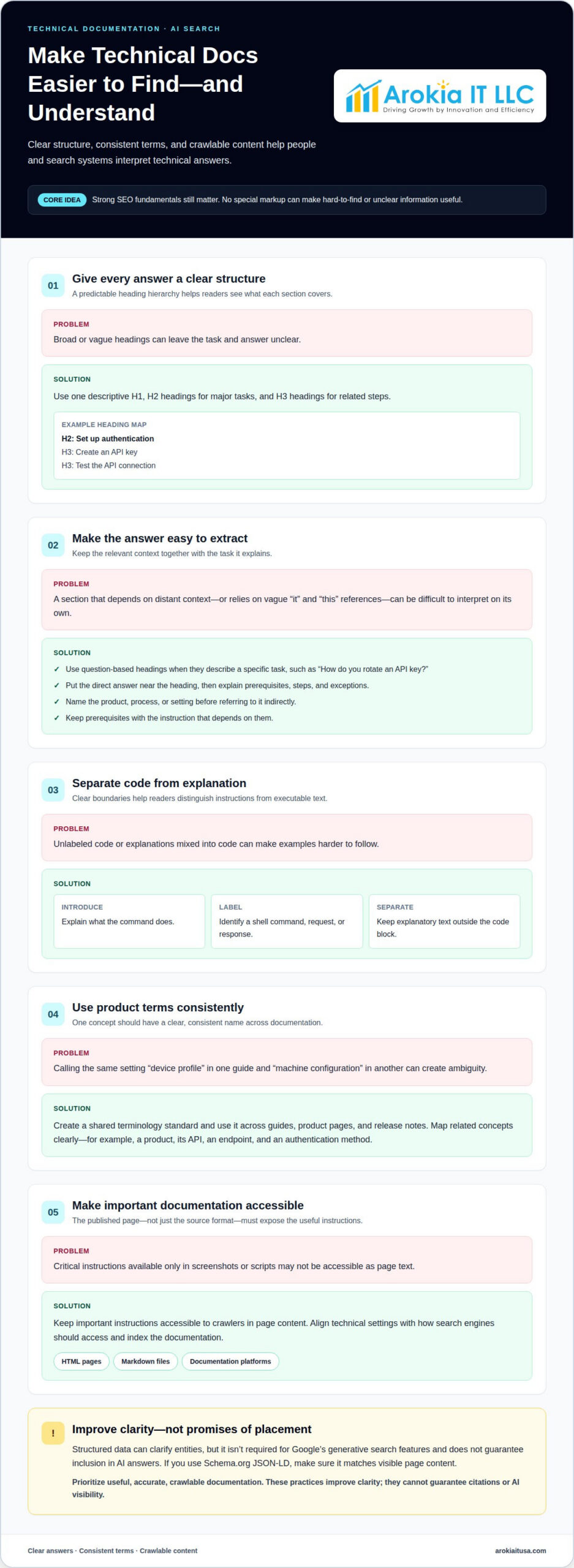
Technical documentation commonly appears as HTML pages, Markdown files, or content managed through documentation platforms. What matters most is the published result: critical instructions should be accessible as text, not only embedded in screenshots or scripts. A setup guide can separate prerequisites, commands, and expected output, making the material easier for people and retrieval systems to navigate.
Structured authoring connects each statement to a clear subject and action. “The API key authenticates each request” is more precise than “It does this.” Entity mapping applies that clarity to related concepts, such as a product, its API, an endpoint, and an authentication method. Kocaeli University describes AI-mediated search as favoring context, credibility, and usefulness alongside traditional ranking signals.
Structured data can clarify entities, but it isn’t required for Google’s generative search features. Google says sites don’t need special schema markup for these features, and structured data doesn’t guarantee inclusion in AI answers. If a site uses Schema.org JSON-LD, the markup should match visible page content. For example, article data should identify the author shown on the page. Validate markup for accuracy, not as a promise of AI placement.
A professional process to optimize technical documentation for AI search starts with priority content, such as authentication, key endpoints, and getting-started guides. The team maps important entities, clarifies terminology, and organizes pages around complete answers. It then reviews crawlability and checks structured data against visible content. Testing representative questions about authentication or error handling in AI tools can reveal unclear passages. These steps improve documentation quality without promising citations.
Clear headings and extractable answer sections
A predictable heading hierarchy gives humans and AI systems a map of each page. Use one descriptive H1, then H2 headings for major tasks, followed by H3 headings for related steps. For example, an API setup guide might group “Create an API key” and “Test the API connection” under a “Set up authentication” section. This structure keeps related instructions together and helps search engines identify each section’s purpose.
Question-based headings make an answer’s scope explicit. A heading such as “How do you rotate an API key?” signals a specific task more clearly than “Key management.” Put the direct answer near the heading, then explain prerequisites, steps, and exceptions. This helps retrieval systems connect a user’s question with relevant documentation without relying on surrounding pages.
Documentation chunking, descriptive headings, and internal links make information easier to find and interpret. Each section should address a coherent task, while links connect it to related concepts. For example, an authentication section can link to a specific permissions guide, helping readers and AI engines follow the relationship between credentials and access.
Make each section self-contained enough to make sense when extracted. Define the relevant product or process before using “it” or “this setting.” A section about token expiration should identify which token expires and what that affects. Don’t separate a prerequisite from the instruction that depends on it. The goal is useful context, not artificially tiny fragments or special formatting for every passage.
Code needs clear boundaries and labels. Introduce a command and explain its purpose, then place it in a separate code block. Label whether an example is a shell command, a request, or a response. For instance, distinguish a curl request from the JSON response it returns. Keep explanations outside the code block so readers and automated systems can distinguish instructions from executable text.
These practices improve clarity, not guaranteed placement in generative results. Google doesn’t require websites to break content into tiny pieces for AI systems. Instead, documentation teams should preserve complete explanations and use headings that accurately describe the content beneath them. Descriptive internal link text, such as “configure API permissions,” communicates the destination better than “learn more.” Review each page as a whole: every heading should set an accurate expectation, and every linked section should add useful context.
Consistent terminology
A technical term should identify the same concept across every guide, product page, and release note. If one page calls a setting “device profile” and another calls it “machine configuration,” readers may not know whether the labels mean the same thing. AI systems face the same ambiguity. A shared terminology standard gives editors a foundation for accurate, connected documentation.
Start with a controlled vocabulary for product names, components, actions, and user roles. For example, choose “sensor gateway” as the preferred term, then document “gateway” as an acceptable shortened form. Don’t switch among “sensor hub,” “edge connector,” and “gateway” without explaining their relationship. A terminology record can define the preferred label, approved alternatives, meaning, and usage context.
Consistency also means naming entities instead of relying on unclear pronouns. “The controller stores the calibration file” identifies both the actor and the object. “It stores this” forces readers to infer what “it” and “this” mean. In instructions, name the specific file, interface, or component where it matters. This helps people and generative systems follow relationships accurately.
Attribution clarifies who made a statement and what it describes. A release note should identify the product version or feature change, while a troubleshooting guide should distinguish manufacturer instructions from user actions. For example, “The controller reports a fault when the sensor loses power” states a behavior directly. If that statement applies only to a particular model, name the model in the same passage.
Terminology can drift as products evolve. A documentation review should compare current product language with older guides, support articles, and interface labels. If a control changes from “Export log” to “Download diagnostic report,” update related instructions and explain any retained alias. This prevents search results from presenting conflicting labels for the same action and helps teams spot outdated material before it appears to be current guidance.
For complex documentation, maintain a terminology source of truth and assign an owner to manage changes. Editors can check new pages against that vocabulary, then audit existing content when product language changes. Asking an AI tool to summarize conflicting labels may expose inconsistencies, but human review must establish the correct term. Google and other search engines benefit from clear entity relationships; consistent wording makes those relationships easier to interpret without promising a particular result.
Crawlability, indexing, and Search technical requirements
Search engines can’t use documentation they can’t access. Google can process JavaScript-rendered pages when the content isn’t blocked, but important instructions should still appear in crawlable HTML. A setup step hidden in an image or an unreliable script may be harder to discover. Describe diagrams and screenshots in text, and make the page’s main content easy to distinguish.
Separate crawlability from indexability. A crawler may fetch a URL without that page becoming a useful search result. Review robots.txt, access controls, canonical tags, and snippet directives together. For example, a canonical tag should identify the preferred version of a guide, and internal links should point consistently to that version. Google recommends allowing Googlebot access and avoiding overly restrictive snippet controls.
Robots.txt can affect AI agents as well as other crawlers. A rule using User-agent: * and Disallow: / blocks all crawlers covered by that rule. Review robots.txt alongside CDN and firewall settings, since either can prevent access. For JavaScript-heavy documentation, test whether the rendered HTML contains the actual instructions. Server-side or hybrid rendering can make critical content available in the page response.
Canonicalization, hreflang, and crawl depth help manage large documentation libraries. Canonicalization consolidates duplicate or near-duplicate URLs around a preferred page. Hreflang connects equivalent language versions so search engines can interpret their relationship. Keep important guides reachable through clear internal paths instead of burying them several layers deep. An XML sitemap with accurate lastmod values can also signal meaningful content updates.
Page speed and crawler efficiency depend on more than a fast homepage. Heavy scripts, repeated redirects, and slow responses can make a documentation site harder to use and process. Google recommends a good page experience across devices, reduced latency, and clearly presented main content. Removing unnecessary page weight and avoiding redirect chains can improve access without hiding essential technical details.
Measure visibility and accuracy by combining search performance data with repeatable AI-answer reviews. Track whether priority documentation pages are crawled and indexed, then test representative questions in tools such as Google AI Overviews and ChatGPT. Record whether answers cite the right page and describe its instructions accurately. Support-ticket patterns and developer onboarding metrics can show whether documentation changes address recurring confusion.
Avoiding unsupported AI-search optimization claims
Be cautious of claims that a special file guarantees AI visibility. Google says websites don’t need llms.txt, special machine-readable files, AI text files, or Markdown to appear in its generative search features. Google also says traditional search best practices remain sufficient, and no specific structured-data type guarantees inclusion in AI answers. A vendor promising guaranteed placement is claiming more than these facts support.
Semantic language improves precision, but it isn’t a ranking switch. A sentence such as “The controller sends temperature readings to the monitoring dashboard” identifies the subject, action, and destination. That clarity helps readers understand the relationship and gives AI systems less room to confuse the entities. It doesn’t prove the sentence will appear in an AI Overview or a ChatGPT response.
Sources make technical claims easier to evaluate. For example, a product guide can attribute a compatibility statement to the manufacturer’s current release notes while distinguishing it from the company’s own instructions. Include relevant source names and dates when they establish useful context. A citation alone doesn’t ensure search visibility: attribution supports trust, but discovery also depends on access, relevance, and how systems select material.
Common risks include AI hallucinations and outdated documentation. A generated answer may omit a condition, confuse similar components, or repeat a setup step that changed in a later release. For instance, an old guide might describe a retired authentication method as current. Clear version labels, maintained source content, and precise qualifiers reduce confusion, but they can’t control how an AI system summarizes a page.
Evaluate optimization proposals by separating verifiable work from promised outcomes. A concrete scope might include improving terminology, resolving duplicate documentation, or making key instructions accessible to crawlers. “Guaranteed citations in Google AI Overviews” is not an equivalent deliverable. Ask which pages and content changes are covered, how accuracy will be assessed, and which results can actually be observed. The defensible goal is stronger, more useful documentation that search systems can access and interpret, not guaranteed inclusion in every generated answer.
Arokia IT LLC: AI Search & GEO
Arokia IT LLC helps B2B companies connect technical content with search discovery through its AI Search & GEO offering. When documentation is accurate but difficult for prospects to find, the work starts by aligning its structure, language, and search context with the questions buyers and users ask. The goal is practical discoverability, not a promise of placement in a particular AI answer.
This support can be useful when product guides, API documentation, and company messaging describe the same product in different terms. Arokia IT LLC can help identify content gaps and clarify how technical pages relate to product entities, use cases, and audience needs. For example, a software company may need authentication documentation to serve developers while also making the product’s capabilities understandable to decision-makers.
AI Search & GEO connects documentation improvements to a broader content strategy. That means prioritizing pages that explain core workflows, making their purpose clear, and ensuring content supports the questions prospective customers bring to search. Arokia IT LLC’s AI search optimization work can help businesses consider how technical information fits into organic discovery without treating special markup or keyword repetition as a shortcut.
Consider professional support when documentation spans multiple products, teams, or audiences, or when existing pages attract attention without helping readers understand the product. A coordinated review can identify where terminology, page structure, and search intent diverge. If technical content contributes to a longer B2B buying process, it can also be considered alongside demand generation or Account-Based Marketing, rather than handled as an isolated search task.
Arokia IT LLC focuses on AI-driven search and Generative Engine Optimization for B2B and industrial audiences. The appropriate scope depends on the documentation, its intended readers, and the business goals it needs to support. Clear priorities help focus effort on the pages that matter most, while realistic measurement distinguishes content improvements from outcomes that search platforms control.
If you’re considering AI Search & GEO for technical documentation, contact Arokia IT LLC to discuss your needs, with no pressure to proceed.
Frequently Asked Questions
Should I write differently for AI versus human readers?
No. Write one useful version for people, with enough context for readers at different experience levels. For example, explain a required setting in the main procedure, then provide advanced configuration details in a clearly labeled subsection. This lets a new user complete the task without making an experienced engineer work through every implementation detail. Keep critical warnings visible in the workflow instead of relying on readers to find them elsewhere.
What is generative engine optimization (GEO)?
Generative engine optimization is a content and discovery practice focused on helping generative search systems interpret relevant information. It is not a separate file format, a guaranteed ranking position, or a replacement for maintaining accurate source material. For a technical publisher, GEO can mean aligning page topics with real customer questions and making product information coherent across the site. Its value lies in disciplined content work, not a shortcut to citations.
How does AI search retrieve and rank technical documentation?
There is no single public ranking formula that applies across AI search products. Systems can differ in how they find sources, choose passages, and compose answers, so a page’s visibility may vary by tool and question. For a useful evaluation, define a representative set of developer tasks, such as diagnosing a failed request, then assess each platform separately. A result in one system should not be treated as a universal ranking.
How should technical documentation be structured for AI search and retrieval?
Separate documentation by purpose: use tutorials for guided tasks, reference pages for specifications, and troubleshooting pages for failure conditions. A developer looking up a parameter shouldn’t have to sift through a full onboarding narrative. Connect related content when a task depends on a specific reference, and make product or version scope explicit. This information architecture helps users choose the right kind of answer before following instructions.
What metadata and schema markup help AI search understand documentation?
Use metadata to describe the actual page, not to add claims readers can’t see. A reference page’s title should identify its product and subject; a tutorial should signal the task it teaches. Schema markup should reflect the page’s actual type and visible content. For example, don’t label an API reference as an editorial article solely to add structured data. Metadata can clarify context, but it can’t assure an AI citation.
What technical SEO requirements affect AI indexing of documentation sites?
Check a representative URL from each documentation template, including versioned pages and pages with interactive elements. Confirm that the intended page loads without a user session, resolves to the correct version, and presents its main instructions in the rendered experience. Also review how search and filter URLs are handled, since they can create competing paths to similar material. These template-level checks can reveal issues that a homepage review would miss.
What documentation formats and platforms are best for AI search optimization?
HTML pages, Markdown files, and documentation platforms can all work. What matters most is the published content: keep critical instructions accessible as text, not only in screenshots or scripts.