
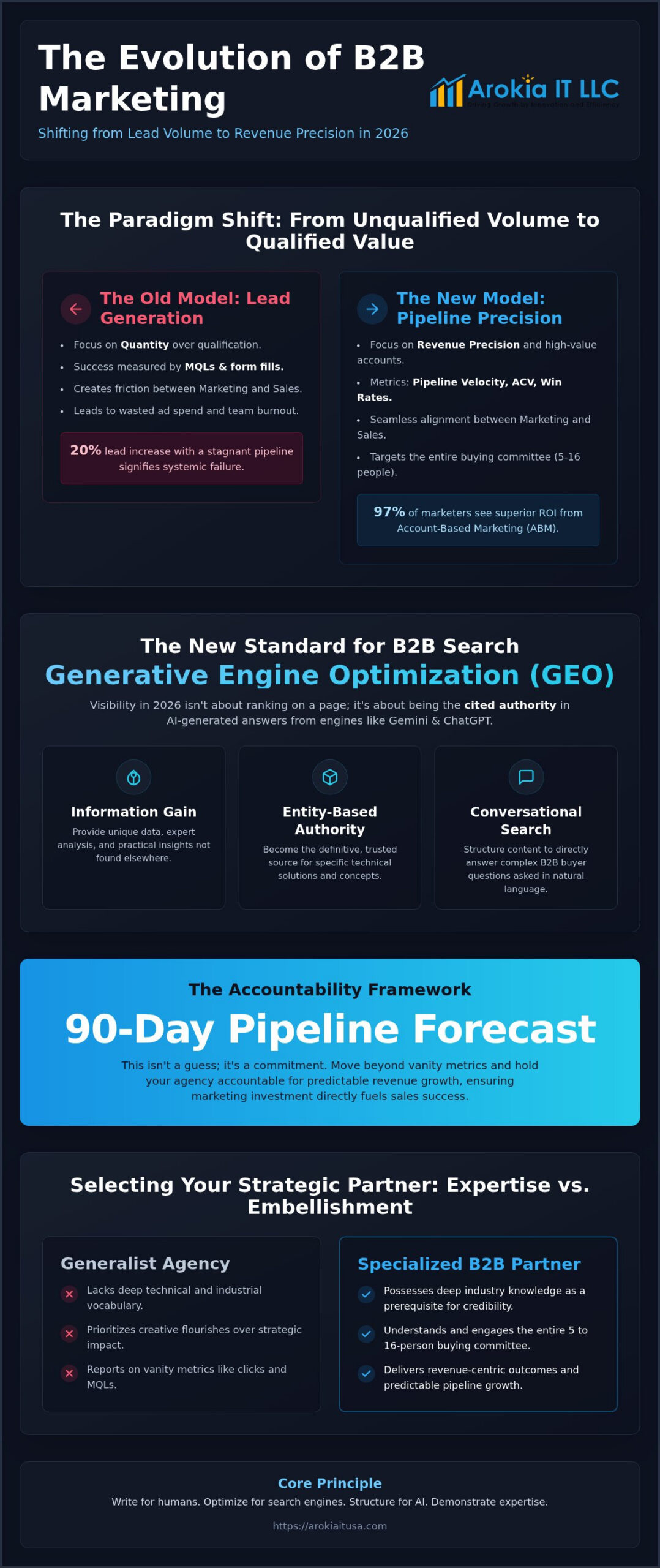
If your marketing dashboard shows a 20% increase in leads while your sales team reports a stagnant pipeline, you aren’t looking at growth; you’re looking at a systemic failure. When 97% of marketers recognize that Account-Based Marketing (ABM) delivers superior ROI, the traditional model of broad-reach lead generation has become a strategic liability. Choosing the right b2b digital marketing agency in 2026 requires moving beyond creative flourishes and demanding clinical accountability for revenue outcomes.
You likely agree that the persistent disconnect between marketing activity and sales reality is the greatest drain on your organization’s efficiency. It’s time to stop funding opaque reporting that hides a lack of tangible impact. This article explores how the shift from lead volume to pipeline precision is redefining what a strategic partner must provide. You’ll discover how to secure predictable 90-day pipeline forecasting, align your content with sales enablement, and maintain dominance in an era of AI-driven search engines and generative engine optimization.
Key Takeaways
- Pivot from vanity lead metrics to pipeline precision to resolve the chronic disconnect between marketing output and sales reality.
- Adopt Generative Engine Optimization (GEO) to secure brand authority within AI-powered answer engines like Gemini and ChatGPT.
- Balance Account-Based Marketing with demand generation to capture high-value targets while maintaining a sustainable growth foundation.
- Utilize a 90-day pipeline forecast to hold your b2b digital marketing agency accountable for predictable revenue rather than just lead volume.
- Prioritize technical industrial expertise over creative flourishes when selecting a partner to ensure alignment with complex B2B buying committees.
The Death of ‘Lead Gen’: Why B2B Marketing Strategy is Shifting
Volume is a distraction. For too long, the success of a b2b digital marketing agency was measured by the sheer number of leads poured into the top of the funnel. This approach is fundamentally flawed. It prioritizes quantity over qualification, leading to a toxic friction between marketing teams celebrating record numbers and sales teams struggling with low-intent prospects. In the 2026 landscape, this disconnect isn’t just an operational hurdle; it’s a financial drain that high-performing organizations can no longer afford.
Strategic growth now demands revenue precision. High-stakes sectors are abandoning full-service generalists in favor of specialized partners who understand that a single high-value account is worth more than a thousand unqualified clicks. The hidden costs of generic marketing are staggering. Wasted ad spend on broad keywords and the inevitable burnout of sales teams chasing cold MQLs can erode margins faster than any competitor. Modern Business-to-business (B2B) marketing requires a clinical focus on the entire buying committee, which often includes 5 to 16 decision-makers, rather than an obsession with individual form fills.
From MQLs to Revenue-Centric Metrics
The Marketing Qualified Lead (MQL) has lost its status as a reliable growth indicator. It’s a vanity metric that fails to account for the complexity of modern procurement. A revenue-first mindset replaces these superficial tallies with metrics that actually impact the bottom line: pipeline velocity, average contract value, and win rates. When an agency shifts its focus toward Account-Based Marketing (ABM), the alignment between marketing content and sales enablement becomes seamless. This synergy ensures that every touchpoint serves a specific strategic purpose in moving a high-value account toward a closed-won status.
The Rise of Specialized B2B Expertise
Generalist agencies often struggle with the nuances of technical sales cycles. They lack the vocabulary to speak to engineers, procurement officers, or C-suite executives in specialized fields. In manufacturing and high-tech sectors, deep industry knowledge isn’t a luxury; it’s a prerequisite for credibility. Specialized firms bridge the gap between complex technical products and strategic market positioning. By focusing on industrial marketing, these partners translate technical specifications into value propositions that resonate with professional buyers who have no patience for fluff. This expertise transforms marketing from a cost center into a precise engine for organizational growth.
Generative Engine Optimization (GEO): The New Standard for B2B Search
Ranking on page one is no longer the finish line. In 2026, the success of a b2b digital marketing agency is measured by its ability to secure citations within AI-generated summaries. Platforms like Gemini, Perplexity, and ChatGPT are fundamentally changing how buyers conduct research. They don’t just provide a list of links; they synthesize answers. If your brand isn’t part of that synthesis, you’re effectively invisible to a significant portion of your target market.
Generative Engine Optimization (GEO) is the strategic process of ensuring your brand’s expertise is recognized and cited by these AI models. This requires a shift from traditional keyword targeting to a focus on “information gain.” AI engines prioritize content that offers unique data, expert analysis, or practical insights that aren’t already present in their training sets. Visibility now depends on entity-based authority. Your organization must be recognized as a definitive source for specific technical solutions, backed by verifiable expertise and structured data.
How AI Answer Engines Reshape the Buyer Journey
Integrating GEO with B2B Content Strategy
A modern content strategy must produce self-contained, authoritative answers that AI engines can easily extract and summarize. This involves a clinical approach to how information is presented. Key strategies include:
- Utilizing structured data and schema markup to define semantic relationships between products and solutions.
- Prioritizing technical accuracy over marketing fluff to build trust with both AI models and human buyers.
- Creating modular content blocks that address specific technical pain points directly.
See how AI search optimization secures your brand’s place in the generative future. By aligning your digital presence with the way AI models process information, you ensure that your authority isn’t just maintained, but amplified. If you’re ready to move beyond traditional search metrics, consider discussing your GEO strategy with our team to secure your market position.
ABM vs. Broad Demand Generation: Choosing Your Growth Engine
Data from recent industry reports indicates that 97% of marketers find ABM delivers a higher ROI than other strategies. Mature programs show a 171% lift in qualified pipeline compared to non-ABM efforts. Companies utilizing these strategies also see deal sizes increase by up to 200%. A hybrid approach remains essential for maintaining both long-term brand awareness and immediate pipeline velocity. LinkedIn marketing has emerged as the primary vehicle for this precision, allowing teams to target specific buying committees with expert-led content that builds trust before the first sales call occurs.
When to Deploy Account-Based Marketing
Deploy ABM when the lifetime value of a target account justifies a highly personalized, multi-channel investment. This isn’t a strategy for every prospect; it’s a disciplined strike at high-ticket opportunities. Learn how a dedicated ABM strategy shortens sales cycles for high-ticket services by aligning marketing assets directly with sales objectives. Success requires total synchronization between departments. If your marketing content doesn’t mirror the technical conversations your sales team is having, the alignment fails and the account remains closed. Precision in targeting must be matched by precision in messaging.
Building Sustainable Demand Generation
Sustainable growth requires moving beyond top-of-funnel noise to create genuine market desire. Effective demand generation establishes long-term brand authority by solving problems for your audience before they are ready to buy. It’s about capturing the 95% of the market not currently in a buying cycle. By using data-driven insights to refine targeting, a b2b digital marketing agency can significantly reduce acquisition costs over time. This process creates a self-sustaining ecosystem where your brand is the default choice when a prospect finally enters the market. It’s a long-term play for market dominance that protects your margins and stabilizes your revenue forecasts. For a deeper look at how precision targeting applies specifically to technical sectors, explore our guide to industrial lead generation in 2026 and the frameworks that convert high-intent signals into qualified pipeline.
Predictable Growth: The 90-Day Pipeline Forecast
The Mechanics of Pipeline Forecasting
Forecasting is a calculation, not a hope. It involves mapping every stage of the buyer journey to specific revenue outcomes. If the average industrial sales cycle spans six months, the leads generated today are the foundation of your revenue two quarters from now. High-performing agencies use AI-driven analytics to identify bottlenecks in real time. If lead velocity slows at the consideration stage, the system flags the issue before it impacts the quarterly target. Sales enablement content is the primary tool for fixing these gaps. By providing technical buyers with the exact data sheets or comparison guides they need, you accelerate the transition from interest to intent.
Achieving Sales and Marketing Alignment
Silos are the primary cause of pipeline leakage. The agency must serve as the structural bridge between marketing activity and sales execution. This requires a “Single Source of Truth” for revenue data where both departments agree on the definition of a qualified opportunity. When marketing efforts are validated by sales outcomes, the entire organization moves with greater speed. Precision in data leads to precision in execution. Evaluate your current strategy with the AI Scorecard to identify pipeline gaps and secure your growth trajectory.
Selecting the Right B2B Partner for Industrial Dominance
The Industrial Marketing Imperative
Manufacturing, medical technology, and industrial services operate under a unique set of constraints that generalist agencies often fail to grasp. These sectors require a technical vocabulary and a deep understanding of multi-layered procurement processes. We provide industrial marketing solutions specifically tailored for these complex environments. Technical accuracy is the foundation of trust in these markets. You can see this methodology in action by reviewing the Arterex Medical SEO Case Study, which serves as a benchmark for achieving industrial dominance through data-driven precision rather than creative guesswork.
Final Checklist for Agency Selection
Before committing to a long-term partnership, you must verify that the agency’s framework aligns with your financial objectives. Use these criteria to evaluate potential partners:
- Strict B2B Focus: Does the agency specialize exclusively in business-to-business growth, or are they distracted by B2C consumer trends?
- Mastery of ABM and GEO: Can they demonstrate a proven track record of securing citations in AI-powered answer engines and executing high-precision account-based campaigns?
- Clinical Forecasting: Do they provide a transparent, 90-day pipeline forecast that holds them accountable for revenue, not just clicks?
A b2b digital marketing agency must be more than a service provider; it must be a critical partner in your financial growth. For a deeper analysis of these requirements, review the 2026 Executive Framework for evaluating agency performance. Your choice should reflect a commitment to stability, predictability, and market leadership.
Executing the Strategic Pivot for 2026
The landscape of 2026 doesn’t reward activity; it rewards outcomes. To maintain industrial dominance, your organization must move beyond the friction of traditional lead generation. By integrating specialized industrial marketing expertise with AI-driven GEO mastery, you ensure your brand remains cited by the engines that now drive professional research. Choosing a b2b digital marketing agency is no longer about finding a creative vendor. It’s about securing a clinical ally who provides 90-day pipeline forecasting and total revenue accountability.
You’ve seen the mechanics of this shift. Now, you must decide if your current path leads to predictable growth or systemic waste. The tools for precision are available. The methodology is proven. Your next move will define your market position for the rest of the decade. Transitioning to a revenue-first model is the only way to protect your margins and outpace technical competitors who still rely on vanity metrics. Organizations ready to make this transition can begin by understanding the full scope of engineering B2B demand through modern industrial lead generation frameworks built for the realities of 2026.
Your organization is ready for a partnership that values transparency as much as you do. Let’s build a pipeline that stands up to executive scrutiny and drives sustainable financial expansion.
Frequently Asked Questions
What is the primary difference between a B2B and B2C digital marketing agency?
The primary difference lies in the complexity of the decision making process and the duration of the sales cycle. B2C agencies focus on high volume and individual emotional triggers. In contrast, a specialized b2b digital marketing agency prioritizes the alignment of multiple decision makers within a buying committee. Success in the B2B sector requires technical accuracy and a clinical focus on revenue precision rather than creative flourishes or broad consumer appeal.
How does Generative Engine Optimization (GEO) impact B2B search rankings in 2026?
GEO redefines visibility by moving beyond traditional link lists toward citations in AI generated answers. In 2026, engines like Gemini and ChatGPT synthesize content to provide direct solutions. Your brand must be recognized as an authoritative entity to be cited in these results. This shift requires content that provides high information gain and structured data, ensuring your technical expertise is easily extracted and summarized by AI models.
What should a 90-day pipeline forecast include for a manufacturing company?
For a manufacturing firm, this forecast must include stage by stage conversion probabilities and historical lead velocity. It maps current marketing activity to specific revenue outcomes three months into the future. A clinical forecast identifies potential bottlenecks in the industrial sales cycle before they impact the quarter. This level of transparency eliminates the uncertainty of marketing spend and provides executive leadership with a predictable growth trajectory based on actual data.
Why is Account-Based Marketing (ABM) more effective for high-stakes B2B sales?
ABM is superior because it concentrates resources on the high value accounts most likely to drive significant growth. Rather than chasing individual leads, ABM engages the 5 to 16 decision makers typically found in a B2B buying committee. This strategy delivers a higher ROI by ensuring that every touchpoint is personalized and strategically aligned with sales enablement goals, resulting in larger deal sizes and significantly improved win rates.
Can a B2B marketing agency help shorten our sales cycle?
What are the common mistakes B2B firms make when choosing an agency partner?
The most frequent error is selecting a generalist agency that lacks deep industrial marketing expertise. Many firms prioritize creative portfolios over a clinical framework for pipeline forecasting. Without a strict focus on B2B growth, these agencies often fail to grasp the technical nuances of complex sales cycles. You must evaluate a partner based on their ability to demonstrate accountability, data driven precision, and a total lack of marketing fluff.
How do I measure the ROI of a B2B demand generation campaign?
ROI should be measured through metrics that directly impact the bottom line, such as pipeline velocity and average contract value. Relying on vanity metrics like clicks or Marketing Qualified Leads (MQLs) creates a disconnect between marketing activity and sales reality. A successful demand generation campaign is validated by its contribution to closed won revenue. You must analyze how effectively the campaign captures market desire and transitions it into a predictable forecast.