
What if more inquiries are making your industrial pipeline harder to manage, not easier to grow? The problem often isn’t a shortage of activity. It’s a disconnect between account fit, the technical information buyers need, and the sales follow-up that turns interest into an opportunity. Effective industrial lead generation strategies connect those pieces instead of treating every form fill as a qualified lead.
Long buying cycles and multiple stakeholders make that alignment difficult. Marketing may count a download as success while sales sees no buying intent. Technical buyers may need credible answers well before they’re ready to speak with a representative. More volume won’t solve that gap. A focused system can.
This article explains how to prioritize industrial accounts using fit and buying signals, engage technical and commercial stakeholders with relevant content, and coordinate timely follow-up. It also covers how to measure progress through sales-qualified opportunities and pipeline contribution, so your team can see which efforts are advancing real deals, not just generating activity.
Key Takeaways
- Separate raw inquiries from sales-accepted leads and opportunities so teams can assess lead quality consistently.
- Use industrial lead generation strategies to prioritize accounts based on verified fit and observable buying signals.
- Match each channel to its role in the buying journey, then measure the contribution it can reasonably influence.
- Set clear marketing-to-sales handoff rules, ownership, and feedback to keep qualified opportunities moving.
- Identify whether account data, technical content, channel execution, or sales alignment is the main constraint before choosing what to improve first.
Why industrial lead generation requires more than a steady stream of inquiries
Industrial lead generation is the coordinated process of identifying potential business buyers, engaging them with relevant information, and qualifying their fit and purchase intent. A form submission is an initial signal, not proof that the company fits your market, has a relevant application, or is actively evaluating a purchase.
The stages matter. A raw inquiry is a response, such as a request for information or a content download. A qualified lead meets agreed fit and need criteria. A sales-accepted lead is one sales agrees to pursue. An opportunity is an active potential deal tracked by sales, while pipeline represents the value of those opportunities. Clear definitions prevent activity from being mistaken for revenue progress. The broader concepts of lead generation include lead management and scoring, which help teams make these distinctions.
Industrial demand also develops through technical evaluation, commercial review, and input from people with different responsibilities. Buyers may compare specifications, operational requirements, implementation considerations, and business value over an extended decision process. A single inquiry may reveal only one part of an account’s interest. Strong industrial lead generation strategies account for the buying group, not just the person who fills out a form.
Why industrial buying committees change the lead generation process
Engineers may focus on performance, compatibility, and technical requirements. Operations leaders assess workflow and reliability; procurement evaluates commercial terms and supplier fit; executives consider strategic value and business risk. One general message is unlikely to answer all these questions. A buying group may research and share information internally before anyone contacts a supplier, so useful content should address different roles at different stages.
What counts as a qualified industrial lead?
Define qualification before launching a campaign. Assess the company, the application or use case, the stated need, and the contact’s role in the buying process. Distinguish verified information from assumptions: a relevant job title may suggest influence, but it doesn’t confirm purchase intent. A download signals engagement, not necessarily readiness. Marketing and sales should agree on what evidence warrants follow-up and what makes a lead sales-accepted.
That agreement also makes campaign results easier to interpret. If sales repeatedly rejects inquiries because applications fall outside the target market, revisit account and application criteria before increasing outreach. If the fit is strong but timing is unclear, relevant follow-up or a demand generation approach can maintain engagement while the buying group evaluates its needs.
Build industrial lead generation strategies around account fit and technical proof
Effective industrial lead generation starts with a defined market, not a broad contact list. Lead generation is the foundation for attracting and engaging potential buyers, but industrial teams need to connect that activity to account fit, technical credibility, and sales execution. Use this sequence to build a focused system:
- Define the market: Specify the industries, applications, and business needs your organization can serve.
- Prioritize accounts: Evaluate target companies against that fit and your team’s capacity to pursue them.
- Map stakeholders: Identify the technical, operational, procurement, and executive roles that may shape a decision.
- Match proof: Select information that addresses each role’s actual questions.
- Agree on follow-up: Set what warrants sales outreach, who owns it, and how outcomes return to marketing.
How to prioritize industrial accounts without relying on lead volume
Set ideal-customer criteria around the industries and applications you serve, company characteristics, and sales capacity. Then assess observable engagement, such as a request tied to a specific application or activity from multiple relevant roles. Interpret each signal carefully: a content view may indicate interest, but it doesn’t prove a project exists. Mark information as validated, inferred, or unknown so assumptions don’t become targeting facts. Account-Based Marketing (ABM) can support coordinated, personalized outreach when a focused list of high-value accounts justifies the effort.
What technical content helps move an industrial buyer forward?
Match content to the decision at hand. An application guide can help an engineer assess fit; specification information can clarify technical requirements; implementation details can help operations evaluate practical considerations; and FAQs can address recurring concerns. Keep claims precise and attributable, and have appropriate subject-matter experts review them. Don’t imply performance or compatibility beyond what the evidence supports. Useful technical content gives stakeholders material they can assess and share internally.
Teams refining their targeting and technical proof can discuss their industrial lead generation priorities with Arokia IT LLC.
Compare industrial lead generation channels by buyer intent and sales role
No single channel reaches every industrial buyer at the right moment. Organic search can answer an active technical question, while LinkedIn can support professional engagement and targeted account communication. Email nurturing and sales outreach help continue a conversation; paid campaigns can extend reach. The right mix depends on how target accounts research, which stakeholders you need to reach, and what your campaign data confirms.
| Channel | Audience | Best-fit use | Contribution | Limitation | Measurement signal |
|---|---|---|---|---|---|
| Organic search | Buyers researching a need or application | Answer specific technical and commercial questions | Captures existing information needs and builds discovery | Visibility and engagement may take time to develop | Relevant organic visits, inquiries, and qualified opportunities |
| Professional roles and target accounts | Share useful expertise and reach selected audiences | Supports account awareness and stakeholder engagement | Engagement alone doesn’t confirm purchase intent | Target-account engagement and sales-accepted conversations | |
| Email nurturing | Known contacts who need more information | Deliver relevant next-step content over time | Maintains continuity across a longer evaluation | Repetitive or poorly timed messages can lose relevance | Meaningful responses, content engagement, and progression |
| Paid campaigns | Selected audiences or people searching relevant terms | Extend reach or test a defined offer | Can create visibility beyond existing organic reach | Spend and clicks don’t establish account fit | Qualified conversions and opportunity contribution |
| Sales outreach | Identified contacts at priority accounts | Follow up with context tied to role or observed interest | Creates direct dialogue and validates need | Generic outreach can miss stakeholder priorities | Relevant replies, accepted leads, and opportunities created |
When should industrial marketers use LinkedIn, search, and paid media?
Use search when target buyers are actively looking for answers your technical content can credibly provide. Use LinkedIn to communicate with professional audiences and coordinate account-focused messages where those audiences are present. Consider paid media when a campaign needs additional reach or a controlled way to test an audience or message. Validate each choice against target-account behavior and qualified campaign results, not platform activity alone.
How do email and sales outreach support long buying journeys?
Email should offer a useful next step, such as application guidance after an initial technical resource, rather than repeat a generic promotion. Sales outreach should reflect the contact’s role and the engagement context without assuming readiness. This coordination helps marketing and sales reinforce one account strategy instead of competing for credit as isolated lead sources. Arokia IT LLC also offers LinkedIn marketing to support B2B outreach.
Evaluate industrial lead generation strategies by whether channels work together to reach relevant stakeholders and advance qualified accounts. A click or download is an engagement signal, not proof of pipeline impact. Compare it with sales acceptance and opportunity progression.
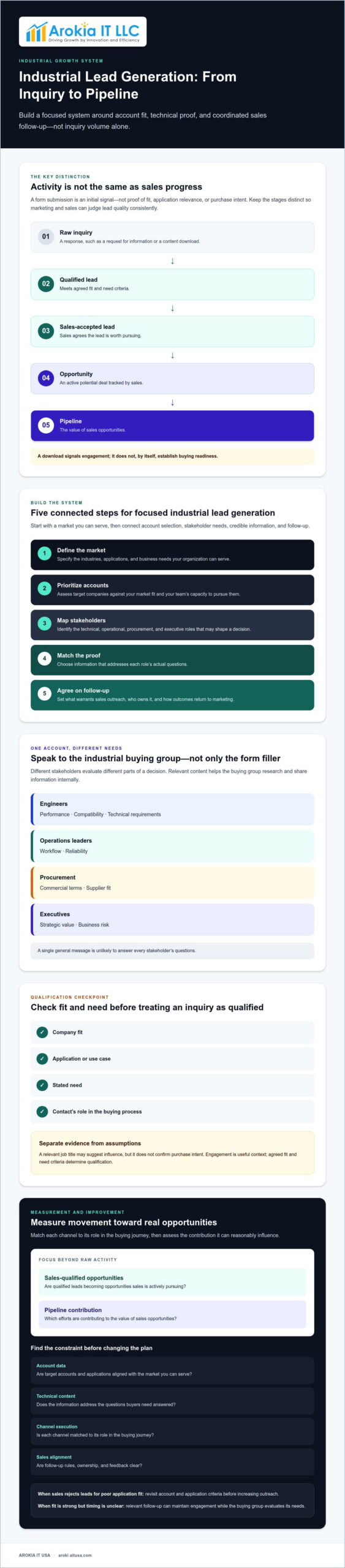
Turn industrial lead generation activity into a measurable sales pipeline
Industrial lead generation becomes measurable when marketing and sales track the same account from initial engagement through commercial evaluation. Agree on stage definitions before reviewing results, so a click, a qualified lead, and an active opportunity aren’t treated as equivalent outcomes.
- First engagement: Record the account and relevant activity, such as a technical resource request or direct inquiry.
- Qualification: Assess whether the company, application, need, and contact role fit agreed criteria.
- Sales acceptance: Sales accepts the lead for follow-up or records a consistent reason for rejection.
- Opportunity creation: Sales confirms an active potential deal and tracks it through its established process.
- Pipeline review: Marketing and sales review progression, quality, and channel contribution together.
Pipeline measures are more useful for decision-making than lead counts alone because they show whether qualified accounts are advancing toward sales opportunities. Lead volume can flag campaign activity, but it can’t show by itself whether inquiries match the target market or receive sales follow-up.
Which industrial lead generation metrics should teams review?
Separate indicators by what they tell you. Reach and engagement metrics, such as relevant visits or content interactions, show whether an audience encounters a campaign. Qualification and sales outcomes show whether accounts meet criteria and progress. Review accepted leads, account-stage movement, opportunity creation, and sourced or influenced pipeline using consistent definitions. Sourced pipeline identifies opportunities connected to marketing-originated activity; influenced pipeline can reflect marketing interactions alongside sales and other channels. Both labels require documented attribution rules.
Industrial decisions often involve multiple stakeholders and touchpoints, so attribution has limits. A search visit, a colleague’s content share, and a sales conversation may all contribute, while available records capture only part of that path. Treat channel reporting as evidence for decisions, not perfect proof that one interaction caused an opportunity.
How can sales feedback improve lead quality over time?
Establish a recurring review of accepted, rejected, stalled, and converted leads. Use consistent rejection categories, such as poor account fit, unsupported application, unclear need, or mistimed follow-up. Then use the patterns to refine targeting, qualification criteria, or content. If a suitable account isn’t ready for a sales conversation, relevant lead nurturing can maintain useful engagement without treating every delay as a lost lead.
Set handoff ownership and response expectations jointly. Marketing should provide the context behind an inquiry; sales should record the outcome and next step. These feedback loops make industrial lead generation strategies accountable to opportunity quality, not just campaign activity.
Choose the right industrial lead generation operating model and next steps
The right operating model depends on the constraint holding back progress. More campaigns won’t fix unreliable account data, and more leads won’t solve unclear sales ownership. Diagnose the bottleneck before adding channels or resources:
- Account data: Can the team identify companies and applications that fit its capabilities?
- Technical content: Can engineers and operational buyers find credible answers to their evaluation questions?
- Channel execution: Are chosen channels reaching the target accounts in ways the team can measure?
- Sales alignment: Do marketing and sales agree on qualification, handoff, ownership, and feedback?
What should an industrial team clarify before launching a program?
Confirm target-account criteria, priority applications, relevant stakeholder roles, and sales capacity. Audit existing content, CRM records, channel activity, and lead definitions to find gaps before creating new work. Then assign owners for audience selection, content review, campaign execution, and sales follow-up. Choose a small set of decision-useful measures, such as accepted leads and opportunity progression, and document when the team will review them.
Start with a focused plan rather than trying to redesign every activity at once. For example, if the main issue is weak application fit, refine account criteria and qualification questions before expanding media. If suitable accounts engage but lack credible material to share internally, prioritize the technical content gap. This keeps industrial lead generation strategies tied to a specific operating need and makes it easier to assess what changes.
When does outside demand generation support make sense?
Arokia IT LLC offers demand generation, Account-Based Marketing, sales enablement content, and a 90-Day Pipeline Forecast. The forecast supports planning, but it isn’t a guarantee of pipeline results. Teams assessing these options can review the demand generation offering and compare it with their specific constraints.
Use the diagnosis to define the audience, content requirement, owners, sales handoff, and review cadence for an initial program. If you’re ready to discuss how those pieces could fit together, contact Arokia IT LLC about your industrial lead generation priorities.
Build a stronger pipeline one focused decision at a time
Industrial growth becomes more manageable when teams treat lead generation as an operating discipline, not a collection of disconnected campaigns. Use the clearest constraint in your current process to decide what deserves attention next, then make ownership and measurement explicit.
Arokia IT LLC offers Account-Based Marketing and demand generation, supported by sales enablement content and lead nurturing for B2B programs. Its 90-day pipeline forecast is a planning service, not a promise of results. These capabilities can help address the gap your team has identified.
Progress doesn’t require changing everything at once. Make one deliberate improvement, review what the evidence shows, and use that learning to guide the next decision.
Frequently Asked Questions
What are the most effective industrial lead generation strategies?
The most effective industrial lead generation strategies align target-account fit, useful technical information, and sales follow-up. Start by defining which industries and applications your company can serve, then prioritize accounts using verified fit and observable engagement. Choose channels based on how those buyers research, and measure whether accounts progress to sales-accepted leads and opportunities. The right mix depends on your market, sales capacity, and evidence from campaign performance.
How is industrial lead generation different from general B2B lead generation?
How can manufacturers generate qualified leads online?
Manufacturers can attract and qualify online prospects by publishing useful information for specific applications, making that content discoverable through search, and engaging relevant professional audiences through channels such as LinkedIn. Paid campaigns may extend reach when they target a defined audience or need. Use forms and follow-up to learn about company fit, application, need, and contact role. Then evaluate results by sales acceptance and opportunity progression, not clicks alone.
Is account-based marketing effective for industrial lead generation?
Account-Based Marketing can be effective when a company has a defined group of high-value industrial accounts and the capacity to coordinate relevant outreach to them. It helps align content and communication around account needs and the stakeholders involved in evaluation. ABM isn’t automatically the right choice for every team; its value depends on account data quality, sales participation, available resources, and whether the focused approach matches the company’s growth priorities.
How do you measure industrial lead generation success?
Measure progress across the funnel: relevant account engagement, lead qualification, sales acceptance, opportunity creation, and pipeline contribution. Define each stage and agree on how the team records it before comparing campaigns. Track engagement to understand reach, but don’t treat it as proof of revenue impact. Multiple channels and stakeholders may contribute to an industrial decision, so sourced and influenced pipeline should follow consistent attribution rules and be interpreted with those limits in mind.
What content attracts industrial B2B buyers?
How can marketing and sales improve industrial lead quality together?
Marketing and sales improve lead quality by agreeing on target-account criteria, qualification terms, handoff ownership, and response expectations before campaigns launch. Sales should record whether leads are accepted, rejected, or deferred, using consistent reasons such as poor fit or unclear need. Review those outcomes together on a regular cadence. Marketing can then adjust targeting and content, while sales receives clearer context for follow-up and continued engagement.