
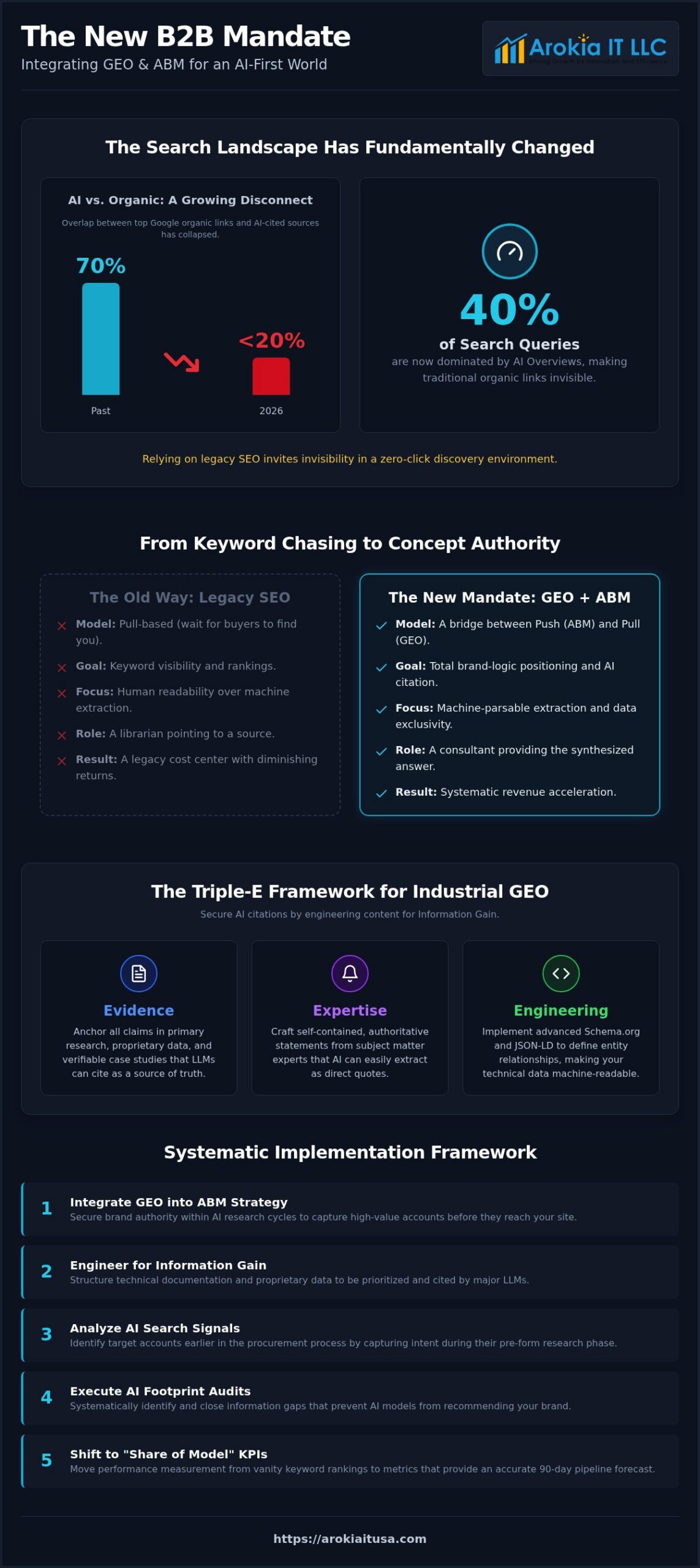
The overlap between top Google organic links and AI-cited sources has plummeted from 70% to below 20% in 2026. This disconnect represents a fundamental shift in B2B procurement. Traditional organic traffic is evaporating as AI Overviews now dominate 40% of search queries. Sales cycles are lengthening because your target accounts rely on LLM research before they ever touch your website. Legacy SEO is no longer a tool for pipeline growth; it’s a legacy cost center that fails to account for zero-click discovery. Relying on it invites invisibility.
Integrating geo into abm strategy is the only disciplined response for revenue teams focused on precision and accountability. This guide delivers the strategic framework for combining Generative Engine Optimization with Account-Based Marketing to capture high-value accounts during their pre-intent research phase. We’ll master the mechanics of sustaining brand authority across ChatGPT and Gemini to ensure your brand is the cited solution for your most valuable prospects. By aligning GEO with your 90-day pipeline forecast, you’ll replace falling traffic with high-intent discovery and systematic revenue acceleration.
Key Takeaways
- Secure brand authority within AI-driven research cycles by integrating geo into abm strategy to capture high-value accounts before they reach your site.
- Engineer technical documentation using the Information Gain requirement to ensure your proprietary data is prioritized and cited by major LLMs.
- Identify target accounts earlier in the procurement process by analyzing AI search signals to capture intent during the pre-form research phase.
- Execute a systematic AI Footprint Audit to identify and close information gaps that currently prevent models from recommending your brand.
- Shift performance measurement from traditional keyword rankings to Share of Model KPIs to provide a more accurate 90-day pipeline forecast.
The Convergence of GEO and ABM: A 2026 Strategic Mandate
The Decline of Traditional B2B Search Discovery
Google’s AI Overviews now appear in 30-40% of all search queries. This shift has rendered high-intent industrial keywords nearly invisible to the traditional user journey. Traditional content marketing often fails in this environment because it prioritizes human readability over machine-parsable extraction. Standard SEO acts like a librarian, pointing to a book. GEO acts like a consultant, providing the answer directly. If your technical data isn’t structured for these models, you aren’t just losing rank. You are being excluded from the consideration set entirely. In a zero-click environment, being the third link on page one is a failure if the AI agent doesn’t cite your data in its primary response.
Concept Authority: The New Ranking Factor
Visibility now hinges on Concept Authority. This metric measures how deeply an LLM adopts your brand’s technical logic as its own baseline. When a buying committee uses an AI agent to compare vendors, the model doesn’t just list links. It synthesizes a recommendation based on who owns the logic of the solution. To win, your brand must be the primary source for the data that defines the category. Successful teams are already integrating geo into abm strategy to feed these models precise, proprietary data that shapes the AI’s decision-making framework. This ensures that in the Agentic Research phase, your brand isn’t just a candidate. It’s the standard. Establishing this authority requires a disciplined approach to ai search optimization that goes beyond meta tags.
Buying committees no longer spend weeks manually browsing websites. They deploy AI agents to scrape documentation, compare specifications, and vet claims against industry benchmarks. If your brand logic isn’t present in the training sets or the live-retrieval data of these agents, you don’t exist to the buyer. This marks the definitive shift from keyword-based targeting to brand-logic positioning. You aren’t just targeting a generic industry term. You’re targeting the logic that defines why your specific engineering approach is the only viable solution for a high-value account’s specific pain point. This level of precision is what separates market leaders from those chasing ghost traffic.
Engineering Content for AI Citations in High-Stakes Niches
AI models aren’t searching for consensus; they’re searching for Information Gain. In high-stakes industrial sectors, LLMs prioritize proprietary data that isn’t found elsewhere. If your content merely echoes the top ten search results, it’s invisible to an AI agent. Integrating geo into abm strategy requires a shift from keyword density to data exclusivity. You must provide the specific technical benchmarks and industrial insights that feed the model’s need for new, verifiable knowledge. Without unique data points, your brand becomes a footnote in the AI’s training set rather than a cited authority.
The Triple-E Framework for Industrial GEO
Securing citations in 2026 relies on a foundation of Evidence, Expertise, and Engineering. Evidence involves anchoring your claims in primary research and case studies. Expertise requires crafting self-contained statements from subject matter experts that LLMs can easily extract as authoritative quotes. Engineering is the technical layer. By implementing advanced Schema.org and JSON-LD, you define entity relationships that help AI understand exactly how your solution fits into the enterprise ecosystem. This structured approach ensures your brand logic is the first thing a model retrieves when an account initiates a query.
Optimizing for Synthesis and Comparison
AI agents are synthesizers. They don’t just read; they compare. When a buying committee asks an agent to vet vendors, the agent looks for comparative frameworks and pros-versus-cons tables. To win, you must refactor existing B2B SEO assets into modular, AI-ready blocks. This isn’t just about formatting. It’s about ensuring technical specifications are machine-readable to prevent AI hallucinations. When technical data is presented in clean, structured modules, it increases the probability of being the primary source in a vendor comparison report. If you’re unsure how your current content measures up, you can request a strategic audit to identify critical information gaps.
Structuring technical documentation for LLM parsability is a precise science. It requires breaking down complex white papers into digestible, answer-first segments. These modular content blocks allow AI agents to extract clean, accurate answers without losing context. By focusing on these extraction-friendly structures, you ensure your brand’s technical logic remains intact during the synthesis process. This level of precision is mandatory for any team serious about integrating geo into abm strategy to drive high-value account discovery.
Tactical Alignment: Mapping GEO to the ABM Funnel
The traditional B2B funnel has evolved. In 2026, the primary challenge for revenue teams is no longer lead volume, but intent capture within AI-mediated environments. Integrating geo into abm strategy transforms the top of the funnel from a passive waiting room into an active engine for account discovery. By aligning technical assets with the retrieval patterns of LLMs, you identify high-value accounts before they ever fill out a form. This shift requires moving away from volume-based blogging toward authority-based whitepapers that provide the specific data AI models demand.
Strategic resource allocation must prioritize depth over frequency. Traditional lead generation relies on gated content to identify interest, but AI-driven intent capture identifies account activity through search signals and citation patterns. This approach leverages AI search optimization to shorten the sales cycle by providing immediate, verifiable answers to complex procurement questions. When your brand logic is the baseline for an AI’s recommendation, the trust barrier is lowered before the first sales call occurs. This creates a more efficient path to conversion.
Pre-Intent Discovery: Winning the AI Research Phase
AI agents are the new gatekeepers of the consideration set. To ensure your brand is the recommended solution, you must optimize for unlinked brand mentions and technical citations. These signals build AI trust scores, positioning your firm as the consensus choice in high-stakes niches. If an AI agent cannot find proprietary evidence of your results, it will default to a competitor with better machine-parsable documentation. Success here is not about traffic. It is about being the synthesized answer in a private LLM session. Winning this phase ensures you are part of the initial vendor list created by the AI agent.
Sales Enablement Content as a GEO Asset
Your sales decks and technical FAQs are no longer just for 1:1 outreach. They are critical GEO engines. Transforming these internal assets into public-facing, structured data allows AI models to ingest your most persuasive arguments. This bridges the gap between marketing content and the 90-day pipeline forecast by ensuring your sales enablement content feeds the models that buyers trust. Using AI-cited content builds immediate credibility during active sales cycles. It proves your authority with clinical objectivity. When an AI agent validates your claims, the path to conversion accelerates, eliminating the friction of traditional brand vetting and shortening the time to close.
How to Integrate GEO into Your ABM Strategy
Integrating geo into abm strategy requires a disciplined, five-step execution model. It is not a creative flourish; it is a systematic elimination of brand invisibility. The process begins with a clinical assessment of your current presence within generative models, followed by the aggressive deployment of proprietary data to fill identified gaps. Success depends on moving beyond traditional metrics to focus on “Citation Share” as the primary indicator of account-based influence. This is a continuous optimization loop, not a set-and-forget tactic.
Phase 1: The AI Search Audit
Understanding how models like Perplexity and Gemini summarize your core solutions is the first priority. You must use specific prompts to reveal where these models succeed or fail in describing your technical capabilities. Identifying “Hallucination Risks” is critical for industrial products where a minor technical inaccuracy can derail a high-stakes procurement cycle. Utilizing tools like the AI Search Scorecard allows you to benchmark your brand’s retrieval probability against primary competitors. This audit provides the baseline for all subsequent optimization efforts.
Phase 2: Content Refactoring for AI Discovery
Narrative-heavy content is a liability in 2026. It must be refactored into modular, data-dense blocks that prioritize extraction over storytelling. AI agents require clean, structured access to technical specifications to facilitate accurate comparisons. This phase involves establishing a direct feedback loop between sales objections and GEO content updates. If a prospect raises a concern that isn’t addressed in your AI citations, your content has failed. You must continuously update your technical documentation to ensure AI models have the most accurate, persuasive data available during the account’s research phase.
Step 3 involves developing a primary research engine to generate unique, citeable data points. You cannot rely on recycled industry stats. Step 4 requires implementing advanced Schema.org markups to define brand authority to AI agents. Finally, Step 5 shifts focus to monitoring Citation Share as your primary KPI. This metric measures the frequency with which your brand is cited relative to the total number of AI-generated answers in your niche. By integrating geo into abm strategy, you ensure your technical logic is the baseline for all agentic research. For a comprehensive breakdown of how to structure your brand for generative engine retrieval, the AI Search Optimization: A Strategic Executive Guide for 2026 provides the systematic framework revenue leaders need to replace ambiguity with precision.
Measuring Pipeline Impact: The GEO-ABM ROI
Revenue leaders must abandon vanity metrics like keyword rankings in favor of Share of Model (SoM). In 2026, organic traffic is a lagging indicator that fails to capture the nuances of AI-mediated procurement. Integrating geo into abm strategy allows for a more rigorous 90-day pipeline forecast by identifying high-value accounts at the moment of discovery. When an AI agent recommends your brand, it validates your solution with a degree of objectivity that traditional marketing cannot match. This systematic approach to demand generation ensures that your pipeline is built on verified intent rather than speculative clicks.
Analyzing the correlation between AI brand citations and account engagement reveals a definitive trend. Accounts that interact with AI agents citing your brand logic show significantly higher engagement rates during initial sales outreach. This isn’t a coincidence. It’s the result of your technical authority being established before the first human interaction occurs. By the time your sales team initiates contact, the prospect has already been conditioned to view your brand as the category standard. This pre-conditioning eliminates the friction of the “awareness” stage and moves accounts directly into technical evaluation.
KPI Evolution for Executive Leadership
Citation Share has replaced Click-Through Rate (CTR) as the primary KPI for high-stakes industrial marketing. In a zero-click environment, the frequency of your brand’s appearance in AI-generated answers is the only reliable measure of market authority. Unlinked brand mentions now carry significant weight in revenue attribution models. These mentions signal to LLMs that your brand is a trusted entity, even if the user never visits your site. Measuring this impact requires a shift from tracking sessions to auditing the synthesis logic of the models themselves to ensure your brand remains the primary recommendation.
Closing the Loop: From Citation to Contract
AI-preferred status reduces friction within the enterprise buying committee by providing pre-vetted proof of capability. When an AI agent consistently cites your technical documentation, it acts as a third-party endorsement that accelerates internal consensus. This data is also critical for refining ABM account selection. By analyzing which accounts are triggering queries related to your proprietary data, you can prioritize sales efforts with clinical precision. Integrating geo into abm strategy transforms your content from a passive asset into a predictive engine for revenue growth.
Securing Your Position in the AI-Mediated Pipeline
The transition from keyword-focused SEO to brand-logic positioning is a strategic mandate for 2026. Successful revenue teams understand that visibility now hinges on technical citations and proprietary data. By integrating geo into abm strategy, you ensure your brand logic is the baseline for AI-driven discovery, removing friction from the enterprise procurement cycle. This isn’t about vanity metrics. It’s about securing a seat at the table before the first sales call occurs.
This approach replaces speculative traffic with clinical, data-driven demand generation. It leverages specialized expertise in industrial manufacturing to produce a predictable 90-day pipeline forecast. You don’t just need to be found; you need to be the synthesized recommendation for your most valuable target accounts.
The window to define your authority within these models is narrowing. Now is the time to act and lead your category in the age of agentic research.
Frequently Asked Questions
How does GEO differ from traditional B2B SEO?
Traditional SEO focuses on securing high rankings for human clicks within a search engine results page. Generative Engine Optimization (GEO) prioritizes citation probability within AI-synthesized answers. While SEO acts as a librarian pointing to a source, GEO acts as a consultant providing the answer directly. In 2026, the overlap between top organic links and AI citations is below 20%, making extraction-ready content a separate strategic requirement.
Can GEO really help identify target accounts for an ABM strategy?
Yes, by analyzing retrieval patterns and AI search signals that indicate account-level interest before a form is ever filled. Integrating geo into abm strategy allows revenue teams to capture intent during the agentic research phase. By tracking which proprietary data points AI models are citing in response to specific industrial queries, you can identify high-value accounts engaged in deep technical vetting before they visit your site.
Will AI engines replace search engines entirely for B2B buyers?
They won’t replace them entirely, but they have already dominated the research and consideration phases. As of 2026, AI Overviews appear in up to 40% of search queries. B2B buyers increasingly rely on AI agents to synthesize technical documentation and compare enterprise vendors. Traditional search is becoming a secondary verification step rather than the primary discovery engine for complex procurement cycles in industrial sectors.
How long does it take to see results from an integrated GEO and ABM strategy?
Initial visibility shifts often occur within 30 to 60 days of technical refactoring and schema deployment. However, a full pipeline impact typically aligns with a 90-day pipeline forecast cycle. This duration allows enough time for AI models to crawl updated documentation and for the buying committee’s research cycles to reflect your brand as the new cited authority in their specific technical niche.
Which AI engines should industrial companies prioritize for optimization?
Priority must be given to ChatGPT, Gemini, and Perplexity. ChatGPT reached 900 million weekly active users in 2026, while Gemini surpassed 750 million monthly users. These platforms are the primary tools used by buying committees for technical synthesis. Industrial firms must ensure their technical specifications and primary research are formatted for extraction by these specific models to maintain competitive visibility in high-stakes procurement.
Do unlinked brand mentions contribute to brand authority in AI models?
Unlinked brand mentions are a critical trust signal for LLMs. Unlike traditional SEO which relies heavily on backlinks, AI models prioritize brand-entity relationships. There is a 0.664 correlation between brand mentions and AI citation probability. In an AI-first environment, being discussed as an industry standard in technical forums and third-party whitepapers is significantly more valuable than a high volume of low-quality backlinks.
Is schema markup still necessary for Generative Engine Optimization?
Schema markup is more critical than ever. It provides the structured framework that allows AI agents to parse complex entity relationships without ambiguity. By using JSON-LD to define your technical specifications and expert credentials, you reduce the risk of AI hallucinations. Structured data ensures that when an LLM retrieves information about your brand, it does so with clinical precision and total accuracy.
How can I measure my brand’s share of voice in AI-generated answers?
Measurement has shifted from keyword rankings to Share of Model and Citation Share. You can use tools like the AI Search Scorecard to audit how frequently your brand is cited relative to competitors. This involves tracking the percentage of AI-generated responses that include your brand logic as the primary solution. This metric provides a transparent, objective view of your authority within the models buyers trust.