
Your current search strategy is likely optimized for a world that no longer exists. Visibility in 2026 isn’t about winning a blue link. It’s about becoming the trusted data source for the models that answer the query before a user even clicks. If your brand isn’t appearing as a cited authority in Gemini or ChatGPT, you’re losing market share to competitors who have already pivoted to ai search optimization. Legacy tactics are failing because they prioritize traffic volume over the clinical precision required by generative engines.
You’re likely facing internal pressure to prove marketing ROI while watching organic click-through rates plummet due to zero-click AI summaries. It’s a complex environment where the rules of engagement feel opaque and the sources chosen by AI seem arbitrary. This guide replaces that ambiguity with a systematic approach to securing your brand’s authority. You’ll learn how to structure your B2B intelligence so LLMs prioritize your brand for citations. We’ll outline how to transform your content into a high-performance engine that maintains visibility, builds authority, and provides the AI-ready sales enablement required to shorten complex buyer journeys.
Key Takeaways
- Stop chasing clicks and start securing citations. Learn to position your brand as the primary data source for generative answer engines.
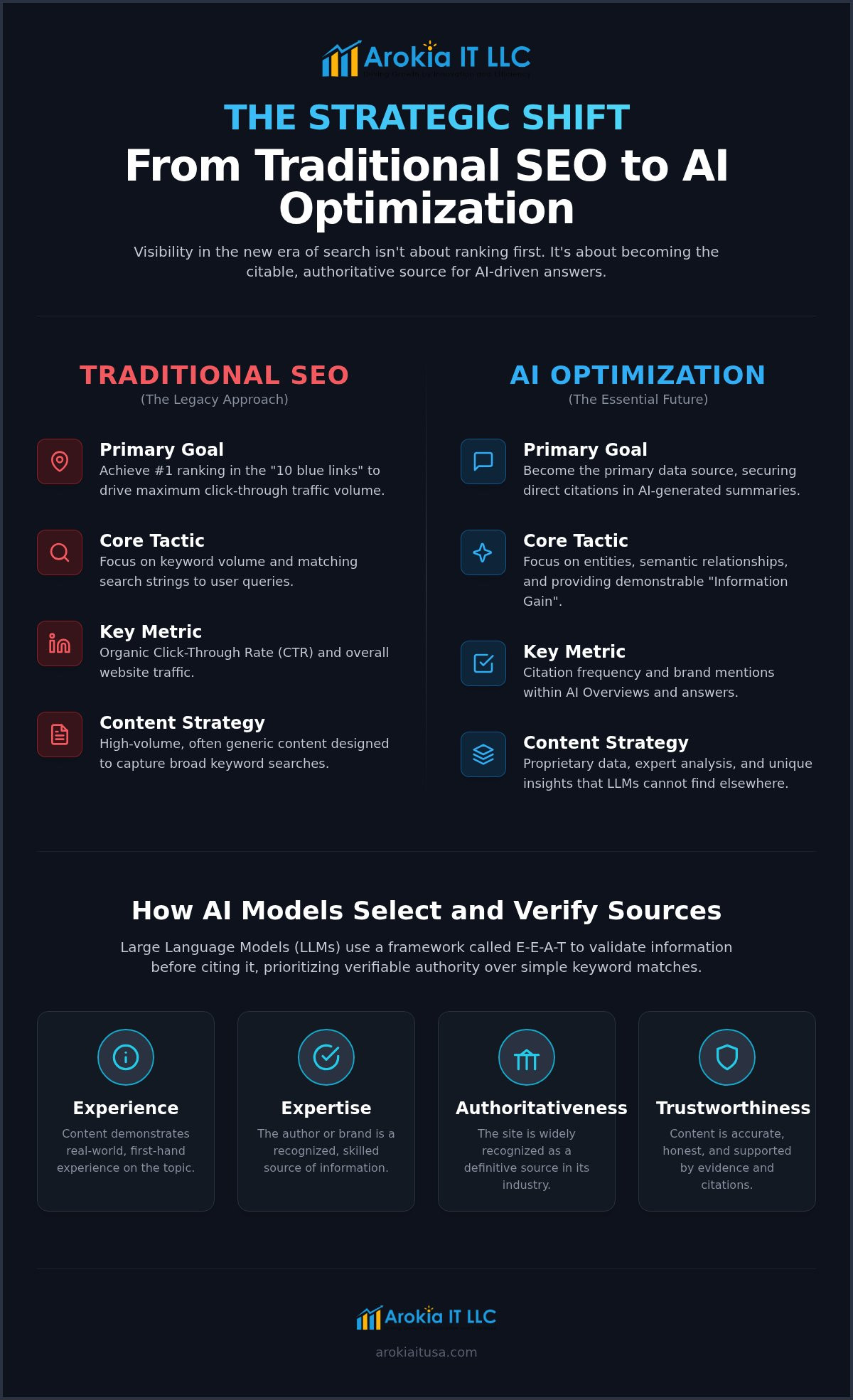
- Master the mechanics of LLM source selection. We detail how models use E-E-A-T to validate your B2B authority before citing your content.
- Pivot from keyword volume to entity-based ai search optimization. This strategic shift ensures your brand remains visible as traditional search traffic declines.
- Re-engineer your content infrastructure for technical precision. Implement schema that allows AI models to map your expertise with clinical accuracy.
- Align AI visibility with your 90-day pipeline goals. Arokia IT LLC integrates cited content to shorten sales cycles and reinforce your account-based marketing efforts.
The Transition from Traditional Search to AI-Driven Answer Engines
Why Generative AI is Redefining B2B Discovery
B2B buyers are increasingly bypassing traditional search bars in favor of platforms like Perplexity, Gemini, and ChatGPT for initial vendor research and market analysis. These tools provide immediate, synthesized comparisons that often lead to a “zero-click” reality where the user finds the answer without ever leaving the engine. If your brand isn’t part of that initial synthesis, you’re effectively invisible to the modern buyer. Maintaining visibility requires a strategic evolution of search that prioritizes information gain and unique data over generic industry commentary. This ensures your expertise is captured during the discovery phase, even when a user doesn’t visit your site.
The Executive Mandate: From Rankings to Citations
Understanding the Mechanics of Generative Engine Optimization (GEO)
How LLMs Select and Attribute Sources
The Role of Semantic Connectivity in 2026
Keywords are a legacy metric. In 2026, AI understands the relationship between your brand and specific industrial problems through entity relationships and topical clusters. This semantic connectivity is the reason Why Traditional SEO Content Marketing Strategies Fail: The 2026 Shift to GEO. Models analyze how often your brand is mentioned alongside specific technical challenges or solutions across the web. To dominate this landscape, your content engine must build a narrative of total oversight. If you’re interested in how your current assets stack up, we suggest reviewing your strategic alignment with our consultants.
Traditional SEO vs. AI Search Optimization: A Strategic Comparison
Keywords vs. Intent-Based Entities
AI models don’t care about specific phrases. They care about intent. While B2B SEO services traditionally targeted high-volume keywords, modern strategies focus on “entities.” These are the people, products, and technical problems that define your industry. If a buyer asks an AI to “solve supply chain bottlenecks in medical manufacturing,” the engine looks for brands that are semantically linked to those specific challenges. You don’t just want to be a result. You want to be the entity the AI recommends to solve the user’s specific pain point.
The Death of Generic Content
Pillar pages that merely summarize existing information are now a strategic liability. They offer no new data for an LLM to digest. To secure a citation, your content must provide “Information Gain.” This is the mandatory standard for 2026. If your assets don’t include unique data or expert-led analysis, they’ll be ignored by generative engines. Use this checklist to audit your current content for AI citation readiness:
- Proprietary data: Does the asset contain unique research or internal findings?
- Technical precision: Are claims supported by specific, documented case studies?
- Synthesized utility: Is the information structured for rapid RAG extraction?
Building a High-Authority Content Infrastructure for 2026
- Step 1: Audit existing assets to identify expert-led data and unique insights that LLMs can’t find elsewhere.
- Step 2: Implement advanced JSON-LD schema to define your brand entities and relationships for AI crawlers.
- Step 3: Develop a “Primary Source Strategy” centered on proprietary research and technical case studies.
- Step 4: Optimize for conversational queries by providing clear, direct-answer formats at the start of technical documents.
- Step 5: Validate every asset through an AI readiness diagnostic to ensure it meets citation standards.
Prioritizing Information Gain in B2B Assets
Information gain is the mandatory standard for citation. It’s the difference between summarizing a market and owning it. To achieve this, extract granular insights from your engineering and sales teams. These individuals possess the technical nuance that generalist writers lack. Transform these internal truths into public-facing assets. Case studies serve as definitive proof of authority for AI models because they provide verifiable results that can’t be replicated. Our Case Study: Arterex Medical SEO demonstrates how technical depth creates a moat against generic competition. If a model can’t find your specific data elsewhere, it’s forced to cite you.
Technical Foundations for AI Discovery
Clean site architecture is no longer just for Googlebot. It’s for the training sets of the future. Structured data must go beyond basic breadcrumbs to define your specific industrial niche and service capabilities. If an LLM struggles to parse your site, it won’t include your brand in its knowledge graph. Every page should be a self-contained node of authority. We recommend evaluating your Website Development & Design through an AI-first lens. This ensures that your technical foundation supports rapid extraction and entity mapping. Precision at the code level is what separates cited leaders from overlooked followers.
Integrating AI Search Optimization into B2B Demand Generation
AI Search as a Catalyst for ABM
Account-Based Marketing requires a level of precision that traditional search cannot provide. Buying committees in industrial sectors don’t search for generic solutions. They ask AI engines complex, multi-layered questions about technical feasibility and vendor reliability. When your brand is cited as the primary source in these responses, you bypass the skepticism typical of early-stage outreach. It’s a clinical method of influencing high-value stakeholders across targeted accounts. By aligning your GEO efforts with specific account lists, you ensure that when stakeholders perform market due diligence, your proprietary data is the first thing they encounter. By integrating these insights into your Account-Based Marketing services, you transform content from a passive asset into a strategic tool for account penetration. Authority in the knowledge graph leads to faster consensus among decision-makers, as the AI has already done the work of validating your expertise.
Measuring the Impact on Pipeline Acceleration
The ROI conversation must pivot from traffic volume to pipeline velocity. Presence in generative answers reduces friction by providing your sales team with AI-ready sales enablement content. This content has already been “pre-vetted” by the models your prospects trust. This validation shortens the sales cycle by eliminating the need for basic education during initial discovery calls. When an AI model consistently cites your brand as the expert solution, it removes the burden of proof from your sales representatives, allowing them to focus on closing rather than justifying your market position. Your brand’s presence in a synthesized answer acts as a silent, third-party endorsement that carries more weight than any traditional advertisement. To understand how your current strategy impacts your revenue targets, you should evaluate your readiness with the Arokia IT LLC AI Scorecard. This diagnostic tool identifies exactly where your authority is leaking and how to plug those gaps to accelerate growth. Precision in search is now the primary driver of precision in revenue.
Securing Market Authority in the Generative Era
Implementing ai search optimization is the only way to protect your market share as traditional organic traffic declines. Arokia IT LLC specializes in bridging the gap between digital visibility and 90-day pipeline forecasting, ensuring every citation contributes directly to your revenue targets. You’ve seen the shift; now you must secure your place within it.
The transition to an AI-first search environment requires immediate action. You have the strategic framework to lead your industry. Execution is the final step toward total market oversight.
Frequently Asked Questions
What is the difference between SEO and AI search optimization (GEO)?
Traditional SEO focuses on ranking within a list of blue links by matching search strings. In contrast, Generative Engine Optimization (GEO) prioritizes becoming the cited source that an LLM uses to synthesize an answer. SEO optimizes for clicks, while GEO optimizes for authority and citation frequency. It’s a fundamental shift from appearing in a directory to being the intelligence that powers the response itself.
How can I tell if my B2B brand is currently being cited by AI search engines?
You must audit your “Share of Model” by querying generative engines like Perplexity or Gemini with technical, industry-specific problems. Look for direct mentions or superscript citations that link back to your domain. If your brand doesn’t appear in these synthesized answers, you’ve been effectively hallucinated out of the market. A diagnostic audit identifies exactly where your authoritative data is failing to bridge the gap between your site and the model.
Will traditional SEO keywords still matter for B2B brands in 2026?
What is ‘Information Gain’ and why is it critical for AI rankings?
Information Gain is the unique value your content provides that doesn’t exist elsewhere in an LLM’s training data. It’s the mandatory standard for securing citations in 2026. If your white paper repeats common industry knowledge, it offers zero gain for the model to synthesize. To win, you must publish proprietary research or expert-led analysis that forces the AI to recognize your brand as a primary data source for its responses.
How does AI search optimization affect my Account-Based Marketing (ABM) results?
It acts as a force multiplier for ABM by influencing stakeholders during their silent research phase. When targeted accounts query AI for vendor comparisons, your brand’s presence in the synthesized response serves as a silent, third-party endorsement. This reduces friction in the sales cycle. Integrating ai search optimization into your ABM strategy ensures your authority is established before your sales team even initiates contact with a high-value buying committee.
Do I need to rewrite all my existing content for AI engines?
You don’t need to rewrite every page, but you must re-engineer your high-impact assets. Focus on technical papers and guides that demonstrate unique expertise. These assets require advanced JSON-LD schema and direct-answer formatting to facilitate rapid extraction by generative models. It’s a process of clinical elimination where generic posts are replaced with high-utility intelligence. Precision in a few key areas is more effective than a high volume of fluff.
How long does it take to see results from AI search optimization?
Visibility changes can occur rapidly through real-time search integrations in platforms like Perplexity and SearchGPT. While traditional SEO takes months to mature, technical optimizations for generative engines can show results within a few crawl cycles. Most B2B organizations see a measurable shift in citation frequency within 90 days. This timeline aligns with our 90-day pipeline forecasting to ensure that your marketing efforts contribute to immediate revenue targets and sales velocity.