
Qualified machinery leads rarely come from one channel. Effective lead generation for custom machinery manufacturers combines inbound content that answers technical questions with targeted outbound outreach, then reinforces both through partners, marketplaces, and intent signals. Capital-equipment evaluations can span 6 to 18 months, so a coordinated approach needs to educate buyers early while keeping engineering focused on viable opportunities.
Long sales cycles make it understandable to rely on trade shows, referrals, or occasional RFQs. But no single channel reaches every buyer at the moment they are ready to evaluate a custom solution. A practical strategy connects sustainable channels with the accounts and buying signals that matter.
This article explains how inbound and outbound work together, where partner channels and marketplaces fit, and how intent data can help prioritize outreach. It also covers how to assess lead generation agency options by company size and service, so you can choose an approach that supports your sales process without adding noise for your engineering team.
Key Takeaways
- Qualify buyers with clear technical information and a defined handoff, so engineers can focus on viable opportunities.
- Pair inbound education with targeted outbound outreach to engage buyers at different stages of a long purchasing process.
- Use partners, directories, and manufacturing marketplaces to extend reach, while assessing lead fit and source quality.
- Apply intent signals to prioritize accounts and make outreach more relevant, rather than treating every prospect the same.
- Match agency support to your company’s sales capacity, target accounts, and channel needs.
1. How can machinery manufacturers generate qualified leads without overloading their engineering department?
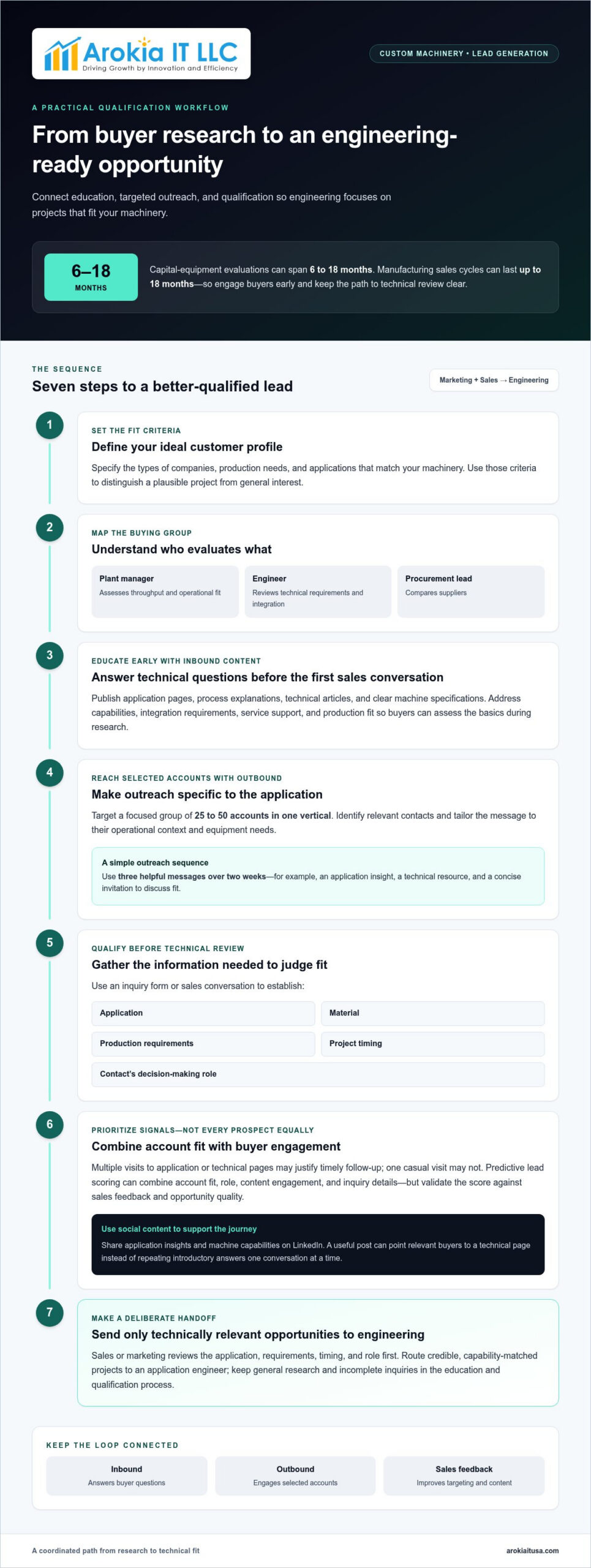
The strongest strategy combines useful technical content, targeted outreach, and clear qualification before engineering gets involved. For lead generation for custom machinery manufacturers, sales and marketing should identify target accounts, answer early buying questions, and route only credible projects for technical review.
That separation matters because machinery buyers research suppliers long before contacting sales. Capital equipment evaluation cycles can span 6 to 18 months, while manufacturing sales cycles can last up to 18 months. Buyers may compare machine capabilities, integration requirements, service support, and production fit before asking for a quote. A website should address those questions with application examples, process descriptions, and clear specifications.
Start by defining an ideal customer profile (ICP): the types of companies, production needs, and applications that fit your machinery. Then map the people involved, such as a plant manager assessing throughput, an engineer reviewing technical fit, and a procurement lead comparing suppliers. A custom packaging machine maker, for example, can prioritize facilities whose product formats and production constraints match its capabilities.
Use those criteria to qualify inquiries before assigning engineering work. A form can ask about the application, material, production requirements, project timing, and decision-making role. Marketing or sales can review the answers, distinguish general research from active projects, and send only technically relevant opportunities to an application engineer. This helps prevent incomplete inquiries from becoming immediate engineering tasks.
Intent data adds context. A prospect reading several pages about a specific application or returning to technical content may warrant timely follow-up, while a single casual visit may not. Predictive lead scoring can combine account fit, role, content engagement, and inquiry details. Treat the score as a prioritization tool, then validate it against sales feedback and opportunity quality.
Social media can help reach industrial buyers as they research. LinkedIn is useful for sharing application insights, machine capabilities, and educational content with specific professional audiences. A post about reducing changeover complexity, for example, can direct relevant buyers to a technical page instead of prompting engineers to answer the same introductory question repeatedly.
Coordinate these steps as one demand generation strategy: publish answers for early-stage research, target accounts that fit the ICP, and use qualification criteria before technical handoff. The result is a clearer path from buyer research to sales conversation, with engineering time reserved for projects that match the manufacturer’s capabilities.
2. What is Inbound and Outbound for Manufacturing Lead Generation?
Inbound lead generation attracts buyers with useful information they find during research. For machinery companies, this can include application pages, technical articles, process explanations, and search-friendly answers about machine capabilities. A buyer comparing custom automation options might find a page describing supported applications, then submit a request after confirming basic fit. Inbound creates a discoverable path to your sales team, but depends on content that answers real buying questions.
Outbound lead generation starts with a manufacturer identifying suitable prospects and initiating outreach. Instead of waiting for an inquiry, sales contacts a relevant plant, explains the application fit, and offers a useful next step. A focused campaign can target 25 to 50 accounts in one vertical. For example, a machinery maker serving food packaging plants can tailor its message to production challenges and equipment requirements common to that segment.
Inbound and outbound work better as a coordinated strategy than as competing channels. Inbound content gives outbound contacts something useful to review, while sales conversations reveal which technical questions need clearer website answers. A prospect who engages with a machine application page could receive relevant follow-up from sales. Repeated questions during outreach can also guide new content, such as a comparison of machine configurations or an explanation of integration considerations.
Appointment setting should create a qualified conversation, not just fill calendars. Before proposing a meeting, confirm the prospect’s role, application, current challenge, and reason for exploring a change. A short call with a plant manager may establish operational fit; an engineer can then assess technical requirements separately. This gives each contact a relevant conversation and helps prevent premature requests for engineering analysis.
Account-based outbound campaigns target selected companies and the people involved in their buying decisions. For each account, map relevant contacts, identify a plausible operational need, and tailor the message to the company’s context. A practical sequence can use three helpful messages over two weeks. Each should offer something distinct, such as an application insight, a technical resource, or a concise invitation to discuss fit.
Evaluate outbound by reviewing the full path from contact to opportunity. Track whether prospects match the intended account profile, engage with outreach, accept meetings, and progress after sales conversations. Record why contacts decline or stall, then adjust targeting, message relevance, or handoff criteria. If your team needs to align campaign priorities with sales capacity, discuss your lead generation goals as a practical next step.
3. Partner channels, directories, and manufacturing marketplaces
Partners can extend a machinery manufacturer’s reach into accounts it may struggle to access alone. System integrators, component suppliers, engineering firms, and distributors often understand a buyer’s production environment before a machine search begins. Define referral fit first: which applications, industries, and project stages should prompt an introduction? A packaging-line integrator, for example, can refer a manufacturer when a customer needs a specialized machine beyond its standard configuration.
Make referrals useful to both sides. Give partners a concise capability brief covering applications, operating constraints, integration needs, and the information required for an initial assessment. Agree on how introductions are recorded and followed up, then share appropriate status updates. A referral without context can create extra discovery work; one that identifies the application and buyer role gives sales a stronger starting point.
Directories and manufacturing marketplaces offer another route to discovery. Buyers may use them to compare suppliers, review capabilities, or find firms serving a particular process. A profile should explain what the manufacturer builds, which applications it supports, and what information buyers should provide. For example, a custom material-handling equipment maker can highlight supported configurations and clear project requirements instead of making broad claims that fit every supplier.
These channels need measurement, not just a presence. Track which listings and partners produce relevant opportunities, complete inquiries, and sales conversations. Review lead quality by application fit, project details, and buyer role, not raw inquiry volume alone. If a directory generates inquiries for unsupported work, revise its profile or reduce attention there. If an integrator repeatedly refers suitable projects, strengthen the relationship with useful technical updates.
Content marketing supports these channels by giving prospects a reason to trust the manufacturer’s expertise. Build pages around actual buyer questions, such as machine selection, integration planning, or process limitations. A case example can explain the production challenge, the solution’s role, and the resulting workflow without overstating outcomes. A technical article can also help a partner explain when a custom machine is appropriate.
Inbound marketing and search engine optimization connect that content to active research. Organize the website around applications and machine capabilities, use descriptive page titles, and make contact paths clear. A buyer searching for a specific production application should reach a relevant page, not a generic homepage. Manufacturing content marketing can support this process when editorial planning connects technical expertise with buyers’ search questions.
Marketing technology helps coordinate these channels. A customer relationship management system can record whether an inquiry came from a partner, directory, or organic search. Automation can route requests by application or territory and send relevant follow-up content. Review those rules regularly: a misrouted marketplace inquiry can delay a response, while a well-tagged referral helps sales identify which channels create qualified conversations.
4. AI-powered and intent-based lead generation
AI can help machinery makers organize account signals, prioritize outreach, and surface relevant buying activity. It works best as decision support, not as an automatic substitute for sales judgment. For example, a system can combine account fit with visits to application pages, repeat engagement, and direct inquiry details. Sales can then focus on accounts showing both a plausible need and meaningful intent.
Intent data helps distinguish active research from a weak match. Useful signals include repeated visits to technical pages, engagement with machine specifications, and inquiries about an application. A single page view rarely explains a project by itself. Combining several signals with company fit gives the sales team a clearer reason to engage a prospect.
Predictive lead scoring can rank accounts using agreed criteria, such as industry, application fit, buyer role, and recent engagement. The model should reflect the manufacturer’s actual opportunity history. If qualified opportunities often involve a particular process, that pattern can inform scoring. Sales feedback can then identify false positives, missed accounts, or criteria that no longer predict pipeline quality.
AI can also organize early technical information before an engineer reviews a request. A modernized machinery lead-generation system can dispatch and classify an initial technical dossier in under 5 minutes. That speed is useful when the dossier captures the application and key requirements clearly. The engineering team still needs to assess technical feasibility; automation should improve routing, not replace engineering review.
Intent-based cold calling can lead to up to 30% more appointments. For a machinery manufacturer, the practical value depends on relevance: call the right account, reference a credible signal, and connect the conversation to a specific application. A prospect researching automated material handling, for example, needs a different opening than a company exploring a packaging line.
Connect scoring to revenue outcomes, not activity alone. Track which scored accounts become qualified opportunities, progress through the pipeline, and close. Compare the results with sales notes to determine whether intent signals identify genuine projects or merely curious visitors. This review keeps the process accountable and helps refine targeting.
Start with a defined workflow: select intent signals, set account-fit criteria, assign lead scores, and specify who reviews each alert. Then test the process against sales outcomes and adjust criteria as evidence changes. AI becomes useful when it reduces noise, makes buying signals easier to act on, and directs human attention to opportunities that fit the manufacturer’s capabilities.
5. Lead generation agency options by company size and service
For a lean team, an integrated demand-generation partner can connect audience research, campaigns, content, and lead routing. This helps when sales lacks time to manage separate vendors or maintain consistent follow-up. For example, a custom conveyor manufacturer could align application pages, targeted emails, and inquiry qualification around one priority market. The key is clear ownership of each step, from first contact through sales acceptance.
A channel specialist suits a different need. If your website attracts relevant visitors but few inquiries, a search or conversion specialist can examine page structure, calls to action, and technical content. If outreach reaches the right companies but generates weak conversations, a prospecting specialist can refine account selection and messaging. Define the bottleneck first, then select expertise that addresses that part of the pipeline.
Company complexity matters, too. A manufacturer selling several machine types across distinct industries may need coordinated campaigns by application and buyer role. A focused machine builder serving one niche may benefit more from a tightly defined account list and a small set of relevant messages. In either case, the agency should understand how engineers, operations leaders, and procurement contacts influence a machinery purchase.
Assess the operating model before weighing promises. Ask how the team will use your existing CRM, what information it needs from sales, and how it will report lead quality. A useful plan identifies target accounts, campaign sources, qualification criteria, follow-up responsibility, and measures such as accepted opportunities. It should also explain how sales feedback will shape targeting and messaging.
Review deliverables, not just channel labels. “Outbound” might mean researched contacts, tailored emails, and documented responses. “Content” might mean technical pages mapped to buyer questions and search intent. A manufacturer should know who approves application details, who handles incoming responses, and how opportunities move to sales. Without those handoffs, campaign activity can increase while engineering receives poorly scoped requests.
Compare agency fit with your internal resources. If sales can handle follow-up but lacks target-account research, prioritize support that fills the gap. If technical experts can contribute knowledge but cannot turn it into buyer-facing material, prioritize content development. The right arrangement gives each internal team a defined role and avoids duplicate work across marketing, sales, and engineering.
Before committing, request a working plan for one priority market. Check whether it names relevant buyers, credible information sources, channel roles, email themes, and reporting measures. A focused plan should show how activity connects to qualified opportunities, rather than treating clicks or contact volume as the end result.
Arokia IT: Account-Based Marketing (ABM)
Arokia IT LLC helps custom machinery manufacturers coordinate account targeting and buyer engagement through Account-Based Marketing (ABM), Demand Generation, LinkedIn Marketing, and AI Search & GEO. This approach can help when broad campaigns attract inquiries that do not fit your applications, or sales needs more consistent engagement with selected accounts.
ABM aligns marketing activity around companies that fit your capabilities and the people involved in their purchasing decisions. Demand Generation and LinkedIn Marketing support visibility and engagement, while AI Search & GEO helps buyers discover relevant information. Arokia IT LLC also offers 90-day pipeline forecasting and sales enablement content to support planning and sales conversations.
For machinery manufacturers, the next step is to identify priority accounts, buyer roles, and the gaps slowing engagement. Contact Arokia IT LLC to discuss a focused approach.
Turn your channel mix into a focused growth plan
Turn what you have learned about your market into a decision your team can act on. Choose one priority audience, agree on what qualifies as a meaningful sales opportunity, and set a review point to assess campaign quality. For lead generation for custom machinery manufacturers, this discipline keeps marketing activity tied to sales capacity and business priorities.
Arokia IT LLC can help your team develop a practical plan around its target market and internal resources. Start by clarifying the accounts you want to reach, the buying signals worth acting on, and the handoff your sales team can maintain. Use those decisions to set a focused direction before expanding campaign activity.
A clear starting point gives your team room to learn, adjust, and make deliberate decisions about what to scale next.
Frequently Asked Questions
What is Inbound and Outbound for Manufacturing Lead Generation?
Inbound lets buyers discover a manufacturer; outbound initiates contact with selected prospects. For measurement, distinguish whether a channel sourced an opportunity or merely influenced it. A trade show conversation, for example, may prompt a later branded search before an RFQ arrives. Record both the original source and meaningful interactions in the CRM, so reporting reflects the full buying path rather than crediting only the final touch.
How can machinery manufacturers generate qualified leads without overloading their engineering department?
Set clear criteria for when engineering joins a prospect conversation. Sales can first establish whether the request fits the manufacturer’s product scope, project stage, and commercial priorities. Engineering can then focus on questions requiring technical judgment, such as process compatibility or design constraints. A shared response library for routine capability questions also helps sales give consistent answers without asking engineers to repeat the same explanations in early-stage inquiries.
What is the most effective digital content for capturing capital equipment buyers?
Content that helps a buying team build its internal case can be especially useful. Consider a project-planning template that prompts buyers to document production goals, integration dependencies, acceptance criteria, and internal stakeholders. A commissioning-readiness guide can help operations and engineering teams identify implementation questions before supplier discussions. These resources support internal alignment, a common hurdle when several departments evaluate a capital equipment purchase.
How can custom machinery manufacturers identify and target ideal buyers?
Use closed-won and closed-lost records to identify patterns beyond industry labels. Compare the applications, production environments, and project conditions associated with strong-fit opportunities. Then document exclusion signals, such as requirements outside the manufacturer’s design scope or support model. This negative profile helps sales avoid poor-fit accounts. Validate the criteria with sales and engineering before using them to shape prospect lists or campaign audiences.
Which B2B marketing channels generate qualified leads for machinery manufacturers?
Channel performance depends on buyers’ research habits and the manufacturer’s ability to serve resulting inquiries. For clearer reporting, distinguish opportunities first introduced by a channel from those where it supported an existing conversation. A partner referral and a later search visit may both matter, but they play different roles. Keep those distinctions in CRM campaign records to make budget and planning discussions more accurate.
How can manufacturers use SEO and paid search to attract custom machinery inquiries?
Organize paid search around distinct query intent, such as a machine category, an application, or a production problem. Exclude irrelevant searches like jobs, used equipment, or repair instructions when they fall outside the campaign’s purpose. For organic search, review which queries lead visitors to application pages and whether those visitors take meaningful next steps. Separate campaigns by intent so teams can assess inquiry quality without blending unlike searches.
What trade shows and industry directories are effective for finding machinery buyers in the United States?
Match event audiences to the machinery’s application: IMTS is relevant to manufacturing technology, FABTECH to metal forming and fabrication, and PACK EXPO to packaging and processing. For directories, compare category coverage and profile detail before investing effort. Thomasnet and IndustryNet are examples of U.S. supplier directories. Review whether listings describe the manufacturer’s capabilities clearly enough for buyers to identify a fit.
How can manufacturers measure lead generation ROI and conversion rates?
Track whether leads match your target profile, engage with outreach, accept meetings, and progress to opportunities. Review results by source, application fit, project details, and buyer role to identify which channels produce relevant opportunities.