
A catalog alone rarely earns attention from industrial buyers. A marketing strategy for industrial automation components gives manufacturers a practical way to connect product information with commercial priorities, coordinate marketing and sales, and help buying committees evaluate solutions. The goal is not simply to generate more activity, but to make each market-facing decision serve a clear business purpose.
That focus matters when selling across varied industrial markets. A manufacturer pursuing opportunities in Oklahoma, Texas, Louisiana, Arkansas, New Mexico, and Northern Mexico must account for different industries, applications, and customer relationships without diluting its core positioning. A clear strategy creates consistency while allowing messages to address each market’s needs.
This article explains how to research customer fit, develop positioning, select channels, and measure campaign performance. It also shows how industrial marketing differs from consumer promotion, where the purchase context and decision process require a more disciplined approach.
Use these steps to identify where your current marketing needs greater focus and turn that focus into a practical plan. Start with deliberate choices, then build momentum through coordinated execution.
Key Takeaways
- Map the engineering, operations, procurement, and leadership roles involved in automation purchases so messaging addresses each buyer’s priorities.
- Use customer and sales insights to define ideal accounts, identify buying signals, and focus resources on the strongest opportunities.
- Match technical content to each stage of the buying process, combining search visibility, email, and video with coordinated sales follow-up.
- Build a value proposition around the component’s practical role in a customer’s operation, not a list of specifications alone.
- Plan for longer, multi-stakeholder business decisions by aligning marketing and sales around trust, technical information, and measurable goals.
1. What is an Industrial Marketing Strategy?
An industrial marketing strategy coordinates research, positioning, content, and sales activity to reach business buyers. For automation components, it connects a product’s application and technical value to the needs of engineers, operations teams, procurement, and executives. A marketing strategy for industrial automation components should guide concrete decisions, from which accounts to target to what evidence buyers need before requesting a quote.
Industrial buying differs from an individual purchase because several people may assess the same component. An engineer may prioritize compatibility, while operations weighs reliability and procurement compares purchasing terms. Research customers by industry, company size, job title, application, and buying behavior. Then develop buyer personas using CRM records, sales conversations, and common use cases, such as a controls engineer sourcing sensors for a production line.
Market research should uncover niche segments where a component solves a defined operational problem. Compare customer inquiries, lost opportunities, repeat orders, and product applications to identify patterns. A manufacturer serving food-processing plants, for example, may need different messages for OEM design teams and maintenance departments. Both groups may buy the same component but evaluate different technical requirements and business outcomes.
Personalization is effective when it reflects those differences. Create content around an account’s industry and the recipient’s role instead of changing only a name. For account-based marketing, select high-fit companies, map relevant stakeholders, and coordinate tailored outreach across marketing and sales. Record each interaction in the CRM so the next conversation reflects earlier questions, application needs, and buying-stage signals.
U.S. regulations, certifications, and standards depend on a component’s function, intended application, installation, and claims. Identify the product category and end use first, then have engineering and compliance teams determine which requirements apply before publishing certification or safety statements. A component used in a control panel may have different evaluation needs from one marketed for a specialized industrial environment.
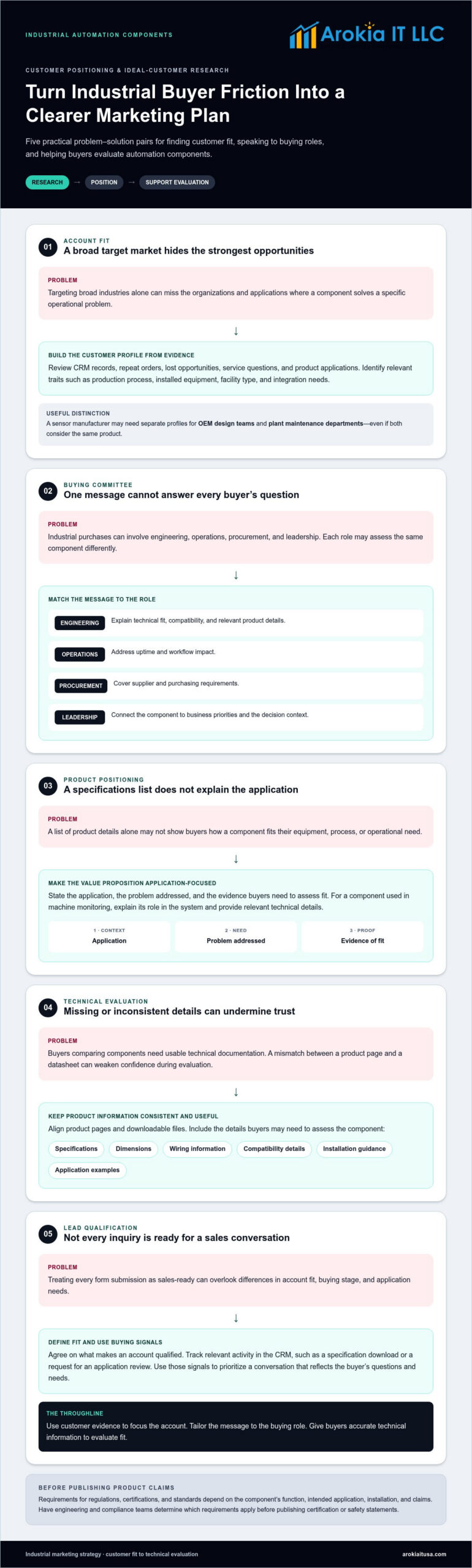
To generate qualified leads through a long B2B sales cycle, define a qualified account and its buying signals, then pair technical content with coordinated sales follow-up. Track actions such as a specification download or a request for an application review in the CRM. Use those signals to prioritize relevant conversations instead of treating every form submission as sales-ready.
Automation buyers need usable technical documentation, including product specifications, dimensions, wiring information, compatibility details, installation guidance, and relevant application examples. Keep product pages and downloadable files consistent. An engineer comparing sensor options needs precise selection criteria, not broad claims about innovation.
Distributors, system integrators, and OEMs extend component marketing by connecting products with real applications. Give channel partners accurate product information, use cases, and audience-specific messaging. A systems integrator can explain how a component fits into a larger control solution, while an OEM can show its role in equipment design.
Common risks include unsupported performance claims, inconsistent specifications, and broad messaging that overlooks buyer roles. A mismatch between a product page and a technical datasheet can undermine trust during evaluation. Establish a review process for claims and documentation, and use CRM feedback to refine targeting rather than relying on clicks alone.
2. Industrial customer positioning and ideal-customer research
Target buyers for industrial automation components include controls engineers, plant managers, maintenance leaders, procurement teams, and executives. Engineers assess technical fit, operations evaluates uptime and workflow impact, and procurement reviews supplier and purchasing requirements. An ideal customer profile should identify the organizations and applications where a component solves a specific operational problem, not merely list broad industries.
Build that profile from customer and sales data. Review CRM records, repeat orders, lost opportunities, service questions, and product applications to identify traits associated with a strong fit. These may include production process, installed equipment, facility type, integration needs, and purchasing role. A sensor manufacturer, for example, could distinguish OEM design teams from plant maintenance departments, even when both consider the same product.
Positioning turns that research into a clear reason to consider the component. Name the application, the problem addressed, and the evidence buyers need to assess fit. If a component supports machine monitoring, explain its role in the system and provide relevant technical details. Avoid claims that blur product capabilities or go beyond the supporting documentation.
AI-supported analytics can help segment audiences based on company, role, behavior, and buying-history patterns. Use those insights to shape campaigns, then ask sales and product experts to review segments before outreach. AI can support customer segmentation, predictive analytics, and content optimization, but it complements rather than replaces human judgment and knowledge of applications and customer constraints.
Customer experience is part of positioning, not a separate after-sale concern. Track recurring questions, response gaps, installation concerns, and product feedback in a shared CRM record. Net Promoter Score can help organize feedback about satisfaction and loyalty, while direct follow-up clarifies what customers mean. A poor experience carries commercial risk: 50% of industrial buyers will switch brands after a poor customer experience.
Make feedback actionable by routing product-fit questions to technical teams and recurring documentation issues to the content owner. Repeated requests for compatibility details, for example, may point to a gap in product pages or sales materials. Close the loop with customers by explaining what changed, then track whether the issue continues across accounts.
Customer experience also includes the digital path from discovery to evaluation. Make product information easy to find, keep specifications consistent, and clarify the next step for engineers and procurement teams. If analytics show visitors leaving a product page before reaching key documentation, revise its structure and test whether buyers can find what they need.
For manufacturers refining positioning or audience segmentation, discuss a focused marketing plan that connects customer insights with campaign priorities.
3. Email, video, SEO, and search engine marketing
For U.S. automation buyers, the most useful channels connect technical discovery with direct sales follow-up. Search engine optimization helps engineers find product pages while researching terms such as “PLC input module” or “machine vision sensor.” LinkedIn supports professional visibility and role-specific outreach. Email, industry publications, application videos, and trade shows can reinforce these channels when each serves a clear buyer need.
Search optimization starts with the language engineers and purchasing teams use, not broad promotional phrases. Build pages around component categories, applications, compatibility, and selection questions. A page about an encoder, for example, should explain relevant specifications and link to its datasheet. Review search queries and landing-page behavior, then address missing information and improve page structure. Competitor analysis can reveal content gaps, but differentiation should come from accurate product knowledge.
LinkedIn can bring technical insights to controls engineers, OEM teams, and plant operations leaders. Share an application example, product comparison, or troubleshooting explanation, then direct interested readers to useful documentation. Industry publications can extend reach when their readership matches the component’s target market. Choose publications for audience relevance and editorial fit, not circulation claims alone.
Email marketing supports longer evaluation cycles when messages reflect buyer actions. Segment contacts by role, product interest, and engagement. After a datasheet download, send a follow-up that explains selection criteria or a related application. Don’t send the same sequence to engineers and procurement teams. Coordinate email timing with sales activity, and record responses in the CRM so account teams can see which content shaped a conversation.
Video can make complex components easier to understand when it shows a real task. A brief demonstration might explain installation context, configuration steps, or the component’s role in a machine. Keep claims aligned with product documentation, and pair each video with a transcript and relevant product page. This creates useful material for search discovery and sales conversations.
For U.S. automation marketing, prioritize SEO, LinkedIn, segmented email, technical video, relevant industry publications, and direct sales engagement. Measure channels by qualified inquiries, document engagement, and progress toward sales conversations, not impressions alone. Use analytics to identify which sources attract relevant accounts and which campaigns bring low-fit traffic.
Useful U.S. trade shows and events depend on the application and buyer audience. Automate is relevant to robotics and automation, while IMTS, PACK EXPO, and FABTECH serve manufacturing, packaging, and metal fabrication. Compare the event audience with your target market, then set a specific meeting and follow-up plan before committing resources.
When search visibility needs to support technical discovery, AI search optimization can help structure clear, useful information for search engines and answer platforms.
4. Developing a value proposition
A strong value proposition tells industrial buyers what problem a component addresses, where it fits, and why it merits evaluation. “Reliable automation solutions” says little about a product’s role. A clearer example might explain how a photoelectric sensor detects parts on a conveyor and supports a defined inspection task. Keep every claim consistent with product documentation and engineering review.
Start with the application, not the catalog description. Identify the operating challenge, the component’s function, and the buyer’s decision criteria. A controls engineer may need integration details, while a plant manager may focus on production interruptions. Write a message for each priority, then verify that both accurately describe the same product.
Use a practical message structure: name the target application, state the component’s role, identify relevant evidence, and offer a next step. For a motor controller, describe the equipment it serves, link to its documented specifications, and invite the reader to review fit with an engineer. Don’t promise savings, uptime, or performance without evidence.
Positioning should distinguish a component from alternatives without relying on vague claims. Compare supported attributes such as configuration options, compatibility, operating conditions, or available documentation. If competitors emphasize broad system benefits, a manufacturer can stand out through specific application guidance or clearer selection information. The distinction should help buyers evaluate fit, not disparage another supplier.
Industrial buyers often scan before committing. Make the product’s purpose clear at a glance, then provide deeper technical detail for further evaluation. A product page can lead with the application and component type, followed by specifications, diagrams, selection guidance, and a relevant contact action. This sequence supports both quick scanning and detailed review.
Use the four elements of the marketing mix, product, price, place, and promotion, to check whether the value proposition holds together. Product claims must match the actual component. Pricing communication should reflect the company’s sales process. Place covers how buyers access product information and purchase paths. Promotion carries the same message across search, sales materials, and events.
Validate the message through customer engagement and observable actions. Ask sales teams which questions stall evaluations, then check whether product pages answer them. Track actions such as specification downloads, application inquiries, and requests for technical discussions. If buyers repeatedly ask about the same compatibility issue, improve the explanation rather than simply increasing campaign volume.
Develop the final value proposition with input from product, engineering, and sales. Have each team review the same statement, supporting evidence, and call to action. This helps prevent marketing from overstating capabilities and gives sales a consistent explanation for conversations, product pages, and follow-up materials.
5. Industrial B2B marketing compared with consumer marketing
Industrial B2B marketing targets organizations buying components for production, operation, or resale. Consumer marketing targets individuals and households purchasing for personal use. That difference changes the message: a homeowner considering a smart thermostat may focus on convenience, while a manufacturer evaluating an automation component needs to assess application fit, reliability, and cost-effectiveness.
Industrial purchases often require agreement among several roles. Engineering assesses technical suitability, operations considers production impact, procurement reviews purchasing requirements, and leadership weighs business priorities. Consumer decisions usually involve fewer organizational steps. Industrial marketing must therefore help multiple stakeholders evaluate one purchase instead of relying on a single emotional appeal.
The buying journey also differs. A consumer campaign may aim for an immediate transaction, while a component purchase can involve extended research, technical review, and sales discussions. Content marketing supports each stage with product information, application examples, and comparison guidance. An engineer researching a sensor, for example, needs useful specifications, while a procurement contact may need clear purchasing information.
Lead generation should reflect the longer buying process. A downloaded datasheet can indicate technical interest, but it doesn’t automatically mean an account is ready to buy. Track account engagement and subsequent actions, then coordinate follow-up with sales. Someone who repeatedly reviews compatibility information may need technical guidance; someone requesting a quote is at a different stage.
How should companies measure ROI and performance for industrial automation marketing campaigns? Connect campaign and channel data to qualified leads, conversion rates, cost per lead, and customer acquisition cost. Review these alongside sales opportunities and closed business in the CRM, so traffic and clicks are judged against pipeline outcomes.
Measurement also depends on clear definitions. Marketing and sales should agree on what qualifies as a lead, which activities count as engagement, and when an account is ready for outreach. If one team counts every form submission while another counts only sales-accepted leads, the reports won’t guide decisions. Shared CRM fields and consistent campaign tracking make comparisons more useful.
Industrial marketers should assess performance by channel and audience, not just total traffic. Search may attract engineers researching technical terms, while LinkedIn campaigns may reach named companies or job roles. Compare each source’s qualified inquiries, conversion rates, and customer acquisition costs. If a channel generates visits but few relevant accounts, refine its targeting or content before increasing investment.
Consumer tactics can inform industrial creative, but the objective must fit the purchase. Clear messaging and strong visuals help both audiences; unsupported urgency or broad lifestyle claims rarely answer engineers’ evaluation questions. For manufacturers, effective lead generation depends on relevant evidence, consistent sales handoffs, and measures tied to business goals.
Arokia IT LLC: Account-Based Marketing (ABM)
Arokia IT LLC helps industrial companies focus marketing on the accounts and buying groups most relevant to their growth goals. Its Account-Based Marketing (ABM) aligns account selection, audience-specific messaging, and coordinated outreach, giving sales and marketing a shared framework for engaging target companies.
Turn to this approach when broad campaigns attract attention but fail to create useful conversations with priority accounts. Arokia IT LLC also offers Demand Generation, LinkedIn Marketing, and AI Search & GEO to support visibility and engagement throughout buyer research and outreach. These strategies can connect component-specific expertise with the needs of engineers, operations leaders, and procurement teams.
To discuss an approach for your industrial marketing priorities, contact Arokia IT LLC.
Put the Strategy Into Motion
A marketing strategy for industrial automation components becomes actionable when someone owns its execution. Assign responsibility for campaign decisions, technical review, sales handoffs, and performance reporting. Set a regular review rhythm so marketing, sales, and product teams can resolve gaps and adjust priorities together.
Start with one practical decision: which audience or business objective needs focused attention next? Document the intended outcome, the action buyers should take, and the evidence that will show whether the effort is working. This creates accountability without mistaking activity for progress. As the plan develops, use insights from sales conversations and update messaging when buyer needs or product priorities change.
A disciplined next step can help your team move from scattered tactics to coordinated execution. Arokia IT LLC can discuss how its marketing capabilities fit your industrial business goals.
A clear strategy gives your team a stronger foundation for focused, sustainable growth.
Frequently Asked Questions
What is an Industrial Marketing Strategy?
An industrial marketing strategy is the operating plan that connects a manufacturer’s market goals with decisions about customers, messaging, channels, and sales support. In practice, it should help teams answer questions such as which product line needs attention, what evidence supports its claims, and how marketing-qualified inquiries reach sales. A useful plan also assigns owners, timelines, and review points, so teams can act without relying on disconnected campaign requests.
What are the key elements of a marketing strategy for industrial automation components?
Beyond audience selection and channel planning, the strategy needs clear ownership, a practical measurement framework, and a process for improving execution. Define how marketing records inquiries, how sales reports lead quality, and which CRM stages reflect real buyer progress. A datasheet request and a request for an application discussion, for example, should not count as identical signals. Review the outcomes together to determine what needs follow-up or refinement.
How should industrial automation component manufacturers position products against competitors?
Use customer interviews, sales-call notes, and win-loss feedback to understand why buyers select or reject an option. Look for recurring decision factors, such as ease of evaluation, confidence in application guidance, or clarity during the quote process. Equip sales teams with concise responses and supporting materials for those concerns. Revisit the findings as product priorities and customer needs change, and avoid claims about competitors that cannot be substantiated.