
More channel activity does not automatically create more qualified opportunities. A marketing plan for manufacturing channel partners works when it aligns sales and marketing around shared targets, gives partners consistent messaging and useful co-branded assets, and measures how each tactic contributes to pipeline and revenue.
That coordination matters because industrial purchases often involve engineers, operations leaders, finance teams, and executives, each weighing different risks and requirements. Partners need more than occasional promotions. They need clear priorities, practical sales content, and a reliable process for following up with prospective buyers.
This guide explains how to build the plan, from setting goals and aligning partner activity with the sales process to allocating budget, generating and converting leads, and reviewing performance. It also covers how LinkedIn, email, industry events, and account-based marketing can work together, helping your team focus on tactics that support measurable growth rather than disconnected activity.
Key Takeaways
- Set shared goals for manufacturers and channel partners, then map responsibilities, messaging, and sales content to each stage of the buying process.
- Build the budget around business objectives and selected channels, with a clear method for evaluating costs against pipeline and revenue contribution.
- Agree on lead qualification criteria with sales, then track how prospects move from initial engagement to meaningful opportunities.
- Coordinate LinkedIn, email, events, and account-based marketing around priority audiences instead of running disconnected campaigns.
- Use CRM, marketing automation, and analytics together to identify which tactics deserve more investment and which need adjustment.
Implementing marketing tactics and measuring KPIs
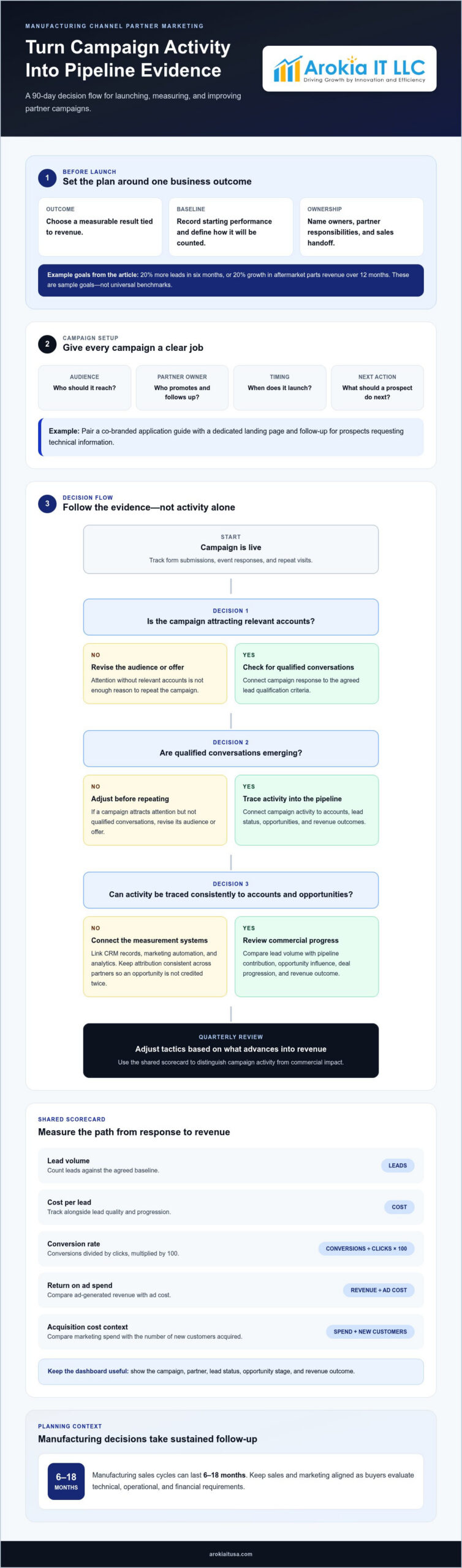
Build a 90-day channel partner plan around one business outcome, named owners, scheduled campaigns, and a shared scorecard. Set the baseline first, then review leading indicators during execution and revenue outcomes as opportunities progress.
-
Set Measurable Marketing Goals
Choose a result, define its measurement, and assign an owner before launching. For example, a manufacturer could target 20% more leads in six months or 20% growth in aftermarket parts revenue over 12 months. These are sample goals, not universal benchmarks. Select a target that reflects your starting performance, sales capacity, and partner coverage.
For the 90-day plan, translate the longer-term outcome into a near-term milestone. Set a baseline for qualified leads, partner-sourced opportunities, or another agreed measure, then specify how the team will count it. Avoid goals such as “increase awareness” unless you attach a measurable indicator, such as relevant website traffic or campaign engagement. Keep the executive scorecard focused on outcomes tied to revenue.
-
Implement Campaign Tactics
Give each campaign a target audience, partner owner, launch date, and next action. A distributor campaign might pair a co-branded application guide with a dedicated landing page and a follow-up sequence for prospects who request technical information. Connect each asset to a clear stage in the buyer journey instead of distributing materials without a defined purpose.
Use a 90-day calendar to coordinate launch, partner promotion, and sales follow-up. Give each partner the current version of approved messaging and campaign assets, then record who is responsible for lead handoff. Check engagement behavior by channel, including form submissions, event responses, and repeat visits. If a campaign attracts attention but no qualified conversations, revise its audience or offer before repeating it.
-
Measure Campaign ROI and Pipeline
Connect CRM records, marketing automation, and analytics so campaign activity can be traced to accounts and opportunities. Track lead volume alongside pipeline contribution, opportunity influence, and deal progression. A dashboard should show the campaign, partner, lead status, opportunity stage, and revenue outcome. This makes it easier to distinguish activity from commercial impact.
Consider comparing marketing spend with the number of new customers acquired when assessing acquisition costs. Calculate return on ad spend by dividing ad-generated revenue by ad cost. For a channel scorecard, also monitor cost per lead and conversion rate, calculated as conversions divided by clicks, multiplied by 100. Review results every quarter and adjust tactics based on what advances into revenue. Keep attribution consistent across partners so one opportunity is not credited twice.
Sales and marketing alignment
Connect each campaign to a channel sales goal, partner responsibility, and clear lead handoff. Manufacturing sales cycles can last 6-18 months, so sales and marketing need a shared strategy for supporting buyers throughout evaluation.
-
Align Campaigns with Sales Goals
Start with the sales outcome, then choose campaigns that help partners achieve it. If the goal is more qualified distributor conversations, align landing-page content, social posts, and sales follow-up around the same application or buyer need. Check that marketing attracts relevant accounts, not just more visits.
Define the pipeline handoff: who responds, what qualifies a lead, and what information sales records. This keeps campaign activity connected to the sales process. For U.S. manufacturer-distributor marketing, keep product claims accurate, follow channel agreements and approved pricing policies, and handle customer information under applicable privacy requirements.
-
Define Partner Roles and Targets
Segment potential partners by product fit, customer access, technical capability, and coverage. Recruit through targeted outreach that explains the value proposition and expected responsibilities. Assign each partner a role, territory, account rules, and sales target. Avoid overlapping ownership that leaves buyers unsure who manages the relationship.
Set targets based on each partner’s market opportunity, capacity, and historical performance. Document how house accounts, referrals, and shared opportunities are handled. This helps prevent channel conflict by clarifying where partners lead, when they collaborate, and how sales credit is assigned.
-
Enable Partners to Sell
Give partners practical tools for customer conversations: current product messaging, application guides, case studies, and objection-handling resources. Train sales teams to connect product features with the operational needs buyers raise. Keep assets aligned with approved product claims and maintain one current version to reduce inconsistent messaging.
Use incentives that reward the behavior your channel strategy needs, such as qualified pipeline creation, training completion, or closed sales. Performance rebates, cooperative marketing funds, and margin-based compensation are possible models. Define eligibility and payout terms in partner agreements so participants understand the requirements and value.
-
Nurture Leads Through Long Sales Cycles
Map follow-up to buyer questions, not a generic email schedule. During a 6-18-month manufacturing sales cycle, a prospect may need technical documentation, implementation details, or financial justification at different stages. Coordinate marketing nurture with the partner’s sales notes so outreach reflects each account’s behavior.
Review stalled opportunities with sales and partners, then select a relevant next action, such as sharing an application guide or scheduling a technical discussion. Use regular pipeline reviews to identify ownership gaps and re-engage buyers without duplicating contact. To structure these handoffs around your channel strategy, discuss your sales and marketing alignment.
Defining a marketing budget and expected ROI
Set the budget by connecting business targets to measurable marketing outcomes and the economics of channel sales. Use a 12-month forecast to account for campaign timing, partner participation, and the time required for opportunities to mature.
-
Set Budget Goals and KPIs
Start with a revenue or pipeline target, then identify the marketing activity needed to support it. A manufacturer can set goals for qualified leads, partner-sourced opportunities, or aftermarket revenue, then assign each KPI to an owner and data source. Avoid budgeting against impressions alone. Pair activity measures with indicators tied to sales progress.
Build a forecast across 12 months, with expected timing for campaign launches and partner follow-up. Deloitte’s CMO Survey reported manufacturing marketing budgets at 6.7% of revenue in 2024 and 9.5% in 2025. Use those figures as context, not automatic spending rules: a company’s growth target, sales capacity, margins, and channel coverage should shape its own budget.
Decide how the team will measure progress before committing funds. For example, define whether a qualified opportunity requires an identified need, a known decision process, and a next sales action. A shared definition helps executives compare marketing performance with pipeline movement instead of treating every inquiry as equivalent.
-
Allocate Budget Against Deal Economics
Allocate funds according to the target market, partner readiness, and each tactic’s role in generating or advancing opportunities. Include digital marketing, partner co-marketing, trade shows, content, and campaign operations when they support the plan. Avoid dividing funds evenly across channels for convenience. Give each allocation a purpose and measurable outcome.
Assess deal economics by comparing marketing investment with the expected contribution from acquired customers and influenced opportunities. Consider gross margin, repeat purchases, aftermarket potential, and the sales effort required to close. A high-value equipment sale may justify a longer nurture sequence or technical content, while a lower-value product may depend more on efficient partner reach.
For each budget line, record its intended audience, expected deliverable, partner role, and KPI. A trade show allocation, for instance, should connect attendance and follow-up to target accounts, not just booth traffic. Review the forecast quarterly, shift resources toward campaigns producing qualified pipeline, and document why an investment changes. This grounds ROI analysis in sales evidence rather than assumptions.
The sample marketing plan recommends allocating budget based on marketing goals and selected channels. The sample marketing forecast recommends allocating a portion of the marketing budget to industry trade shows and events. These choices can keep spending connected to a defined outcome instead of treating every available channel as an equal priority. Benchmark figures offer context rather than a substitute for a company’s own economics: 50% of manufacturers increased their digital marketing budgets after 2020, and B2B companies allocate an average of 7.7% of their total revenue to marketing efforts.
A clear rationale for each allocation makes it easier to assess whether spending supports the intended goals and channels. It also helps the team redirect funds when the forecast shows that a tactic is not advancing opportunities.
Lead generation, scoring, and conversion
Build lead generation around qualified opportunities, not raw form fills. A consistent process connects partner activity, buyer behavior, and sales follow-up from the first response through conversion.
- Define a qualified lead with sales and channel partners. Agree on the account fit, buying need, and next action that qualify an inquiry. Manufacturing purchases can involve five-ten stakeholders, so capture relevant roles rather than treating one contact as the entire buying group. For example, record whether an engineer requested specifications and whether an operations leader is involved.
Set a shared monthly target, such as 100 qualified leads, only when it matches sales capacity and partner coverage. Review rejected leads with sales to identify gaps in targeting, timing, or qualification criteria. This feedback keeps lead scoring tied to opportunities instead of arbitrary activity.
- Generate leads through useful content and clear conversion paths. Match an application guide, case study, or technical resource to a specific buyer need. Give each asset a relevant landing page and a direct next step, such as requesting product information or arranging a sales conversation. Partners can share approved materials with their audiences and return responses through a consistent lead process.
Track source, campaign, partner, and requested action for every inquiry. A manufacturer targeting 20% more leads this quarter should also monitor whether those leads meet the agreed qualification standard. More submissions without suitable accounts can increase workload without creating meaningful growth or opportunities.
- Score and route leads using fit and intent. Assign scores for account characteristics and observable actions, such as viewing technical content or requesting a quote. Set routing rules so a high-intent distributor inquiry reaches the right sales owner promptly. Make scoring criteria visible to sales, and revise them when accepted leads fail to advance or strong opportunities receive low scores.
Use marketing automation to record email engagement and trigger relevant follow-up, while the CRM holds account and opportunity status. Measure conversion rate as conversions divided by clicks, multiplied by 100. Compare rates by campaign and partner, then investigate where prospects disengage instead of treating one overall figure as the diagnosis.
- Nurture leads until the buying group is ready. Build email sequences around questions buyers raise at each stage, such as technical fit, implementation, and business value. A prospect who downloads an application guide could receive related material, while sales follows up when the account signals active interest.
Review lead status with partner sales teams and pause automated messages after direct sales engagement. Track responses, meetings, qualified opportunities, and progression in the CRM. These signals show whether nurturing supports buyer decisions and where to adjust content, timing, or handoff.
LinkedIn, email, events, and account-based marketing
LinkedIn, email, industry publications, trade shows, and account-based marketing can generate leads for manufacturing distributors and resellers. Choose channels based on where target buyers engage, then connect each campaign to a useful next step.
- Use LinkedIn to reach professional audiences. Build posts around applications, technical questions, and customer use cases, then equip partners to share approved content. LinkedIn accounts for 80% of B2B leads generated from social media. Treat that figure as context, not a substitute for measuring qualified leads and partner-sourced opportunities.
Develop a campaign asset, such as an application guide, and pair it with a clear landing page. Ask partners to share the same core message while adding relevant context for their audiences. Track engagement and inquiries by partner so the manufacturer can identify which content starts useful sales conversations.
- Connect email to the buyer’s next decision. Segment distributor contacts by product interest, account type, or previous engagement. Send a concise sequence that answers a specific question, such as product fit or an application requirement, instead of repeating a general promotion. Include a relevant resource and one clear action in each message.
Coordinate email timing with partner sales outreach. For example, after a prospect downloads a technical guide, the partner can follow up with a related discussion. Suppress or adjust automated messages when a sales representative is already engaged to avoid conflicting contact and keep communication useful.
- Make trade shows part of a measurable campaign. Before an event, identify target accounts, prepare product demonstrations, and give partner representatives a shared introduction. Use a campaign-specific follow-up plan for contacts who request information or discuss an application. The event’s value depends on what happens after conversations, not booth traffic alone.
Record the partner, account, discussion topic, and agreed follow-up for each lead. After the show, send relevant materials and route qualified inquiries to the appropriate sales owner. Compare event-generated conversations and opportunities with other channels to guide future participation.
- Apply account-based marketing to priority accounts. Select accounts that fit the manufacturer’s market and partner coverage, then coordinate outreach to relevant buying roles. Align LinkedIn content, email, and partner sales activity around shared account priorities. This helps prevent disconnected messages from reaching the same organization.
Use content marketing to support different stakeholders: an application guide for engineers, operational context for plant leaders, and an ROI tool for finance teams. Review account engagement alongside sales follow-up, then refine the audience and content based on which interactions advance opportunities.
Arokia IT LLC: Account-Based Marketing (ABM)
Arokia IT LLC helps manufacturing teams coordinate account-based marketing (ABM), demand generation, LinkedIn Marketing, and AI Search & GEO. Use this approach when channel activity needs to focus on priority accounts, support partner sales conversations, and connect marketing signals with pipeline progress.
ABM can organize outreach around selected companies and relevant buying roles, while demand generation supports a broader flow of qualified prospects. LinkedIn Marketing and AI Search & GEO can strengthen how technical buyers discover and engage with a manufacturer’s content. Arokia IT LLC also offers 90-day pipeline forecasting and sales enablement content to support planning and partner follow-up.
Contact Arokia IT LLC to discuss a channel marketing approach for your manufacturing business.
Make the Next Planning Cycle More Focused
Use the next planning cycle to turn campaign learning into clearer decisions. A marketing plan for manufacturing channel partners should evolve as buyer needs, partner capacity, and account priorities change. The aim is not to preserve every tactic, but to build a repeatable process for deciding what to continue, refine, or stop.
Choose one planning question to resolve before the next cycle begins. For example, identify where partner feedback could sharpen audience selection or where sales conversations reveal a need for more useful technical content. Bringing those observations into planning keeps future work grounded in real customer and partner interactions.
A disciplined learning loop helps your channel program become more responsive without losing strategic focus. Start by identifying the next decision your team needs to make, then define what evidence will inform it.
Clear priorities create room for confident, sustained progress.
Frequently Asked Questions
What should a marketing plan for manufacturing channel partners include?
The plan should define the target market, partner responsibilities, campaign priorities, budget, and measurement approach. Add a partner-facing calendar showing which materials and promotions are available, who approves them, and how partners can adapt the messaging. For example, a component manufacturer might pair a seasonal application campaign with distributor-ready product sheets and a process for sharing customer feedback. Include a review point so the plan can respond to changing product priorities or partner capacity.
What MDF and co-op marketing budgets are typical for manufacturing channel partners?
There is no single MDF or co-op budget that suits every manufacturer. Set the allocation according to partner potential, eligible campaign activity, market coverage, and growth priorities. A practical policy defines eligible expenses, approval steps, required campaign plans, and the evidence partners submit after spending. For example, a distributor requesting event support could document its target audience, promotion plan, and post-event outcomes before receiving future funding.
Which KPIs should manufacturers use to measure channel partner marketing performance?
Track whether partners use the program, not just the results of individual campaigns. Useful measures include partner participation, adoption of co-branded assets, MDF utilization, campaign completion, and engagement from priority accounts. Compare results across partner segments to identify where training or materials need adjustment. For example, low use of an approved product guide may point to a distribution or relevance issue, while strong adoption can show that partners find it practical for customer conversations.