
More features won’t fix a paid campaign program that targets the wrong accounts or fails to connect spend with revenue. If you’re evaluating metadata io alternatives for b2b paid campaign automation, start by identifying the execution gap you need to close.
It’s reasonable to look for comparable campaign automation, reliable account targeting, and clear pipeline measurement without disrupting live campaigns or data flows. But alternatives don’t all do the same job. Some focus on identifying in-market accounts, while others emphasize ad execution or broader marketing workflows. Demandbase acquired Metadata.io in 2024, and the platforms were set to become one unified platform in January 2025. Check current product packaging and capabilities before comparing them.
This guide compares options by campaign needs, targeting approach, workflow fit, and revenue measurement, rather than feature count alone. It covers what to evaluate before switching, where migration can introduce risk, and when software may not address the underlying need. If your team needs stronger account selection, sales alignment, lead nurturing, or pipeline measurement, a managed ABM and demand generation program may complement your software rather than replace it.
Key Takeaways
- Decide whether you need a full platform replacement, a specialist capability, or support with campaign execution.
- Compare options by account targeting, channel coverage, workflow ownership, and how campaign activity connects to pipeline and revenue.
- Assess metadata io alternatives for b2b paid campaign automation against your actual campaign and measurement requirements.
- Before testing a new system, document current audiences, data dependencies, reporting definitions, and live campaign workflows.
- Determine whether software, an agency-led ABM and demand generation program, or a combination best addresses the gap.
Why B2B Teams Look for Metadata.io Alternatives
The right alternative depends on what your team needs to change. Some platforms focus on executing and optimizing paid campaigns; others emphasize account identification, intent signals, or broader marketing and revenue workflows. Before comparing metadata io alternatives for b2b paid campaign automation, decide whether you need a full replacement, a specialist capability, or help with execution. This comparison focuses on B2B paid campaigns, not every function in ABM or marketing automation. Marketing automation platforms cover a broader category of tools and workflows, so compare vendors against the specific campaign work you need done.
Which gaps typically trigger a platform search?
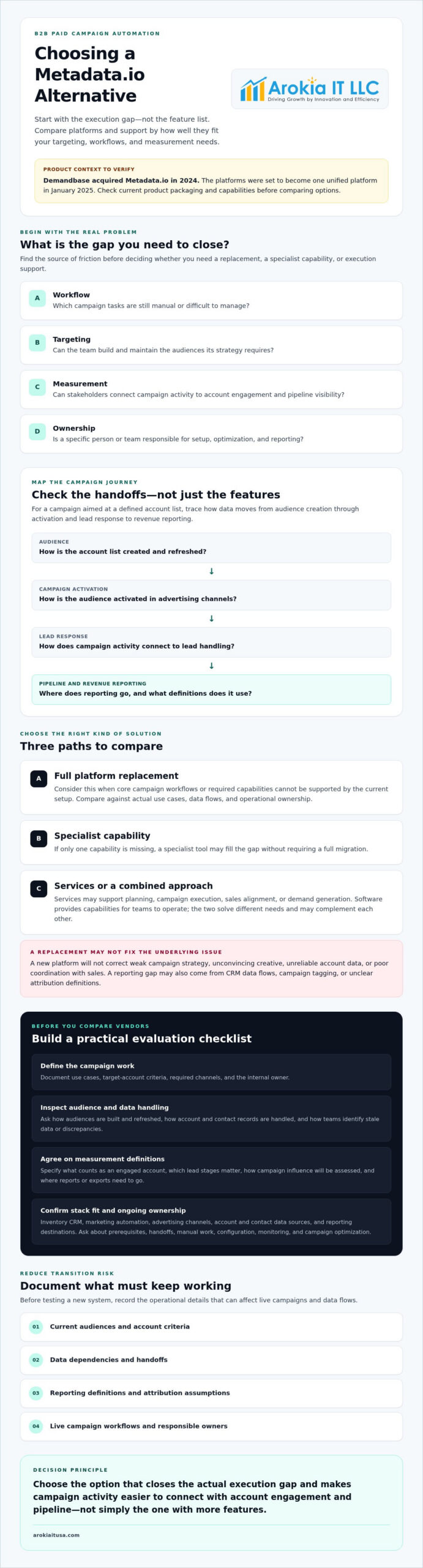
Look for recurring friction in four areas: campaign setup and optimization, account or audience targeting, reporting, and operational ownership. Then identify the source of the problem. A reporting gap, for example, may stem from a platform limitation, an incomplete CRM data flow, inconsistent campaign tagging, or unclear attribution definitions. Each cause calls for a different fix.
- Workflow: Which campaign tasks are still manual or difficult to manage?
- Targeting: Can the team build and maintain the audiences its strategy requires?
- Measurement: Can stakeholders connect campaign activity to account engagement and pipeline visibility?
- Ownership: Is a specific person or team responsible for setup, optimization, and reporting?
Separate confirmed product limitations from configuration or adoption issues before evaluating vendors. Prioritize gaps that materially constrain campaign execution or make account and pipeline outcomes difficult to understand. A long list of inconveniences can distract from the breakdown that most affects business decisions.
Is a software replacement always the right answer?
No. A new platform won’t correct a weak campaign strategy, unconvincing creative, unreliable account data, or poor coordination with sales. If the current system supports the required workflow, improving its configuration or team process may involve less disruption. If only one capability is missing, a specialist tool may fill the gap without requiring a full migration.
Software and services address different needs. Software gives teams capabilities to operate; an agency-led program can support planning, execution, sales alignment, or ongoing demand generation. Arokia IT LLC offers B2B Account-Based Marketing, demand generation, and paid media services, but it isn’t a campaign automation platform or a like-for-like Metadata.io replacement. Confirm the execution scope with any service provider before deciding.
How to Evaluate Metadata.io Alternatives for B2B Campaign Automation
A useful evaluation of metadata io alternatives for b2b paid campaign automation begins with the work your team needs the platform to perform, not a vendor’s feature list. Define your campaign use cases, target-account criteria, required channels, and internal owner. Then map how data should move from audience creation through campaign activation and lead response to revenue reporting.
Make the comparison operational. For a campaign targeting a defined account list, document how the list is created, updated, activated in advertising channels, and connected to engagement and pipeline reporting. Ask each vendor to demonstrate that workflow against your requirements, including where data is sourced, transformed, and reviewed.
Which capabilities belong on the evaluation checklist?
List the steps the platform must support: building and refreshing audiences, activating campaigns, applying relevant personalization, and managing or reviewing workflows. Check how account and contact records are handled at each step, and how your team can spot discrepancies or stale data.
Agree on measurement before a demo. Specify what counts as an engaged account, which lead stages matter, how campaign influence will be assessed, and where reports or exports need to go. Without shared definitions, two platforms may produce different-looking reports without resolving the team’s underlying measurement question.
How should buyers assess stack fit and adoption?
Inventory the systems and owners involved: CRM, marketing automation, advertising channels, account and contact data sources, and reporting destinations. Ask vendors to identify prerequisites, data handoffs, and workflows that will remain manual. Confirm who will configure, monitor, and optimize campaigns after implementation, not just who will handle initial setup.
Compare the full operating effort, including data maintenance, campaign review, troubleshooting, and reporting. More automation doesn’t guarantee better outcomes if the team can’t validate its inputs or act on the results.
- Test the workflow: Ask the vendor to demonstrate a realistic campaign using your target-account rules and required channels.
- Validate the data path: Check that account and contact records reach the intended systems and that reporting definitions stay consistent.
- Confirm ownership: Establish who handles ongoing campaign operations and which tasks stay with your team.
These checks help distinguish a platform that fits your operating model from one that only presents well in a demo. If you’re aligning campaign requirements with broader B2B demand generation needs, talk with Arokia IT LLC about your B2B marketing priorities.
Metadata.io Alternatives: Platforms and Approaches to Compare
Metadata.io alternatives aren’t all direct substitutes. Some emphasize account identification, some support account-based advertising, and others provide broader marketing automation. The right fit depends on whether your gap is campaign execution, account selection, or the capacity to connect paid activity with sales and pipeline outcomes.
Demandbase acquired Metadata.io in 2024, and the platforms were set to become one unified platform in January 2025. Confirm current product packaging and capabilities rather than assuming Demandbase is separate from Metadata.io or offers a particular workflow today.
| Option | Primary use case | Account focus | Campaign role | Measurement focus | Questions to verify |
|---|---|---|---|---|---|
| Demandbase | Broader ABM and revenue platform evaluation | Account-based marketing | Confirm how the unified platform handles paid campaign execution | Verify account, campaign, and revenue reporting scope | Which Metadata.io workflows are included, and how are data and reporting handled? |
| 6sense | Account identification and intent-led targeting | Predictive intent signals help inform who to target | Assess whether its current advertising capabilities fit your execution needs | Confirm how account activity connects to campaign and pipeline reporting | Can it support your audience rules, channels, and measurement definitions? |
| RollWorks, now part of AdRoll ABM | Account-based advertising needs | ABM account targeting | Evaluate against the specific advertising workflows you require | Check account engagement visibility and reporting destinations | What capabilities, integrations, and packaging are currently available? |
| HubSpot Marketing Hub | Broader marketing automation needs | Evaluate fit for your contact and account workflows | Consider as an adjacent platform, not an assumed paid-ad automation equivalent | Confirm whether reporting supports your account and revenue questions | Can it meet your paid campaign requirements without adding process gaps? |
| Agency-led support, such as Arokia IT LLC | Strategy and execution support when internal capacity is the constraint | Account selection and sales alignment depend on the program scope | Services, not replacement software | Can align campaign operations with pipeline measurement goals | Clarify responsibilities, deliverables, and how success will be assessed |
How do direct and adjacent platform alternatives differ?
Start with each vendor’s primary role, then verify current capabilities against your requirements. For Demandbase, ask how the Metadata.io acquisition affects access to paid campaign workflows. For 6sense, distinguish account identification from campaign execution. For RollWorks, verify the current AdRoll ABM offering and confirm that its advertising workflows match your channels and operating needs.
HubSpot Marketing Hub may be relevant if you need broader marketing automation, but category overlap doesn’t establish feature-for-feature parity. For every candidate, check product packaging, channel availability, integrations, and measurement directly with the vendor.
When might an agency-led approach be a better fit?
An agency can support strategy and execution, but it doesn’t replace campaign software. If the constraint is internal capacity, account selection, or alignment between ABM and demand generation, explore Arokia IT LLC’s ABM services. Consider how that work fits your demand generation plan, and confirm specific campaign execution responsibilities before choosing a provider.
How to Shortlist, Test, and Transition From Metadata.io
A controlled evaluation protects campaign continuity and makes vendor claims easier to assess. Before selecting from metadata io alternatives for b2b paid campaign automation, document how campaigns run today, what a replacement should improve, and which outcomes would justify a transition.
What should a platform evaluation or pilot prove?
Use this process to move from requirements to a decision:
- Define the must-haves. Specify priority campaigns, target-account rules, advertising channels, users, and required reporting. Separate essential requirements from preferences.
- Capture the baseline. Record audience definitions, campaign workflows, data sources and handoffs, CRM dependencies, reporting destinations, and the definitions used for engagement, lead progression, and pipeline.
- Select a representative scenario. Choose a campaign that tests the workflows you need, including audience activation and how engagement data should appear in reporting. Don’t evaluate only a simple demo path.
- Assign owners. Name the people responsible for campaign setup, data validation, technical review, sales input, and results assessment. Confirm who will operate the platform after implementation.
- Run a bounded test. Agree on a limited scope and check whether data moves as expected, responsibilities are clear, and campaign activity can be assessed using the agreed measurement definitions.
- Review tradeoffs and decide. Document unmet requirements, manual work, reporting differences, and dependencies. Proceed only if the evidence supports a switch, a complementary tool, or no change.
A successful demo doesn’t prove fit. The evaluation should show the actual workflow, expose data or integration gaps, and give marketing, sales, and technical stakeholders a shared basis for judging results.
How can teams reduce transition risk?
Plan the transition before changing active campaigns. Confirm access and account ownership, preserve documentation, identify campaign and audience dependencies, and agree on who can pause or adjust activity if a data flow or report doesn’t behave as expected. Validate integrations and reporting outputs with the people responsible for CRM data, campaign operations, and revenue measurement.
Test representative audiences and data flows before expanding to the broader program. Compare new reports with the agreed baseline, investigate differences in definitions or timing, and record decisions. Apply the same discipline to paid search planning by documenting campaign goals, audience intent, and measurement expectations.
Use this checklist to base a transition decision on verified workflows, not a feature-page promise. If you’re assessing how campaign changes fit your wider B2B priorities, involve the teams responsible for marketing, sales, and reporting.
Choose the Right Path: Software, Services, or Both
The right choice depends on where the constraint sits. Replace software when a confirmed platform limitation blocks a required workflow. Add a complementary tool when one capability is missing but the existing system still supports the broader process. Consider agency support when the larger gap is strategy, campaign execution, account selection, or coordination with sales.
When should buyers prioritize software?
Prioritize a platform evaluation when your team has defined its campaign workflows and can identify the capabilities it needs to change. Before comparing metadata io alternatives for b2b paid campaign automation, confirm who will own setup, daily campaign operations, measurement, and ongoing optimization. A platform can provide new functionality, but it won’t create internal ownership or clarify priorities.
If the shortfall is narrow, compare the effort and risk of adding a specialist tool with the disruption of replacing the current system. A full migration is more appropriate when a core requirement can’t be met and an alternative demonstrates that it can support the necessary workflow and reporting. Don’t select a platform simply because it appears on an alternatives list.
When should buyers consider agency support?
Agency support may be a better fit when your team needs help connecting account strategy, campaign execution, and sales alignment. Those needs extend beyond software selection. Account-Based Marketing can guide which accounts matter; demand generation can coordinate activity to create demand; lead nurturing and sales enablement can help teams follow through on engagement. Clarify responsibilities based on your execution gap before committing.
Arokia IT LLC is a B2B agency, not an automation product. Its services include ABM and B2B demand generation, while its 90-Day Pipeline Forecast supports revenue planning. The forecast is a planning resource, not a promise of campaign results. Confirm the paid media execution workflows you need before selecting an agency partner.
Software and services can also work together: a platform supports campaign operations, while an agency may provide strategy or execution capacity. Decide based on clear ownership, measurement needs, and the work your internal team can sustain. The goal isn’t to accumulate tools or outsource everything. It’s to connect targeting, campaign activity, sales follow-up, and pipeline visibility.
Choose a Path That Connects Campaigns to Revenue
The right alternative isn’t necessarily the platform with the most features. Choose based on the gap you need to close: replace software when a required workflow is missing, add a specialist tool for a specific capability, or seek execution support when the constraint is strategy, capacity, or sales alignment.
As you compare metadata io alternatives for b2b paid campaign automation, prioritize verified workflows, dependable data movement, and reporting that helps your team understand account engagement and pipeline progression. Test the transition before expanding it across live campaigns.
For teams that need coordinated B2B execution, Arokia IT LLC offers Account-Based Marketing and demand generation, supported by 90-day pipeline forecasting and sales enablement content. These are agency services, not a campaign automation platform or a like-for-like software replacement.
With clear requirements and accountable ownership, you can make a deliberate choice and build a campaign program that is better aligned with revenue goals.
Frequently Asked Questions
What are the best Metadata.io alternatives for B2B paid campaign automation?
The best option depends on whether your priority is paid campaign execution, account targeting, or broader marketing automation. Compare Demandbase for a broader ABM platform direction, 6sense for account identification and intent-led targeting, and RollWorks, now part of AdRoll ABM, for account-based advertising. HubSpot Marketing Hub may fit broader marketing automation needs. These options aren’t automatically equivalent, so verify current capabilities against your campaign workflows and measurement requirements.
Is Demandbase a direct alternative to Metadata.io?
Demandbase may be an option to evaluate, but the relationship is more complex than a standard vendor comparison. Demandbase acquired Metadata.io in 2024, and the platforms were set to become one unified platform in January 2025. Confirm current product packaging and which paid campaign workflows are available to your team. Compare those capabilities with your needs for account targeting, campaign execution, data flows, and revenue measurement before deciding whether the platform can replace your current setup.
Can 6sense automate B2B paid campaigns?
6sense is primarily associated with identifying accounts and using intent signals to inform targeting, while Metadata.io has focused on paid campaign execution. Don’t assume those roles are interchangeable. Ask 6sense to demonstrate the campaign activation, optimization, channel, and reporting workflows your team needs, and verify current product availability. If account identification is the gap, it may be worth evaluating. If execution automation is essential, test that capability directly rather than inferring it from broader platform positioning.
How do I choose between Metadata.io alternatives?
Choose based on the execution gap, not the longest feature list. Define campaign use cases, target-account requirements, channels, data inputs, CRM dependencies, reporting destinations, and internal ownership. Then ask each vendor to demonstrate a representative workflow and show how campaign engagement connects to lead progression and pipeline reporting. Compare manual work, integration dependencies, and measurement definitions alongside platform functionality. The keyword metadata io alternatives for b2b paid campaign automation describes a comparison that should begin with these requirements.
What should I check before switching from Metadata.io?
Document live campaign workflows, audiences, data sources, system dependencies, reporting definitions, and account ownership before making changes. During an evaluation, test representative campaigns and data flows, confirm who will configure and operate the replacement, and compare reporting outputs with your current baseline. Involve marketing operations, technical stakeholders, and revenue teams in reviewing the results. Record gaps or changes in attribution assumptions so a successful demo isn’t mistaken for proof of a safe transition.
Is HubSpot Marketing Hub an alternative to Metadata.io?
HubSpot Marketing Hub may be relevant if your needs extend to broader marketing automation, but it shouldn’t be assumed to directly replace Metadata.io’s paid campaign role. Compare the workflows you depend on, including audience activation, account-level visibility, campaign reporting, and connections to your CRM and marketing processes. Ask for a demonstration based on your requirements, then verify current features and integrations with the vendor before deciding whether it fits.
Can an agency replace a B2B campaign automation platform?
An agency doesn’t replace campaign automation software on a like-for-like basis. It can provide strategy and execution support when the gap involves account selection, campaign planning, sales alignment, or internal capacity. Arokia IT LLC is a B2B-focused agency offering Account-Based Marketing, demand generation, lead nurturing, and sales enablement content. Its 90-day pipeline forecasting supports revenue planning. Confirm the campaign responsibilities and operating model you need before selecting agency support.
To discuss how ABM and demand generation could support your B2B campaign priorities, contact Arokia IT LLC.