
For companies searching for professional website creation, a polished website can still lose a B2B buyer if it doesn’t explain a complex offer or show what to do next. That’s the risk of treating website creation as a design project instead of a business decision.
This guide explains how Arokia IT LLC helps you evaluate website strategy, design, development, and measurement against your B2B buying journey and revenue priorities. You’ll learn how to connect the experience to target accounts, answer buyer questions at each stage, and choose performance measures your teams can use together. It also covers how to compare project approaches by their purpose and deliverables, not visual polish alone. The goal is a practical plan for a website that supports account targeting, buyer education, and sales conversations.
Key Takeaways
- Start website planning with the business problem and desired outcomes, not visual preferences alone.
- Connect buyer questions at each stage of the journey to the site structure and content they need.
- Compare website creation proposals by defined scope, strategic alignment, deliverables, and measurement.
- Set objectives and a baseline before launch so you can distinguish site engagement from qualified opportunities and sales outcomes.
- Coordinate website content with demand generation, ABM, and sales enablement to support a connected B2B growth strategy.
B2B Website Creation Starts With the Business Problem, Not the Visual Design
A B2B website is more than a layout or visual identity. Website creation brings business strategy, content, design, development, and measurement together so the site helps buyers move forward and supports company priorities. For organizations selling complex products or services, planning should reflect how business customers research, evaluate, and make decisions. Business-to-business (B2B) commerce involves organizations buying from other organizations, so a website often needs to serve several stakeholders with different questions and concerns.
Unclear objectives invite competing requests. Marketing may prioritize lead volume, sales may want stronger qualification, and leadership may expect clearer support for pipeline priorities. Without agreement, teams can add pages and features without addressing what buyers need to understand or do.
What should a B2B website help the business accomplish?
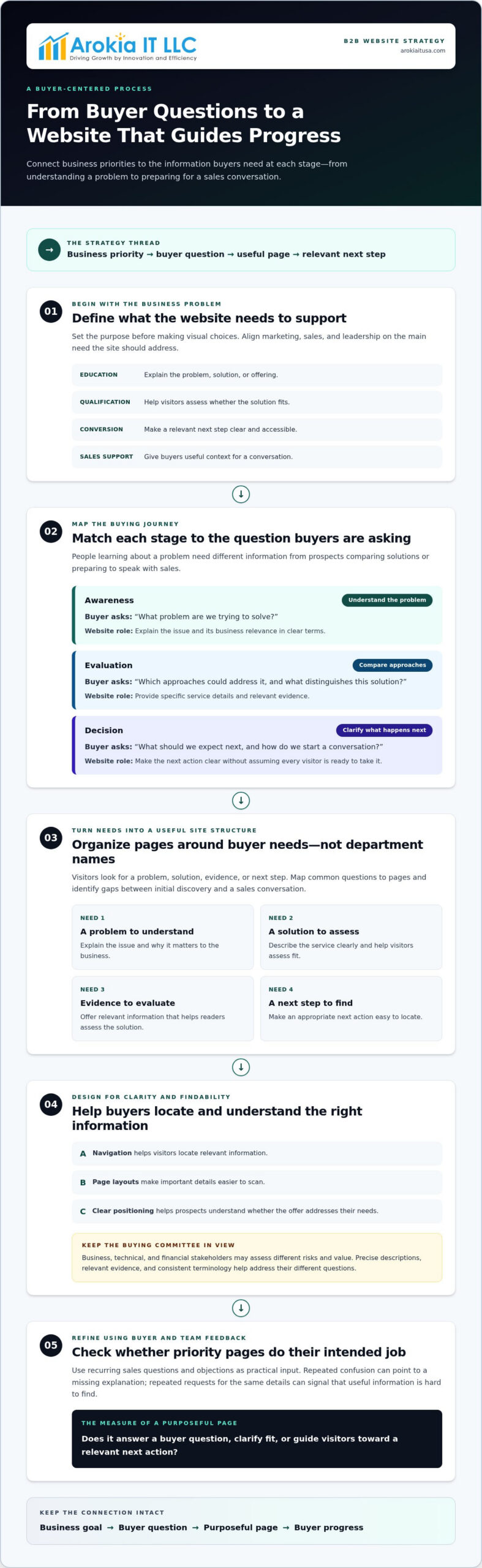
Give every priority page a defined role: answer a buyer question, clarify fit, or guide visitors toward a relevant next action. Match content to the buying stage rather than treating every visit as a sales opportunity. Someone learning about a problem needs different information from a prospect comparing solutions or preparing to speak with sales. Input from marketing, sales, and leadership helps establish which questions matter and what the site should support.
Before the project begins, align on its primary outcome:
- Education: Explain the problem, solution, or offering.
- Qualification: Help visitors determine whether the solution fits their needs.
- Conversion: Make the next step clear and accessible.
- Sales support: Provide information that helps buyers prepare for a conversation.
Why can a polished website still underperform?
Give each priority page a clear job. A service page can explain fit and value; a supporting resource can answer a detailed evaluation question; and a contact page can make a decision-stage action easy to find. Arokia IT provides website development and design grounded in B2B growth, connecting the website experience to buyer education and sales conversations rather than treating design as a standalone objective.
How B2B Website Strategy Connects Buyer Journeys to Content and Design
A B2B website strategy connects business priorities to audience needs, site structure, content, design, and measurement. It turns the buyer journey into a practical plan: what visitors need to understand, where they can find it, and what useful next step each page supports. The core elements of B2B marketing include aligning business strategy with buyer behavior and communicating benefits clearly. A website should make that alignment visible in its language and navigation.
Map information to the questions buyers ask as they move through a purchase:
- Awareness: What problem are we trying to solve? Explain the issue and its business relevance in clear terms.
- Evaluation: Which approaches could address it, and what distinguishes this solution? Provide specific service details and relevant evidence.
- Decision: What should we expect next, and how do we start a conversation? Make the next action clear without assuming every visitor is ready to take it.
How do you map B2B buyer needs to website pages?
Organize the site around buyer needs, not internal department names. Visitors look for a problem, a solution, evidence, or a next step, not an organizational chart. Map common questions to proposed pages, then look for gaps between initial discovery and a sales conversation. Sales questions and objections provide practical input: recurring confusion may point to missing explanations, while repeated requests for the same details may signal that useful information is hard to find.
What makes website content useful to a buying committee?
A buying committee may include business, technical, and financial stakeholders, each assessing different risks and value. Precise service descriptions clarify what a solution does; relevant evidence helps readers assess fit; and consistent terminology reduces confusion across roles. B2B website content should answer buyer questions at each evaluation stage, giving stakeholders the information they need to move forward together.
Arokia IT provides B2B website development and design to support a buyer-focused website experience. If your team is translating buyer questions into a website plan, discuss your website priorities.
Compare Website Creation Proposals by Scope, Strategy, and Measurement
Use the criteria below to make differences visible. Clarify what work is included, what your team must supply, and which decisions or deliverables remain undefined.
| Criterion | What to look for | Why it matters |
|---|---|---|
| Business alignment | Defined website objectives connected to business and sales priorities | Prevents a project from optimizing for preferences that don’t address a business need. |
| Audience research | Specific audiences, buyer needs, and stakeholder input | Shows whether the plan reflects how B2B prospects assess a solution. |
| Content scope | Named pages, content responsibilities, and review expectations | Clarifies who develops and approves the information buyers need. |
| Design and usability | Page layouts, navigation, and responsive design requirements | Connects the visual experience to finding information and taking action. |
| Development and ownership | Technical scope, integrations if applicable, and ownership expectations | Reduces ambiguity about what is built and who controls the resulting assets. |
| Measurement | Baseline, selected indicators, and a plan to review results | Helps teams evaluate performance against meaningful questions, not just traffic totals. |
Measurement should clarify what visitors do and whether that behavior relates to business priorities. The International Trade Administration explains how to use website analytics strategically, including selecting relevant performance indicators. A proposal that includes reporting should specify which indicators it covers and how the team will interpret them.
How should you assess performance claims and portfolio examples?
Plan Website Measurement and Improvements Before the Site Launches
Put the website measurement plan in place before launch, not after teams start asking whether the site is working. Define what the website needs to support, record a baseline, and decide how marketing and sales will interpret results together. This preparation helps connect page activity to buyer progress without treating every visit as a pipeline outcome.
What should a B2B website team measure after launch?
Choose indicators that match the site’s objectives and buyer journey. If a priority page is intended to educate, review whether visitors engage with the relevant information. If a page supports conversion, monitor whether visitors take its intended next step. Traffic alone can’t show whether the right audiences are finding useful information or progressing toward a business conversation.
Leading website indicators show engagement and intent; business outcomes show whether that activity contributes to qualified opportunities and downstream sales. Both matter, but they answer different questions. A form submission, for example, is a site conversion, not automatically a qualified opportunity. Marketing and sales should agree on how to assess lead quality and connect website activity with later pipeline discussions.
How can teams prioritize website improvements?
Use a repeatable review sequence to turn observations into action:
- 1. Define objectives. State what the website or priority page should help a buyer understand or do.
- 2. Establish a baseline. Capture relevant current performance before making changes, so the team has a comparison point.
- 3. Select indicators. Choose measures tied to the objective, such as engagement with key content or completion of a defined action.
- 4. Review behavior. Look for points where visitors appear to stop progressing, and compare observations with sales feedback and recurring buyer questions.
- 5. Prioritize improvements. Address the clearest friction or content gap first, then evaluate whether the change supports the intended objective.
Keep the review grounded in shared objectives. When marketing considers engagement data and sales contributes feedback on lead relevance, the team can prioritize changes based on buyer friction and business questions, not isolated metric swings.
Connect B2B Website Creation to a More Coherent Growth Strategy
A B2B website can support growth when it works alongside demand generation, account-based marketing (ABM), and sales enablement. Campaigns can direct relevant audiences to pages that explain an offer, address buyer concerns, or provide useful evidence. Sales teams can use that content to reinforce conversations. Design alone doesn’t guarantee pipeline impact; value comes from connecting the website’s role to business priorities and the wider marketing strategy.
When should website creation connect with demand generation or ABM?
Connect these efforts when the organization’s goals and marketing strategy call for a coordinated buyer experience. For example, an ABM campaign may focus on selected accounts, while website content helps stakeholders understand a solution and its relevance. Demand generation can bring qualified audiences to educational or service pages, while sales enablement content supports follow-up conversations. The channels should reinforce one another, not compete for attention.
Consider how B2B demand generation fits into the broader plan. The right relationship between website content and campaigns depends on target audiences, priorities, and existing marketing activity. A new site doesn’t need to absorb every function. It should strengthen the parts of the growth system that matter most.
What is a practical next step for a B2B website project?
Before defining scope, write down three things: the business problem the project should address, the priority audiences, and the role the website should play in their buying journey. Then identify the pages, content, design, development, and measurement needs that follow from those priorities. This gives marketing, sales, and leadership a shared basis for decisions.
Arokia IT focuses on B2B growth, particularly in industrial sectors, and provides website development and design alongside ABM, demand generation, and sales enablement. Set the project scope around your organization’s needs and existing strategy rather than a preset formula. A conversation can help clarify the priorities and services that fit your project.
Start with the business problem, audience, and intended website role. Those decisions create a practical foundation for project scope and for assessing how the site can contribute to a more coordinated growth strategy.
Make Your Website Plan Work Toward Business Priorities
A B2B website is more useful when its purpose is clear: help buyers understand the offer, find information relevant to their evaluation, and take an appropriate next step. Strong planning connects business goals to audience needs, page content, design, and measurement. It also gives marketing, sales, and leadership a shared basis for evaluating proposals and prioritizing improvements.
A disciplined approach to dallas website creation looks beyond visual polish. Define the site’s role, compare project scope and deliverables, and decide how you’ll distinguish visitor engagement from qualified opportunities and sales outcomes. Then connect website content to demand generation, ABM, and sales enablement where those activities support your strategy. No design choice guarantees growth, but a coordinated plan makes the website’s contribution clearer.
Arokia IT combines website development and design with B2B marketing capabilities, including ABM, demand generation, AI search and GEO, and sales enablement content. Define the scope around your priorities, audiences, and existing marketing activity. Start by identifying the business problem your website needs to address.
With a clear objective and shared direction, your team can move forward with greater confidence and purpose.
Frequently Asked Questions
What does B2B website creation include?
How much does it cost to create a B2B website?
How long does a B2B website project take?
A B2B website project timeline depends on its scope, content requirements, technical complexity, and review process. A project with extensive content or integrations may involve different work from a focused site update. Before work begins, align on responsibilities, approvals, required content, and key decisions. That shared plan helps the team understand what affects timing without relying on a generic estimate that may not match the project.
What should a B2B website include to support lead generation?
How do you measure whether a B2B website is effective?
Measure a B2B website against its defined objectives, using both visitor indicators and business outcomes. Engagement with key content or completion of a page’s intended action can show whether visitors interact with the experience. Qualified opportunities and downstream sales outcomes answer different questions and require alignment between marketing and sales. Establish a baseline before launch, then review results alongside lead quality and sales feedback to identify useful improvements.
Can a website support account-based marketing?
Yes. A website can support account-based marketing by giving target-account stakeholders relevant information that reinforces campaign messages and sales conversations. For example, a campaign may direct an audience to a service page or resource that explains a specific solution and its business relevance. The content and page experience should reflect the account strategy and buyer needs. A website supports ABM, but it doesn’t replace coordinated targeting, outreach, and sales engagement.