
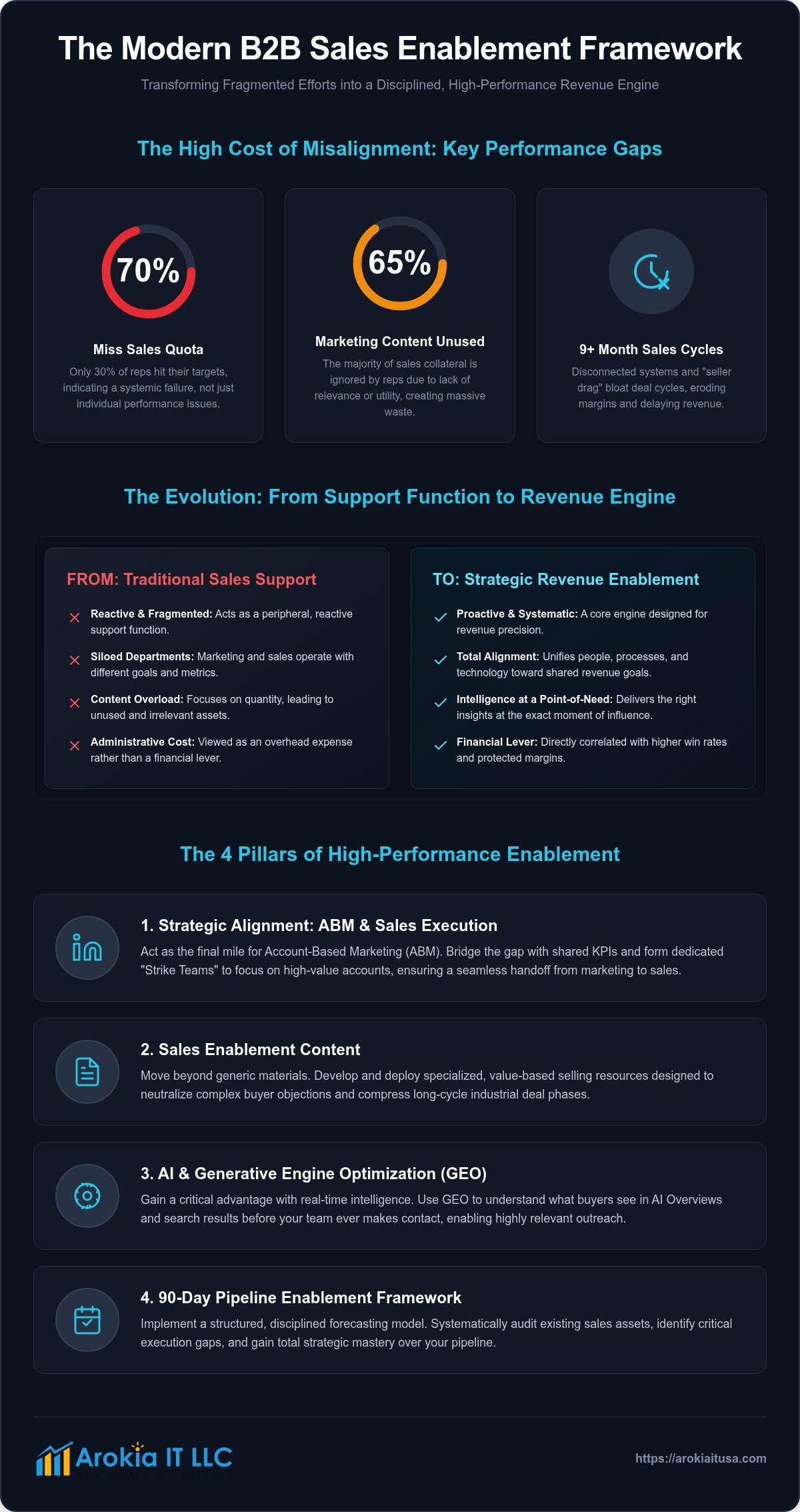
Only 30% of B2B sales representatives hit their quota in recent years; by 2026, the divide between market leaders and the stagnant has become a matter of structural discipline. You likely recognize the friction of a bloated sales cycle that stretches beyond nine months, where marketing intelligence is ignored and sales collateral sits unused. It’s a frustrating reality where “seller drag” and disconnected systems erode your margins while competitors move with surgical precision. We understand that high-stakes revenue growth isn’t about working harder. It’s about eliminating the waste within your b2b sales enablement strategy.
This guide provides a systematic framework to align your marketing intelligence with sales execution to compress deal cycles and maximize revenue precision. You’ll learn how to transform inconsistent messaging into a unified front that drives predictable results. We’ll explore the mechanics of total alignment between Account-Based Marketing and sales execution, ensuring your team has the right tools to close complex industrial deals faster. This transition from fragmented efforts to a disciplined, step-by-step breakdown of execution will provide you with total oversight and strategic mastery over your pipeline.
Key Takeaways
- Transition from reactive sales support to a systematic revenue engine that prioritizes the alignment of people, processes, and technology.
- Implement a b2b sales enablement strategy that acts as the final mile for Account-Based Marketing, ensuring seamless handoffs and consistent executive messaging.
- Leverage specialized sales enablement content to neutralize complex buyer objections and compress long-cycle industrial deal phases.
- Utilize Generative Engine Optimization to gain real-time intelligence on what buyers see in AI Overviews before they ever engage with your team.
- Apply a disciplined 90-day pipeline forecasting model to audit existing sales assets and identify critical gaps in your current execution.
The Evolution of B2B Sales Enablement: Beyond Support to Strategic Revenue
Modern sales enablement is no longer a peripheral support function. It’s a systematic alignment of people, processes, and technology designed to drive revenue precision. Traditional models focused on reactive support; the 2026 mandate demands proactive, data-driven revenue enablement. In the complex landscape of Business-to-business (B2B) transactions, success requires moving beyond generic training toward precision-targeted buyer engagement. A robust b2b sales enablement strategy transforms the sales force from a collection of individual contributors into a unified, high-performance engine. It’s the difference between hoping for a close and engineering a win.
Why Traditional Sales Support Fails in 2026
Information overload has become a structural barrier to growth. Sales representatives currently ignore approximately 65% of marketing-produced content because it lacks immediate utility or situational relevance. This disconnect between top-of-funnel demand generation and bottom-of-funnel closing creates “seller drag.” Seller drag is the silent killer of enterprise growth. It occurs when fragmented tech stacks and disconnected systems force reps to spend more time searching for answers than engaging with prospects. When systems don’t talk to each other, friction wins. Your team doesn’t need more content; they need the right intelligence at the exact moment of influence.
The Financial Mandate for Enablement
Executive leadership must view enablement as a financial lever rather than an administrative cost. There is a direct, measurable correlation between formal enablement strategies and win rates. In high-complexity sectors, reducing the ramp time for new hires is critical for maintaining momentum. A disciplined b2b sales enablement strategy protects your margins by providing value-based selling resources that neutralize price objections early. It ensures that every interaction is validated by data and optimized for conversion. Precision matters. Waste is the enemy of the bottom line. By treating enablement as a core pillar of your financial strategy, you eliminate the inefficiencies that typically erode quarterly targets.
The shift toward strategic revenue enablement requires a fundamental re-evaluation of how marketing and sales interact. It’s about building a bridge over the silos that have traditionally separated these departments. When you align these forces, you don’t just improve performance; you create a predictable path to scale.
Strategic Alignment: Bridging the Gap Between ABM and Sales Execution
Sales enablement acts as the critical last mile of a high-performance Account-Based Marketing (ABM) strategy. While marketing identifies and warms accounts, enablement ensures the sales force is equipped to execute the final conversion with surgical precision. Without this alignment, the investment in ABM is often squandered at the point of contact. A successful b2b sales enablement strategy requires shared KPIs that hold both departments accountable for revenue outcomes rather than vanity metrics. When marketing and sales share responsibility for the same bottom-line objectives, internal silos naturally dissolve in favor of collective efficiency.
The ABM-Enablement Synergy
Execution at the enterprise level requires more than just high-quality data. It demands a coordinated effort where Sales Development Representatives (SDRs) act as an intelligence feedback loop for marketing. By personalizing outreach based on account-level intent data, teams can engage stakeholders with relevant insights that address their specific operational pains. We recommend forming “Strike Teams,” which are dedicated groups of marketing and sales professionals, to focus exclusively on high-value target accounts. This collaborative approach ensures that every touchpoint reinforces a consistent value proposition. For a deeper look at this coordination, consider our framework for integrating ABM and demand generation.
Operationalizing the Hand-Off
Internal silos often persist because of ill-defined transition points. To eliminate this friction, organizations must move beyond the traditional “Marketing Qualified Lead” and adopt the “Sales-Ready Account” standard. A Sales-Ready Account is defined by specific behavioral triggers and stakeholder engagement levels that indicate a high probability of conversion. During long industrial cycles, lead nurturing plays a vital role in maintaining account warmth while the sales team navigates complex buying committees, which now average 11.2 stakeholders. Implementing automated feedback loops allows the sales floor to report real-time market resistance back to marketing, enabling rapid adjustments to the b2b sales enablement strategy. This living dialogue is captured within a dynamic Sales Playbook, which serves as the authoritative source for strategic alignment. If your current hand-off process lacks this level of precision, it may be time to audit your sales-marketing alignment.
Sales Enablement Content: Shortening High-Stakes Industrial Sales Cycles
Generic marketing assets often fail because they lack the technical depth required for industrial scrutiny. In high-stakes environments, your b2b sales enablement strategy must treat content as a tool for engineering consent across complex buying committees. This requires a shift from broad awareness to specific technical validation. Buyers don’t want a sales pitch; they need proof of operational impact. High-performing Sales Enablement Content serves as a silent negotiator, neutralizing objections before they’re even voiced by the prospect.
Essential Content Types for the MOFU Stage
Middle-of-the-funnel engagement is where most industrial deals stall. To maintain momentum, you must deploy lead generation ideas that provide immediate utility to the buyer’s internal evaluation process. Interactive ROI calculators and Total Cost of Ownership (TCO) models are indispensable for moving past initial price resistance. These tools allow prospects to input their own data, transforming your value proposition into a validated business case. We also prioritize industry-specific case studies, such as our work on Arterex Medical SEO, which provide the peer-level proof necessary for technical validation. Competitor comparison matrices should focus on unique value propositions rather than feature lists, helping reps steer conversations toward your core strengths.
Precision Messaging for Buying Committees
The average B2B buying group now consists of 11.2 stakeholders, each with competing priorities and concerns. Your content must be multi-threaded to address these distinct personas simultaneously. A CFO requires a high-level executive summary focused on capital efficiency, while a CTO needs granular technical specifications and integration roadmaps. Using “Micro-Content” for LinkedIn outreach allows your team to stay top-of-mind without contributing to information overload. Pairing this with a disciplined b2b LinkedIn lead generation framework built for revenue precision ensures your social outreach targets the right stakeholders within high-value accounts rather than flooding inboxes with generic messaging. This approach shortens the sales cycle by pre-empting the standard hurdles typically raised by procurement and legal departments. By providing the right documentation early, you remove the friction that often delays final signatures. Pairing this content strategy with strategic B2B sales email templates built for ABM precision ensures your outreach reinforces the same value proposition across every channel. This level of precision ensures that your b2b sales enablement strategy isn’t just about volume, but about the surgical removal of barriers to revenue.
Leveraging AI and GEO for Real-Time Sales Intelligence
Static data no longer suffices for a competitive advantage. By 2026, 89% of revenue organizations have integrated AI into their sales workflows to maintain pace with digital-first buyers. A modern b2b sales enablement strategy must look beyond internal content management to external AI intelligence. This is where Generative Engine Optimization (GEO) becomes a critical sales tool. Instead of guessing buyer perceptions, GEO allows your team to audit the specific narratives that AI models present to your prospects. It transforms your enablement function from a passive library into a proactive intelligence hub.
Reps need to understand the digital mirror of their brand. With 80% of B2B interactions occurring in digital channels, AI Search Optimization provides the necessary roadmap for modern engagement. It helps your team visualize exactly what buyers see in AI Overviews before a discovery call begins. This transition from static CRM records to dynamic “Revenue Intelligence” allows for real-time adjustments based on current market sentiment. Analyzing discovery call transcripts for sentiment and hidden objections ensures your messaging remains clinical and objective. By leveraging these tools, you remove the guesswork from the sales process and replace it with validated intelligence.
AEO and GEO: The New Sales Frontier
Monitoring AI-generated answers is a mandatory component of competitive intelligence. It reveals brand sentiment and competitor mentions that traditional search results often obscure. We equip reps with “AI-Proof” talk tracks designed to address the specific comparisons AI models frequently generate. Additionally, AI can summarize complex industry whitepapers into actionable briefings for quick rep consumption. This eliminates the hundreds of hours annually that reps typically waste searching for or digesting information. When your team knows exactly how your product is compared to competitors in generative search, they steer the conversation with superior authority.
Predictive Lead Scoring with AI
Traditional lead scoring is often reactive and relies on outdated behavioral patterns. AI-driven predictive modeling identifies high-intent accounts by analyzing signals rather than simple website clicks. This precision reduces the effort wasted on accounts with a low probability of conversion. By focusing on accounts with high revenue potential and confirmed intent, your b2b sales enablement strategy becomes a high-stakes engine of growth. You don’t just find leads; you find the specific stakeholders who are most likely to champion your solution. Efficiency is the non-negotiable priority.
Implementing a 90-Day Pipeline Enablement Framework
Traditional annual planning is a relic of slower markets; the 2026 industrial landscape demands an agile, 90-day pipeline enablement framework. This disciplined approach ensures that your b2b sales enablement strategy remains responsive to real-time market shifts and buyer behaviors. By breaking the year into manageable, high-stakes sprints, you eliminate the inertia that typically stalls enterprise-level growth. Success in high-complexity sectors isn’t about broad planning. It’s about the relentless pursuit of revenue precision through short-cycle execution.
The 90-Day Execution Roadmap
Month one focuses on Audit and Alignment. You must identify the specific friction points where reps are losing momentum or ignoring marketing intelligence. This stage involves a clinical assessment of why your content might be sitting idle. Month two shifts to Content and Tooling. This is where you deploy the strategic assets, such as technical validation documents and interactive ROI models, that neutralize objections in the consideration stage. Additionally, deploying high-conversion sales email templates engineered for executive-level pipeline growth ensures your outreach cadence is aligned with the precision your ABM strategy demands. Finally, month three is dedicated to Measurement and Optimization. You refine the feedback loop between the sales floor and marketing to ensure that every touchpoint is data-validated and optimized for the current buying committee.
Measuring Enablement ROI
Measuring the success of these sprints requires looking beyond surface-level activity. Key metrics like deal velocity, win rates, and content adoption rates provide the objective data needed to justify the investment. We utilize a proprietary AI Scorecard to assess the efficiency of your sales technology stack. This tool identifies where software is creating friction rather than facilitating flow, allowing you to reallocate resources toward higher-performing channels. If your technology is contributing to seller drag, the scorecard provides the necessary roadmap for technical remediation.
A critical but often overlooked component is “Enabling the Enablers.” Sales managers must have the tools and coaching frameworks to reinforce the b2b sales enablement strategy on a daily basis. Without leadership buy-in at the management level, even the best strategies fail to gain traction. For organizations seeking a partner in this transition, Arokia IT LLC serves as the strategic architect for industrial growth. We provide the technical expertise and proprietary 90-day pipeline forecasting models required to dominate high-complexity markets. Execution is the only metric that matters in the drive for predictable revenue.
Engineering Predictable Revenue in a High-Complexity Market
Success in the 2026 industrial landscape relies on the clinical integration of intelligence and execution. We’ve explored how a modern b2b sales enablement strategy transcends traditional support by treating every buyer interaction as a data-validated milestone. By neutralizing objections through technical content and leveraging GEO-driven insights, your team moves from reactive pitching to proactive deal engineering. This transition is essential for maintaining a competitive edge as buying committees grow more fragmented and self-directed.
Transitioning to an agile 90-day framework ensures your revenue engine remains responsive to the complexities of modern buying groups. Arokia IT LLC provides the strategic architecture and proprietary forecasting models necessary to eliminate waste and accelerate pipeline velocity. This commitment to precision is what separates market leaders from those hampered by seller drag. It’s time to replace historical guesswork with a disciplined, systematic approach to market dominance.
Your path to predictable scale starts with total alignment and the right strategic partner. We’re ready to help you master the final mile of your revenue journey and secure your financial future.
Frequently Asked Questions
What is the primary difference between sales enablement and sales operations?
Sales operations focus on the infrastructure of the revenue engine, managing CRM data, compensation plans, and technical stack management. Sales enablement prioritizes the human element of the transaction by providing the training and content necessary to engage buyers effectively. While operations ensure the systems function, a b2b sales enablement strategy ensures the sales force knows how to leverage those systems to close complex deals. Both are essential, yet enablement is the primary driver of performance.
How does a B2B sales enablement strategy shorten the sales cycle?
A well-executed enablement strategy shortens the sales cycle by providing high-impact technical validation assets that pre-empt common buyer objections. By delivering the right intelligence at the exact moment of influence, you eliminate the friction that typically stalls deals in the consideration stage. This proactive approach ensures that buying committees have the necessary business cases and ROI models to reach a consensus faster. Precision content removes the seller drag that often extends cycles.
What types of content are most effective for sales enablement in industrial sectors?
High-stakes industrial transactions require technical validation over generic marketing fluff. Effective assets include interactive ROI calculators, Total Cost of Ownership (TCO) models, and industry-specific case studies that provide peer-level proof of success. Executive summaries are also critical for addressing the needs of multi-threaded buying committees. These resources help representatives navigate complex procurement hurdles by offering clinical, data-backed evidence of operational impact and capital efficiency. Buyers value proof over promises during long evaluation cycles.
How do we measure the ROI of a sales enablement program?
The ROI of an enablement program is measured through tangible performance indicators like win rates, deal velocity, and content adoption metrics. We also utilize a proprietary AI Scorecard to assess the efficiency of your sales technology stack and identify where seller drag is eroding margins. By tracking these variables over a 90-day period, you can quantify the financial impact of your b2b sales enablement strategy. Success is defined by the clinical removal of waste and acceleration of revenue.
Why is executive alignment critical for sales enablement success?
Executive alignment is critical because sales enablement requires a fundamental shift in how resources are allocated across the organization. Without leadership buy-in, enablement often remains a secondary support function rather than a strategic revenue driver. Leaders must champion the cultural change necessary to break down internal silos between marketing and sales. This top-down mandate ensures that teams remain accountable for shared KPIs and that the 90-day pipeline framework receives the necessary institutional support for long-term scale.
How does AI search optimization (GEO) impact sales enablement in 2026?
Generative Engine Optimization (GEO) allows sales teams to audit the narratives that AI models present to prospects in real-time. In 2026, understanding what buyers see in AI Overviews is essential for preparing AI-Proof talk tracks. GEO provides a source of buyer intent and brand sentiment that traditional search results cannot offer. By leveraging this intelligence, your enablement team can equip representatives with the specific insights needed to steer conversations away from competitor-led AI narratives and toward your strengths.
What is a 90-day pipeline forecast and how does it help sales teams?
A 90-day pipeline forecast is an agile framework that breaks the annual sales cycle into disciplined execution sprints. It helps teams identify immediate gaps in sales assets and friction points within the current funnel. This model allows for rapid optimization and measurement, ensuring that enablement efforts remain responsive to shifting market conditions. By focusing on a three-month horizon, organizations can maintain high deal velocity and ensure that every touchpoint is validated by current, high-stakes market data.
Who should own the sales enablement function in a mid-market B2B firm?
In a mid-market B2B firm, the sales enablement function should be owned by a dedicated Revenue Enablement Director or the Chief Revenue Officer. This role acts as a bridge between marketing intelligence and sales execution, ensuring that both departments are aligned with the overall growth strategy. Effective ownership requires the authority to implement cross-departmental changes and the technical expertise to manage the revenue intelligence stack. Centralized leadership prevents the fragmentation that typically leads to inconsistent messaging and lost deals. For organizations looking to extend this precision into social channels, our guide on B2B LinkedIn lead generation strategies for revenue precision provides the ABM-aligned frameworks needed to convert platform engagement into qualified pipeline.