
In 2026, a B2B marketing agency is either a strategic revenue architect or a terminal cost center. There is no middle ground for firms that prioritize traffic over transactions. You’ve likely experienced the frustration of hiring an abm marketing agency only to find a CRM flooded with high lead volumes that yield zero sales conversions. This systemic misalignment between marketing campaigns and sales requirements isn’t just a process failure; it’s a drain on your organization’s financial momentum. It’s time to stop funding activity and start demanding outcomes.
This guide provides the framework to identify a partner that prioritizes high-stakes revenue outcomes through precision account-based strategies. You’ll learn how to master the complex shift from traditional SEO to AI-driven search dominance, ensuring your brand appears in the answers generated by systems like Gemini and ChatGPT. We’ll examine how the right partner provides a predictable 90-day pipeline forecast and targets your most valuable accounts with clinical accuracy, effectively bridging the gap between exploratory AI adoption and mature revenue generation.
Key Takeaways
- Transition from tactical vendors to strategic revenue partners who prioritize verified financial outcomes over traditional volume-based marketing metrics.
- Adopt Generative Engine Optimization (GEO) as the primary method for securing brand visibility within AI-driven search results and answer engines.
- Evaluate any potential abm marketing agency by their technical capacity to integrate AI tools and CRM data into a unified, closed-loop revenue system.
- Implement a “flip the funnel” strategy to isolate high-value accounts for precision targeting before deploying capital into broad-market campaigns.
- Secure a predictable 90-day pipeline forecast by replacing fragmented lead generation tactics with a systematic, data-driven revenue architecture.
What is a Modern B2B Marketing Agency in 2026?
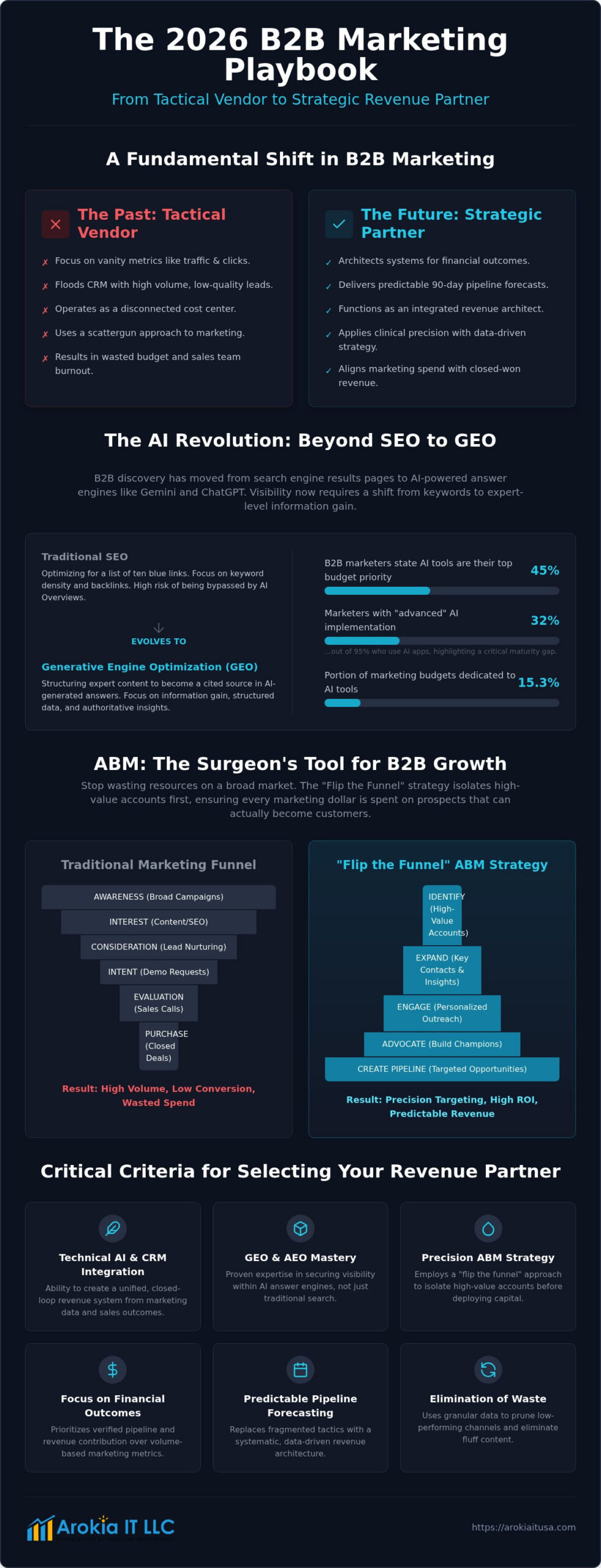
The tactical vendor is dead. In the high-stakes corporate environment of 2026, a modern abm marketing agency acts as a strategic revenue partner. They don’t just deliver clicks; they architect financial systems. Traditional models focused on volume, flooding sales teams with low-quality leads that rarely converted into revenue. Strategic models focus on outcomes. This fundamental shift requires a deep technical grasp of AI-driven search and Account-Based Marketing (ABM) to bridge the gap between marketing expenditure and closed-won revenue.
A revenue partner understands that marketing is a capital investment, not a sunk cost. While 95% of B2B marketers confirm their organizations use AI-powered applications, only 32% describe their implementation as advanced. This maturity gap is where modern agencies provide the most value. They replace the scattergun approach of the past with a clinical, data-driven methodology. With 45% of B2B marketers stating that AI tools are their top budget priority for 2026, technical depth in Generative Engine Optimization (GEO) and CRM integration is now a non-negotiable requirement for any agency partnership.
The Shift from Lead Gen to Demand Generation
Leads are a vanity metric if they don’t match your Ideal Customer Profile (ICP). A high volume of leads from companies that lack the budget or structural need for your solution is a liability that drains sales resources. Modern agencies prioritize demand generation to build long-term market authority. This involves two distinct motions: capturing existing demand from buyers currently in-market and creating new interest among those who aren’t yet looking. It’s about being the definitive choice before the RFP is even written. By focusing on the 5% of your market that is actively buying, while nurturing the 95% that isn’t, a strategic partner ensures a consistent flow of high-intent opportunities.
Eliminating Waste in the B2B Sales Cycle
The AI Revolution: Beyond B2B SEO to Generative Engine Optimization (GEO)
Traditional SEO is no longer the ceiling for digital discovery; it’s the floor. In 2026, enterprise B2B discovery happens within the answer engines. Appearing in a list of ten blue links is insufficient when decision-makers rely on platforms like Perplexity, Gemini, and ChatGPT to synthesize complex vendor landscapes. If your content isn’t structured for AI reasoning, your brand effectively disappears from the consideration set. A specialized abm marketing agency must transition from keyword density to Information Gain, providing unique, expert-led insights that AI models can’t find in generic, recycled datasets. This shift is critical because AI tools now account for 15.3% of total marketing budgets, reflecting a massive pivot toward automated synthesis over manual search.
AI search engines prioritize authoritative content that offers clear reasoning and verifiable data. Generic, AI-generated fluff is invisible to these systems because it provides zero information gain. To dominate AI Overviews, your strategy must move beyond surface-level blogs toward deeply technical white papers and case studies that solve granular business pains. AI models are trained to identify expertise, and they will only cite sources that provide substantive value to the user’s query.
AEO: Optimizing for the Executive’s AI Assistant
Answer Engine Optimization (AEO) targets the hyper-specific queries B2B executives pose to their AI assistants. These aren’t broad searches; they’re high-stakes requests for strategic validation and vendor comparison. The technical requirements for AI search optimization involve structured data, clear semantic relationships, and direct answers to complex procurement questions. By structuring content to be easily parsed by Large Language Models, you ensure your brand is the one recommended when an executive asks for a solution to a specific industrial or corporate challenge.
Establishing Topical Authority in High-Complexity Niches
In technical sectors, generic content is a liability that signals a lack of expertise. AI models identify authority by analyzing the depth and interconnectedness of your digital footprint across high-complexity topics. The relationship between B2B SEO and AI-driven credibility is now symbiotic, as traditional search signals still inform how AI engines weigh your reliability. Deep, technical content is the only way to secure a citation in a high-stakes AI response. GEO is the strategic alignment of content with AI reasoning patterns. If you’re ready to audit your current visibility against these new standards, you should connect with our strategy team to map your 2026 trajectory.
Account-Based Marketing (ABM): The Surgeon’s Tool for B2B Growth
Account-Based Marketing isn’t a tactic; it’s a fundamental strategic realignment. Most organizations waste a significant portion of their marketing budget on leads that never close because they don’t fit the Ideal Customer Profile. An elite abm marketing agency stops this financial hemorrhaging by “flipping the funnel.” Instead of casting a wide net and hoping for the best, you identify your highest-value prospects before a single campaign is launched. This allows for a concentrated allocation of resources where they’ll generate the most impact. It’s the difference between a floodlight and a laser.
Engaging modern buying committees requires a sophisticated multi-channel approach. You can’t rely on a single email sequence to move the needle. Effective ABM strategies engage every critical stakeholder simultaneously, from the CFO concerned with ROI to the technical lead focused on implementation. This parallel processing of objections is what collapses a 12-month sales cycle into six. It ensures that when your sales team finally enters the room, the market has already been educated on your specific value proposition.
The ABM and Sales Enablement Connection
Marketing must serve the sales team. If your marketing collateral doesn’t empower a salesperson to close a high-stakes deal, it’s failed. A strategic partner must deliver high-impact sales enablement content that addresses specific friction points in the buyer journey. A disciplined b2b sales enablement strategy ensures that marketing intelligence is translated directly into the tools and collateral your sales team needs to compress deal cycles and close high-value accounts. LinkedIn Marketing acts as a force multiplier in this process. It allows you to surround the buying committee with strategic authority, ensuring your brand stays top-of-mind throughout the procurement process. For a deeper analysis of the technical integration required, see our guide on AI in Account-Based Marketing: The 2026 Executive Guide to Revenue Precision.
Precision Targeting in Industrial Sectors
Industrial sectors demand a unique level of technical rigor. In industrial marketing, you’re communicating with engineers and procurement officers who are inherently skeptical of traditional marketing claims. They want data, specifications, and verifiable outcomes. ABM is the only way to penetrate these niche manufacturing and engineering firms effectively. Technical accuracy is your primary currency. One incorrect specification can destroy months of relationship building. Your agency must possess the technical depth to speak the language of your industry, or they’ll be ignored by the very people you’re trying to reach. For a comprehensive framework on how to build this precision at scale, our guide on digital marketing for industrial companies outlines the account-based model required to capture anonymous buyers in complex sectors.
Critical Selection Criteria for a B2B Marketing Firm
Selecting an abm marketing agency is a high-stakes decision that requires a clinical evaluation of their strategic architecture. You aren’t just hiring a service provider; you’re selecting a partner for financial growth. A primary requirement is an agency’s mastery of the closed-loop revenue model. If they can’t demonstrate exactly how their activities map to closed-won revenue, they’re a cost center, not an asset. Demand transparency in data and the total elimination of “black box” reporting that obscures actual performance behind vanity metrics.
Expertise in complex B2B or industrial niches is non-negotiable. Generalist agencies often fail because they don’t understand the technical nuances of your product or the skeptical mindset of your buyers. Look for “Sales-First” thinking. A competent agency won’t write a single word of content before they’ve interviewed your sales representatives to understand the granular objections they face daily. This alignment ensures that marketing collateral acts as a genuine tool for b2b sales enablement strategy rather than just digital filler. Equally important is ensuring your outreach infrastructure is built for precision; deploying strategic B2B sales email templates engineered for high-stakes pipeline growth ensures your messaging reaches decision-makers without damaging your domain’s sender reputation.
The 90-Day Pipeline Forecast: A Non-Negotiable Requirement
A strategic partner should be able to forecast the revenue impact of their campaigns within a single quarter. This isn’t about guessing; it’s about using historical data and market analysis to provide a pipeline forecast that holds the agency accountable to business growth. Valid forecasting requires a deep integration with your CRM to track account progression from initial engagement to final signature. This metric shifts the conversation from clicks and impressions to the only number that matters: predictable revenue. To ensure your forecasting is powered by the right technology, evaluating the top revenue intelligence platforms for B2B sales is a critical step in building a data-driven pipeline architecture.
Vetting for Technical and AI Proficiency
Distinguish between agencies using AI for volume and those using it for precision. Vetting for technical proficiency requires asking pointed questions about their AI search strategy.
- How do you ensure our content is cited by AI agents like Perplexity?
- What structured data protocols do you implement for complex industrial products?
- How does your approach to semantic search differ from traditional SEO?
This level of technical depth requires website development that prioritizes search architecture over aesthetic flourishes. If an agency can’t explain how they optimize for AI reasoning patterns, they’re obsolete.
Conclusion: Moving Toward Predictable B2B Revenue
The transition from tactical lead generation to a comprehensive revenue architecture is the definitive requirement for market dominance. In 2026, the twin pillars of AI-driven search and account-based strategies are no longer optional; they are the baseline for organizational stability. A dedicated abm marketing agency provides the clinical precision needed to bridge the gap between marketing expenditure and realized profit. This shift requires a departure from legacy metrics in favor of a results-oriented partnership that treats marketing as a high-stakes financial investment. By prioritizing outcomes over activity, you secure a competitive advantage that is both measurable and scalable.
Moving toward predictable revenue involves a rigorous rejection of marketing waste. If your current strategy relies on generic content and unverified lead volume, you are likely funding a cost center rather than a growth engine. The path forward requires a systematic alignment of your digital authority with the reasoning patterns of modern search engines and the specific requirements of your sales team.
Next Steps: Auditing Your Current Strategy
Identifying whether your current provider is a growth asset requires an objective assessment of their strategic depth. If they cannot provide a verified correlation between their campaigns and your open opportunities, their model is obsolete. To gauge your current standing, ask your marketing team to demonstrate how they are currently optimizing for AI agents like Perplexity and Gemini. If the answers are surface-level, your organization is at risk of digital invisibility. We invite you to use the AI Scorecard to establish a baseline assessment of your current strategic alignment and technical readiness for 2026 standards.
Partnering for High-Stakes Growth
A strategic partnership built for high-stakes growth focuses on the immediate elimination of friction in the sales cycle. During the first 90 days, the priority is to prune low-performing channels and deploy sales enablement content that addresses granular buyer objections. This disciplined approach builds the foundation for long-term demand generation in complex industrial and corporate sectors. The objective is to create a self-sustaining revenue engine that provides total oversight of the customer lifecycle. To initiate a clinical discussion regarding your specific revenue targets and strategic trajectory, Contact Arokia IT LLC to discuss your 90-day forecast.
Securing Your Revenue Architecture for 2026
The transition from broad lead generation to precision account targeting isn’t just a trend; it’s a structural necessity for firms operating in high-stakes B2B markets. Traditional volume-based models fail to deliver sales-qualified opportunities. A modern abm marketing agency replaces these inefficiencies with a clinical focus on Generative Engine Optimization and 90-day pipeline forecasting. By prioritizing technical accuracy and sales alignment, you transform marketing from a cost center into a predictable engine for financial growth. This evolution requires moving beyond legacy SEO to master the nuances of AI-driven authority and industrial-scale demand generation.
Establishing market dominance in an AI-driven landscape requires a partner who understands the granular pains of your sales process. When you align your strategy with the reasoning patterns of modern search and the specific needs of your buying committee, you secure a significant competitive advantage. Success in 2026 belongs to the leaders who demand accountability and precision in every campaign. We’re ready to help you architect that future.
Frequently Asked Questions
What is the difference between a B2B marketing agency and a lead generation company?
A lead generation company typically focuses on high-volume, tactical outreach to secure contact information, often ignoring the quality or intent of the lead. Conversely, a strategic B2B marketing partner architects a comprehensive revenue system. They prioritize demand generation and account-based strategies that align with your sales team’s specific requirements. This approach ensures that every engagement is designed to result in closed-won revenue rather than just a bloated list of uninterested contacts.
How much should a mid-market B2B company spend on a marketing agency?
Budget allocations for a mid-market partnership vary based on the complexity of your sales cycle and the number of target accounts you intend to penetrate. It’s essential to view this as a strategic investment in growth rather than a fixed overhead cost. You should evaluate potential partners based on the projected revenue impact and the depth of their technical integration. A results-oriented firm will help you calculate a spend that minimizes waste while maximizing your presence in high-value accounts.
Why is Generative Engine Optimization (GEO) important for B2B brands in 2026?
Generative Engine Optimization is critical because decision-makers now use AI assistants like Gemini and Perplexity to synthesize vendor information. If your content isn’t optimized for these engines, your brand will be excluded from AI-generated answers. GEO ensures your proprietary insights and technical expertise are cited directly within the AI’s response. This visibility establishes immediate authority during the early stages of the executive research process, long before a formal RFP is issued.
Can a B2B marketing agency help shorten our sales cycle?
A specialized abm marketing agency shortens cycles by engaging the entire buying committee simultaneously. Instead of waiting for a single lead to champion your solution, you surround every stakeholder with authoritative sales enablement content. This parallel engagement addresses technical, financial, and operational objections at once. By the time your sales team begins formal negotiations, the internal consensus has already been built, removing the friction that typically stalls high-stakes B2B deals.
What is a 90-day pipeline forecast and why does it matter?
A 90-day pipeline forecast provides a clinical projection of the revenue impact expected from your marketing activities within one quarter. It matters because it shifts agency accountability from vanity metrics to tangible business growth. This forecast relies on deep CRM integration and historical data to predict how accounts will move through your sales funnel. It provides the predictability executive leadership requires to make informed decisions about scaling their market presence and resource allocation.
Does ABM work for smaller industrial companies or only for enterprises?
ABM is exceptionally effective for smaller industrial companies because it allows for surgical precision with limited resources. You don’t need an enterprise-scale budget to dominate a niche manufacturing or engineering sector. By identifying a handful of high-value accounts and delivering hyper-personalized technical content, you can outperform larger competitors who rely on broad, generic outreach. Precision targeting ensures that every dollar of your marketing spend is directed at accounts with the highest propensity to buy.
How do I measure the ROI of a B2B marketing agency partnership?
ROI should be measured by the increase in pipeline velocity and the percentage of target accounts converted into closed-won revenue. You must move beyond surface-level metrics like clicks or impressions. A successful partnership is validated by the quality of the opportunities generated and the degree of alignment between marketing campaigns and sales requirements. Clinical data management and transparent reporting allow you to track the exact financial return on every strategic initiative deployed.
What are the first signs that a B2B agency is not delivering strategic value?
The primary sign of a failing partnership is a persistent focus on vanity metrics like lead volume without corresponding sales conversions. If your agency doesn’t interview your sales representatives or fails to understand your technical product nuances, they aren’t providing strategic value. Generic content that provides zero information gain is another red flag. An effective abm marketing agency must act as a consultant for your revenue architecture, not just a tactical vendor for digital filler.