
Robotics marketing works when it connects a machine’s capabilities to the production problems buyers need to solve. A marketing plan for industrial robotics company growth should explain how automation could support business priorities, then reach the people who evaluate, approve, and implement a solution.
That takes coordination. Engineers may focus on technical capabilities, while operations leaders want to understand the effect on a specific workflow. Marketing and sales may pursue different accounts or define qualified leads differently. And when a buying decision involves several stakeholders, it can be difficult to tell which activities are helping an account move forward.
A practical plan connects application priorities, target accounts, buyer needs, campaigns, and sales follow-up. This article explains how to assess account fit, match messages and proof to different stakeholders, coordinate campaign handoffs, and measure progress through engagement and pipeline indicators. The aim is to focus marketing on relevant buyers and make it easier to see where account conversations are gaining or losing momentum.
Key Takeaways
- Build a marketing plan for industrial robotics company growth around production needs and business outcomes, not machine features alone.
- Prioritize applications and accounts by comparing company fit with evidence of relevant processes, facilities, and automation needs.
- Match technical proof and campaign channels to each stakeholder’s questions and stage in the buying process.
- Set campaign owners and handoff expectations before launch so sales follow-up is coordinated and accountable.
- Track account engagement separately from qualified opportunities to understand progress across a long buying cycle.
What an Industrial Robotics Marketing Plan Must Accomplish
A marketing plan for industrial robotics company growth should guide four connected decisions: which applications and markets to pursue, which operational problems the company can address, how to reach the people involved in a purchase, and what sales should do when an account shows interest. It is a revenue-focused operating plan, not just a publishing calendar or channel list.
That distinction matters in a technical market. A catalog can describe payload, reach, sensors, or programming options, but those features alone may not explain why a plant manager should evaluate a solution. A useful plan connects capabilities to relevant operational priorities, such as improving consistency in a repetitive workflow, addressing a difficult-to-staff task, or adding inspection to a production process. The right priorities depend on the company’s products, target markets, integration model, and sales process, so there is no universal campaign sequence for every robotics business.
The plan also needs to connect strategy with execution. Marketing develops relevant messages and campaigns; sales shares account context and follows up on buying signals; technical subject-matter experts validate application claims and explain feasibility. A focused industrial marketing strategy can help organize these responsibilities around the markets and buyers the business intends to reach.
Why industrial robotics needs application-led positioning
The same robot capability can support different workflows, each with its own requirements and stakeholders. Material handling may involve moving parts between production steps. Machine tending may involve loading and unloading equipment. Assembly and inspection raise different process questions and require different measures of success. These applications should not be treated as interchangeable messages.
Lead with the production challenge, then explain how the technology may address it. Machine vision, for example, becomes more relevant when the content describes a particular inspection task. Flexibility matters when a buyer needs a system that can support changing workflows. For a foundational overview of the technology and its uses, see Industrial Robot. Application-led positioning gives each buying group a clearer reason to keep evaluating the solution.
What a useful plan should help the business decide
A practical plan helps leadership make tradeoffs. Start by identifying applications where the company’s capabilities and delivery model match an operational need. Next, define account criteria using both firmographic factors and operational evidence, such as relevant processes, facilities, or automation requirements. Then map the people who may influence the decision, from operations and engineering to finance and procurement.
Set roles for marketing, sales, and technical reviewers before campaigns launch. Agree on what counts as meaningful account engagement, when sales takes ownership, and what information a qualified opportunity must include. Clicks, downloads, and meetings can provide context, but they do not show account progress by themselves. Look for movement from initial interest to a qualified opportunity and a clearly recorded pipeline stage.
How to Prioritize Robotics Markets, Accounts, and Buying Committees
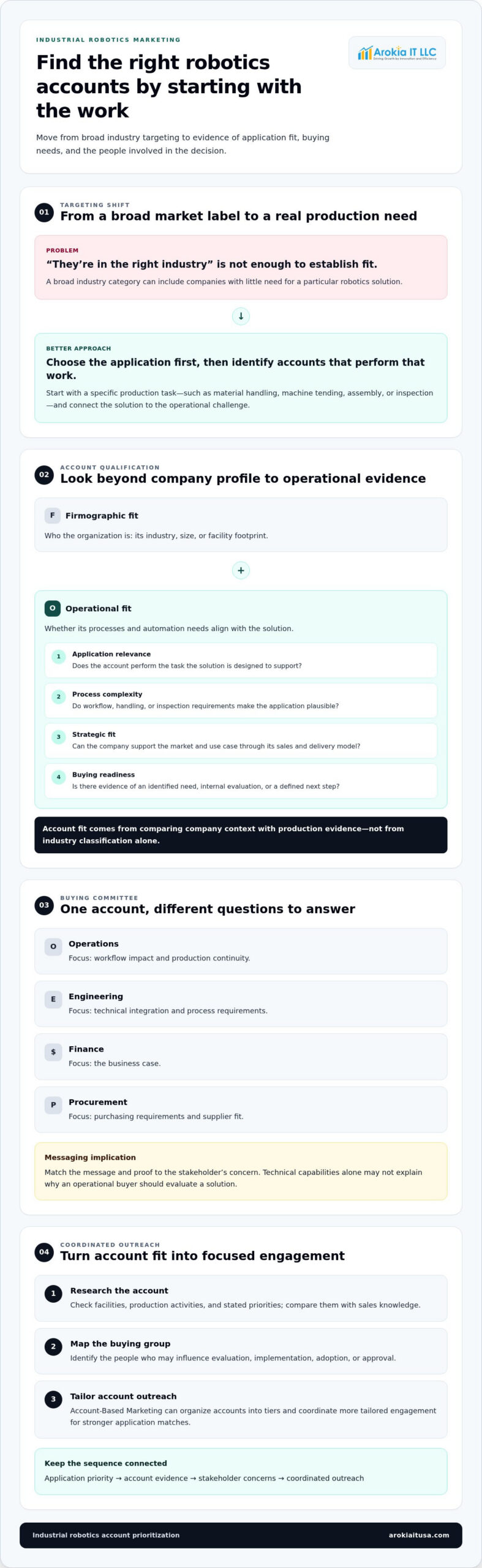
Prioritize in sequence: choose applications, define account-fit criteria, map the buying committee, and focus outreach. Starting with a broad industry label can spread resources across companies that have little need for a particular robotics solution. Starting with an application gives marketing and sales a more useful basis for deciding which accounts warrant attention.
Define the ideal account around operational fit
Separate firmographic fit from operational fit. Firmographics describe an organization, including its industry, size, or facility footprint. Operational fit asks whether its processes and automation needs align with the solution.
Assess prospective accounts against practical criteria:
- Application relevance: Does the account perform the type of task the solution is designed to support?
- Process complexity: Do workflow, handling, or inspection requirements make the application a plausible fit?
- Strategic fit: Does the account match the markets and use cases the company can support through its sales and delivery model?
- Buying readiness: Is there evidence of an identified need, internal evaluation, or a defined next step?
An industry category alone does not establish fit. Research the company’s facilities, production activities, and stated priorities, then compare those signals with what sales has learned in conversations. Industry resources such as the International Federation of Robotics can provide context, but they do not replace account-level evidence or internal sales knowledge. Account-Based Marketing (ABM) can turn these criteria into account tiers and coordinated outreach, with more tailored engagement for the accounts that best match the chosen applications.
Map the robotics buying committee and its concerns
Robotics purchases rarely involve just one decision-maker. Operations leaders may focus on workflow impact and production continuity. Engineering teams may examine technical integration and process requirements. Finance may assess the business case, while procurement may review purchasing requirements and supplier fit. Other stakeholders may influence implementation, adoption, or approval.
Connect each concern to relevant proof. An operations leader may need application-specific content. Engineering may need technical detail reviewed by a subject-matter expert. Finance may need a clear explanation of the assumptions behind a proposed business case. Sales enablement materials should help the sales team respond consistently without treating every stakeholder as if they share the same priorities.
Use the CRM to record account relationships, stakeholder roles, engagement history, open questions, and follow-up ownership. Sales feedback can also improve account tiers. Repeated technical barriers may point to a poor-fit segment, while recurring operational needs may indicate a stronger application. Arokia IT’s Account-Based Marketing and demand generation services help B2B companies organize account focus and coordinated outreach.
How to Compare Robotics Messages, Channels, and Proof
Technical detail builds confidence, but rarely makes the case on its own. A strong marketing plan for industrial robotics company growth connects product features to an application-specific message, then selects channels and proof that help buyers evaluate the fit.
Match the message to the stakeholder and buying stage
Early-stage content should help buyers recognize and understand an application. As evaluation advances, buyers need more specific evidence and clear answers to implementation questions. Match the information to each person’s role:
- Operations leaders: Explain the production challenge and intended operational outcome. Do not promise improvements unless the claim is documented and approved.
- Engineering teams: Provide accurate technical information about system capabilities, integration considerations, and application fit. Identify assumptions or limitations rather than implying every environment is the same.
- Finance and procurement: Offer decision-support materials that clarify the proposed scope, business-case assumptions, purchasing considerations, and evaluation criteria without making unsupported claims.
Choose channels for account progression, not activity volume
Each channel should help buyers understand an application or help sales move a conversation forward. LinkedIn can support targeted visibility among relevant professional audiences and give sales a context for thoughtful engagement. Search and educational content can answer technical questions buyers research independently. Email can deliver relevant material to known contacts over time. Sales conversations can surface account-specific requirements that broad content cannot resolve.
Measure whether the right stakeholders engage and take a meaningful next step, not just how much content the team publishes. A technical article that answers a real integration question may support an account more than a high-volume campaign that attracts unqualified attention. Arokia IT’s industrial marketing services connect audience, message, and channel decisions to a focused B2B strategy.
How to Turn the Plan into Coordinated Campaigns
A strategy only supports pipeline when teams can execute it consistently. Before launch, a marketing plan for industrial robotics company growth should define the application, target accounts, buyer message, campaign steps, and sales handoff. That sequence keeps outreach relevant and makes ownership clear.
Build a practical campaign sequence
Start with one defined application, a specific audience, a selected account group, and a business objective. For example, a campaign focused on machine tending could educate operations and engineering contacts about the application, then invite interested accounts to discuss their workflow. Begin with useful information, rather than an immediate request for a high-commitment sales meeting.
A staged campaign could move through these steps:
- Prepare: Confirm account criteria, stakeholder roles, core message, technical review, and the campaign’s intended outcome.
- Educate: Share application content that answers a relevant operational or technical question.
- Engage: Use targeted email, LinkedIn, search content, or sales outreach to give interested stakeholders a relevant next step.
- Respond: Route meaningful engagement or a direct question to the assigned sales owner, with the account history and content interaction recorded in the CRM.
- Adjust: Continue relevant education when an account is not ready. Reassess timing or fit when engagement remains inactive.
Set response expectations before launch. Define what qualifies for sales follow-up, who owns it, what context marketing passes along, and how the outcome is recorded. A coordinated demand generation strategy connects campaign activity to qualification and follow-up decisions.
Equip sales with content and account context
Sales should not have to reconstruct the campaign or improvise technical explanations. Prepare concise application summaries, stakeholder-specific materials, and discovery prompts that help uncover the account’s workflow, constraints, decision process, and open questions. Technical subject-matter experts should review claims and materials for accuracy. Marketing should maintain consistent messaging, while sales applies account context and owns agreed follow-up.
Use shared CRM processes to capture campaign engagement, relevant account research, stakeholder interactions, next steps, and ownership. This record helps prevent representatives from sending conflicting messages or repeating questions the buyer has already answered. After launch, marketing and sales can review where accounts progressed, where follow-up stalled, and which questions need better content.
How to Measure and Improve an Industrial Robotics Marketing Plan
Measure progress in stages. A marketing plan for industrial robotics company growth should show whether priority accounts are engaging, whether sales is having relevant conversations, and whether qualified opportunities are advancing. No single metric tells the full story when several stakeholders and channels shape a buying journey.
Choose indicators that reflect account progression
Separate leading indicators from later-stage indicators. Leading indicators show whether target accounts and relevant buying roles are engaging with useful content. Later indicators show whether that engagement is becoming a sales-accepted conversation, a qualified opportunity, or movement to another pipeline stage. Clicks or downloads alone do not establish buying intent.
- Engagement: Which priority accounts and stakeholder roles interact with campaign content?
- Sales response: Does sales accept the account for follow-up, and does a meaningful conversation take place?
- Pipeline progression: Are qualified opportunities being created or advancing through agreed stages?
- Qualitative feedback: What do sales and technical teams hear about application fit, objections, and decision progress?
Use review cycles to refine the plan
Define shared terms before reporting begins. Specify what counts as an engaged account, a qualified opportunity, a completed handoff, and movement between pipeline stages. Then review results by application, account group, stakeholder engagement, and campaign objective. This makes it easier to identify whether weak performance stems from the audience, message, content, or follow-up process.
Use recurring reviews to compare results with the plan’s original assumptions. If a message attracts attention but does not prompt relevant conversations, refine it before expanding distribution. If accounts engage but sales follow-up stalls, address ownership or response expectations before increasing campaign volume.
Treat attribution as evidence, not certainty. A robotics buying committee may encounter search content, LinkedIn posts, email, and sales outreach at different points. Record meaningful touchpoints and pipeline movement, but do not attribute a complex decision to one campaign without sufficient evidence. Pair CRM data with sales feedback to understand marketing’s contribution.
Arokia IT’s 90-Day Pipeline Forecast supports near-term pipeline visibility and planning. It is a planning input, not a guarantee of future outcomes. The practical test is whether the forecast and review process help teams make better decisions about accounts, campaigns, and follow-up.
Turn Robotics Marketing Strategy into Pipeline Discipline
A strong marketing plan for industrial robotics company growth turns technical expertise into a clear path from target application to qualified opportunity. Focus on accounts with operational fit, give each stakeholder useful information, and make marketing and sales accountable for coordinated follow-up.
Progress depends on more than campaign activity. Teams need shared definitions for engagement, qualification, handoff, and pipeline stages, followed by regular reviews that reveal where account momentum is building or stalling. This gives teams a practical basis for adjusting priorities without overstating the contribution of any single campaign.
Arokia IT brings together Account-Based Marketing and demand generation with sales enablement content, AI Search and Generative Engine Optimization (GEO), and a 90-Day Pipeline Forecast. These offerings help industrial robotics companies connect account focus, buyer education, and near-term pipeline planning in a coordinated strategy.
With clear priorities and shared accountability, your team can make marketing decisions more deliberately and see where to focus next.
Frequently Asked Questions
What should a marketing plan for an industrial robotics company include?
A marketing plan for an industrial robotics company should connect priority applications and accounts with buyer needs, messaging, campaigns, sales follow-up, and pipeline measurement. Define how the company will explain operational value, what proof supports its claims, and how marketing and sales will qualify and advance account conversations. The plan should reflect the company’s products, target markets, technical expertise, and sales process rather than rely on a generic channel checklist.
How do you identify the right target accounts for industrial robotics marketing?
Assess both firmographic fit and operational fit. Industry, company size, or facility footprint can help narrow the field, but they do not prove that a company has a relevant automation need. Look for alignment between the account’s processes and the robotics application, evidence of a suitable workflow, strategic fit, and signs of buying readiness. Combine company research with sales knowledge, then rank accounts by how well they match those criteria.
Who is involved in buying industrial robotics solutions?
Buying committees often include operations leaders, engineering teams, finance, and procurement, although roles vary by company and project. Operations may focus on workflow and production priorities; engineering may evaluate technical fit and integration questions; finance may assess business-case assumptions; and procurement may manage purchasing requirements. Marketing and sales should prepare relevant information for each role, while technical subject-matter experts help keep application explanations and supporting claims accurate.
Which marketing channels work best for industrial robotics companies?
The most useful channels depend on the target accounts, buyer roles, and stage of evaluation. Search and educational content can address technical questions buyers research independently. LinkedIn can support targeted visibility and professional engagement, while email can deliver relevant information to known contacts. Sales conversations help clarify account-specific requirements. Coordinate channels around buyer progression, and assess whether they engage relevant accounts rather than judging success by publishing volume or clicks alone.
How can industrial robotics companies explain ROI without making unsupported claims?
Explain the method behind the business case, not an unverified result. State the operational problem, identify the assumptions used in the analysis, and distinguish customer-specific estimates from documented performance evidence. If discussing productivity, labor, quality, or safety outcomes, use supportable data and explain the conditions it applies to. Have technical and commercial stakeholders review examples and claims before publication, and avoid presenting one application’s result as typical of every deployment.
How should marketing and sales coordinate robotics campaigns?
Marketing and sales should agree on target accounts, campaign messages, qualification criteria, handoff triggers, follow-up ownership, and CRM documentation before launch. Marketing can share account research and engagement context; sales can add conversation insights and confirm whether an account merits follow-up. Set clear response expectations and record outcomes consistently. Regular reviews help teams identify whether a campaign needs a message adjustment, better sales enablement, or a change in account prioritization.
Which KPIs should an industrial robotics marketing plan track?
Track leading indicators and pipeline outcomes separately. Leading indicators include engagement from priority accounts and relevant stakeholder roles. Later indicators can include sales acceptance, meaningful conversations, qualified opportunities, and movement through agreed pipeline stages. Review results by application, account group, stakeholder, and campaign objective, then pair CRM data with sales feedback about fit, objections, and decision progress. Multiple channels and stakeholders influence complex purchases, so avoid treating single-touch attribution as definitive.