
What if the account with the biggest name is the wrong one to pursue first? For small B2B companies, account prioritization is about deciding where limited sales time can make the greatest difference, not building a perfect scoring model. When potential accounts outnumber your team’s capacity, unclear criteria can waste effort and widen the gap between sales and marketing.
You don’t need a large data stack to make better choices. Start with what your team already knows: how closely an account fits your offer, what evidence suggests it may be ready to buy, and whether you can realistically reach and serve it. This checklist shows how to assess those factors, group accounts into clear tiers, and match your attention to each tier.
You’ll also learn how to revisit rankings as new buying signals emerge, so priorities reflect current evidence rather than an outdated list. The result is a repeatable foundation for focused account-based marketing, with sales and marketing working from the same rules.
Key Takeaways
- Separate account selection from prioritization: first identify qualified prospects, then decide which deserve attention now.
- Use account prioritization for small B2B companies to weigh fit, buying evidence, and your team’s ability to serve each account.
- Build tiers around the research and outreach your team can sustain, not assumptions about an account’s permanent potential.
- Start with CRM records and first-party knowledge, then document decisions so sales and marketing can apply consistent criteria.
- Translate each tier into a focused ABM plan, and use sales feedback to refine the rules without turning every exception into a new standard.
What account prioritization means for a small B2B company
Account prioritization is the decision about which qualified companies should receive attention first and how much effort each deserves. It comes after you build an initial target-account list. The list defines who could plausibly buy; prioritization sets the order for research, outreach, and follow-up based on current fit, evidence, and available capacity.
That distinction matters. A company can match your ideal customer profile without being the best use of sales time this week. A regional manufacturer may fit your offering but show no relevant business need or reachable buying contact. Another account may have a clear operational challenge and a recent inquiry. Prioritization helps your team act on that difference instead of treating every name in a spreadsheet as equally urgent.
For small teams, prioritization is an operating decision, not a forecasting guarantee. A ranking helps allocate limited research and outreach time; it cannot establish whether or when an account will buy. Account prioritization for small B2B companies should make tradeoffs visible and revisable, not disguise uncertainty behind a precise-looking score. That discipline supports focused account-based marketing, where effort centers on selected companies rather than broad, undifferentiated outreach. The broader Account-based marketing model provides useful context for why account-level focus matters.
How account prioritization differs from lead scoring
Account prioritization compares companies. Lead scoring typically evaluates an individual contact’s profile or activity, such as viewing a product page or replying to an email. These signals answer different questions: account evidence can indicate whether a company fits and has a relevant need, while contact activity can suggest who is engaging and what follow-up may be appropriate. An active contact alone doesn’t establish that the account is a priority. Confirm the company-level fit and context before committing substantial effort.
Why small B2B teams need a usable ranking
An unrestricted list can spread attention across too many accounts. A lightweight, shared method gives sales and marketing a common basis for choosing where to spend time. It’s more actionable than a complex scoring system that depends on data your team doesn’t have or can’t maintain. Start with a few agreed criteria, then refine them as you learn which evidence helps the team make better decisions.
Hypothetical example: A small industrial software company has eight plausible prospects and limited time for customized research. One account fits its target industry but has no known project or engaged contact. Another fits and has raised a specific production-planning challenge in a sales conversation. The second account may merit earlier follow-up, while the first stays on the target list for later review. Neither assignment predicts a sale; it simply directs effort toward the stronger current case.
Keep the ranking useful by documenting the reason for each decision. If sales learns about a new project or marketing identifies relevant engagement, the team can reassess the account using the same criteria. This makes exceptions discussable without letting one contact’s activity or one person’s preference redefine the entire target list.
Use a fit-and-evidence checklist to rank B2B accounts
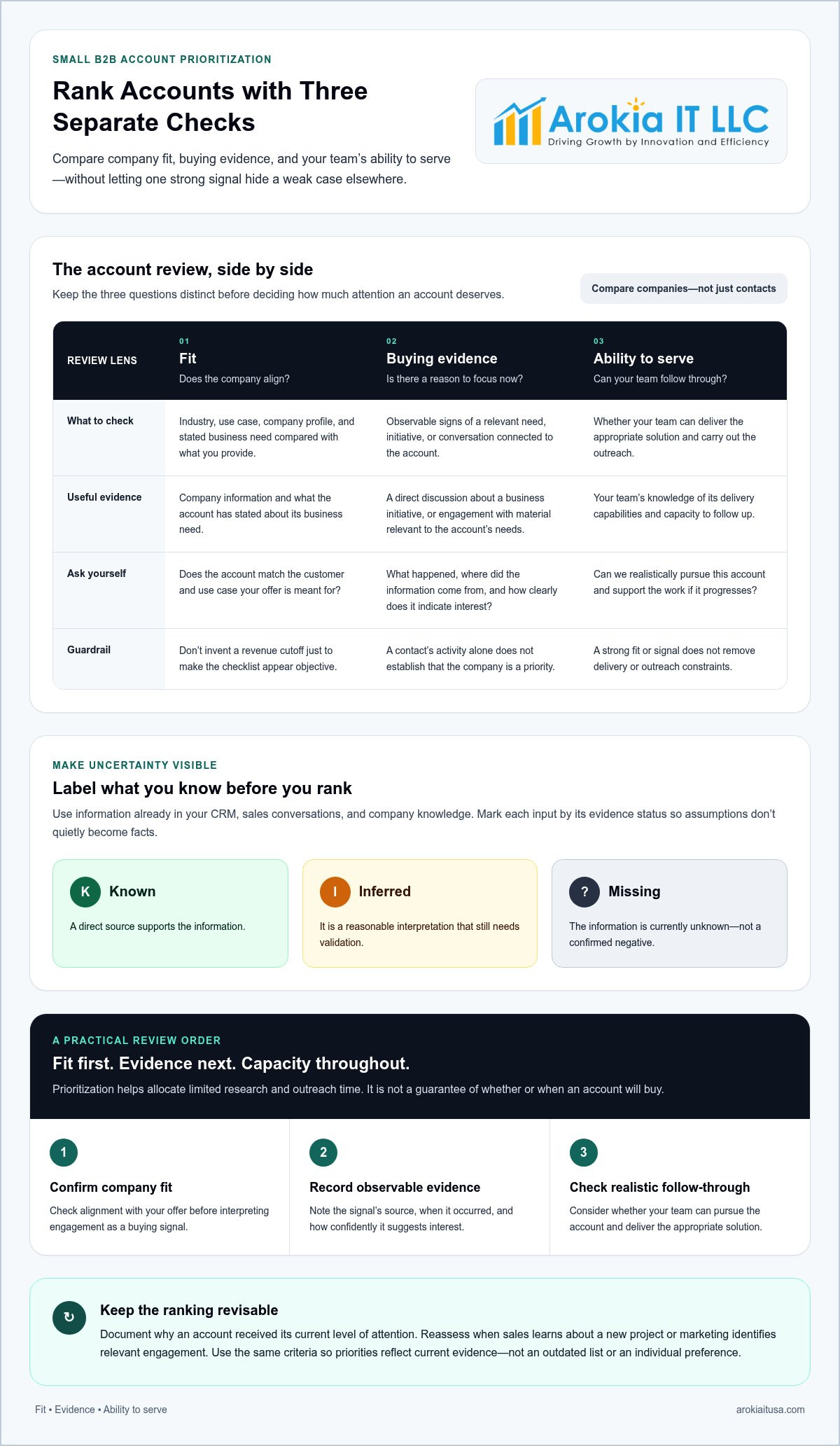
A useful account checklist separates three questions: Does the company fit? Is there evidence of a relevant need or initiative? Can your team serve and pursue it effectively? Keeping these questions distinct prevents a strong signal in one area, such as a contact’s website activity, from masking a poor fit or a delivery constraint.
For account prioritization for small B2B companies, the checklist doesn’t need complex software or a long list of fields. Start with information already available in your CRM, sales conversations, and company knowledge. For each input, label it known, inferred, or missing. A known item has a direct source; an inferred item is a reasonable interpretation that needs validation; a missing item is simply unknown. This makes uncertainty visible instead of turning assumptions into facts.
Check fit before interpreting buying signals
First compare the account’s industry, use case, company profile, and stated business need with what your company provides. Then consider whether the opportunity is strategically relevant and whether your team can support the work. Don’t invent a revenue cutoff just to make the checklist look objective. A highly engaged contact at a company with an incompatible need may warrant a courteous response, but not priority account-level investment.
Use timing and evidence without false precision
Buying evidence helps determine whether a well-fitting account deserves attention now. Record observable signals, such as a direct conversation about a business initiative or engagement with material relevant to the account’s needs. For each signal, note its source, when it occurred, and how confidently it indicates interest. HG Insights’ Account Prioritization Methodology also explores fit, need, and intent as components of account evaluation. A small team can apply those ideas with a simple evidence log.
- Fit: Do the industry, use case, company profile, and business need align with your offer?
- Evidence: What observable signal suggests a relevant need, initiative, or conversation?
- Ability to serve: Can your team deliver the appropriate solution and follow through on outreach?
- Evidence quality: Is each input known, inferred, or missing, and can you record its source and recency?
For example, a software company evaluating a potential distributor might know the distributor serves its target market, infer a possible need from public materials, and have no direct evidence of an active buying initiative. Those entries are not equivalent. The account may fit, but the next step could be targeted research or a relevant conversation, not a high-touch campaign based on assumed readiness.
A single click or third-party intent indicator should prompt investigation, not be treated as a buying commitment. Use the checklist to guide the next action, then revisit it when stronger evidence appears. To discuss a shared process for translating account evidence into coordinated B2B marketing priorities, connect with Arokia IT LLC.
Create account tiers that match your team’s capacity
Account tiers translate a ranking into a resource decision: how much research, personalization, and sales attention an account receives. They are not permanent verdicts on an account’s potential. A good-fit prospect with little timing evidence may belong in a nurture track today and become a high-priority account when a relevant initiative surfaces.
Keep the structure simple. The tier names matter less than clear rules for effort and movement. Demand Spring’s Account Prioritization Glossary describes prioritization as a way to focus attention across accounts. A small team can make that decision operational by connecting each tier to work it can actually complete.
Highest priority
Fit: Strong alignment with your target profile and solution.
Evidence: Meaningful, current indication of a relevant need or initiative.
Effort: Focused research, tailored outreach, and coordinated sales and marketing follow-up.
Develop
Fit: Good alignment, but one or more important details may be uncertain.
Evidence: Limited or indirect timing signals.
Effort: Repeatable, relevant outreach and selective research, with a defined reason to check back.
Monitor or deprioritize
Fit: Weak alignment, or an important mismatch with your offer or delivery capacity.
Evidence: No meaningful current signal, or engagement that does not establish account-level relevance.
Effort: Minimal active sales time; document the reason and a trigger for reconsideration.
What different account tiers should mean in practice
Reserve high-touch work for accounts where strong fit and meaningful evidence coincide. For a good-fit oil and gas company without a clear project signal, use structured, lower-effort engagement rather than starting with custom research. If an account is a poor fit, record the mismatch and a practical revisit trigger, such as a changed use case or new business need. This keeps tier decisions explainable and actionable.
Balance account potential with ability to serve
Potential matters, but so does execution capacity. Before assigning high-touch attention, consider sales coverage, the complexity of the buying process, and whether your team can support the account’s needs. A medical equipment manufacturer may merit deeper engagement if its requirements match your capabilities; a software prospect requiring unsupported delivery may not. Tiers should reflect both opportunity and operational fit.
Set tier sizes according to the time your team can consistently devote to account work, not a universal account count or borrowed budget split. If personalized research is consuming time needed for follow-up, narrow the highest-priority group. The right size is the number your team can work with consistently, not the number that makes a target list look ambitious.
Apply this account-prioritization checklist with limited data
A repeatable process doesn’t require a complete database. It requires consistent criteria, a clear record of what the team knows, and an owner for updating decisions. Start with first-party information already in your CRM and sales conversations. Add outside research only when it can resolve a specific question that affects an account’s priority.
Run the checklist using the data already available
Review the account record, sales notes, and direct interactions before researching elsewhere. Separate verified facts from a salesperson’s interpretation, and label each input as known, inferred, or missing. Record why the account received its current priority and what evidence would change that decision. This preserves useful context and prevents an assumption from quietly becoming a team-wide fact.
- Agree on the decision criteria. Sales and marketing define what counts as fit, meaningful buying evidence, ability to serve, and disqualification. Make each definition specific enough that two people can apply it consistently.
- Review existing records. Check CRM fields, prior conversations, sales notes, and relevant first-party engagement. Capture the source and date where available rather than treating every record as equally current.
- Mark confidence and gaps. Label each relevant detail known, inferred, or missing. Don’t fill a blank with a guess. If an unknown could change the decision, write down the question to investigate.
- Assign an initial priority. Apply the shared criteria and note the reason in plain language. For example, “fits target use case; project timing not established” is more useful than an unexplained score.
- Name the owner and next action. Assign one person to pursue the next step, such as validating a stated initiative or maintaining a nurture touch. Define what update they should record after the interaction.
- Set a review point. Revisit the account when new evidence appears, capacity changes, or the team’s regular review arrives. Match the cadence to the sales cycle and workload instead of imposing an arbitrary schedule.
Keep sales and marketing aligned on priority changes
Use shared definitions for fit, evidence, tier, and disqualification so each team understands what a priority label requires. A brief recurring review can surface new buying evidence, stale assumptions, and shifts in sales or marketing capacity. Change a tier when the evidence or ability to act changes, and record the reason so the decision remains transparent.
A simple review log can include the account, current tier, evidence and confidence, decision owner, next action, and revisit trigger. For a manufacturing prospect, a sales note about a planned production initiative may support a priority change; a vague impression that the company “seems interested” should prompt validation, not automatic escalation. This lightweight record keeps decisions usable without requiring a complex scoring platform.
Use the process to build coordinated account-based marketing: sales validates account context while marketing aligns research and engagement with the agreed priority. If a decision is disputed, return to the recorded evidence and criteria. Don’t create a new rule for every exception; adjust shared definitions only when the same gap repeatedly affects decisions.
Turn account priorities into a focused ABM plan
A priority label only creates value when it changes what sales and marketing do next. Use each tier to set the depth of account research, the intensity of outreach, and the relevance of the content. This turns account prioritization into an execution guide, not another spreadsheet detached from the pipeline.
Connect account tiers to coordinated engagement
For a strong-fit account with credible evidence of a current initiative, sales can research the business context and relevant stakeholders while marketing prepares useful materials aligned with that context. For a good-fit account with unclear timing, use relevant content and measured follow-up rather than immediate high-touch pursuit. A weak-fit account may receive broad demand-generation activity or no active attention until new evidence changes the case.
- Highest priority: Research the account’s business context, coordinate direct sales outreach with relevant marketing content, and capture feedback from each interaction.
- Develop: Share useful content tied to the likely use case, maintain consistent follow-up, and watch for evidence that justifies deeper personalization.
- Monitor: Avoid custom work without a clear reason. Keep the account in an appropriate nurture or demand-generation path, with a defined signal for reconsideration.
For example, if a manufacturer has discussed a specific production challenge, sales can use that context in its next conversation while marketing supports the discussion with relevant educational content. The goal is a consistent, useful experience, not identical messages sent through every channel.
Use sales feedback to refine the rules
Sales feedback should improve the criteria, not make every exception a new rule. Record what happened, which assumption proved wrong, and whether the same issue appears across other accounts. A single unusual deal may call for an individual adjustment; a recurring mismatch between the target profile and qualified opportunities may justify revisiting the profile or evidence standard. Keep the reason for any rule change visible to both teams.
That is the practical link between prioritization and account-based marketing: account selection informs research, outreach, and content focus, while sales conversations help sharpen future decisions. Keep the approach proportional to team capacity. If account-specific research is delaying follow-up or marketing is creating materials for accounts sales cannot pursue, narrow the active focus and reset the work attached to each tier.
Know when strategic support can help
Persistent disagreement about fit, account ownership, or follow-up can signal that the process needs clearer definitions and coordination. Arokia IT LLC focuses on B2B marketing, including ABM and demand generation, and uses 90-day pipeline forecasting as part of its work. Strategic support can connect account priorities with execution and measurement without treating a forecast as a guaranteed result. For B2B teams in Oklahoma, Louisiana, Arkansas, New Mexico, Northern Mexico, and Texas, a shared prioritization process can help coordinate limited sales and marketing capacity across target accounts.
To discuss how Arokia IT LLC can help connect account priorities with B2B marketing execution, get in touch with Arokia IT LLC.
Make your next account decision with confidence
A useful account-ranking process doesn’t need perfect data. It needs clear criteria, honest labels for what’s known and unknown, and a team willing to adjust priorities as evidence changes. That’s the practical value of account prioritization for small B2B companies: it turns limited information into a defensible next action, rather than a false promise about future revenue.
Start by applying the checklist to a manageable set of accounts. Note where sales and marketing agree, where assumptions need validation, and which decisions are difficult to make consistently. Those friction points can show whether the process needs sharper criteria or better coordination.
With a clear process in place, your team can direct its attention with purpose and adapt as stronger signals emerge.
Frequently Asked Questions
What is the difference between account prioritization and lead scoring?
Account prioritization ranks companies for coordinated attention; lead scoring evaluates contacts or their activity. Use the account decision to guide the overall plan, then use contact-level information to decide who should receive a message or follow-up. If several people at one company engage, consolidate those interactions under the account rather than treating each contact as a separate opportunity. This helps the team see whether interest spans relevant roles or rests with one person.
Can a small B2B company prioritize accounts without buying intent data?
Yes. A company can make useful decisions without purchasing intent data. The absence of a signal is not proof that no need exists. A prospect may have a relevant initiative that has not appeared in your marketing engagement records. Keep the account’s evidence status separate from its fit, and use a targeted conversation or another validation step to close the information gap before committing substantial effort.
Should existing customers be included when prioritizing accounts?
Yes, when the team is deciding how to allocate attention across growth opportunities, but track customer expansion separately from new-logo acquisition. An existing customer may be a strong candidate for a new use case, while another may need service or renewal attention that belongs in a different workflow. Record the purpose of the account activity so expansion prospects are compared with similar opportunities, rather than mixed indiscriminately with new prospects.
Who should own account-prioritization decisions: sales or marketing?
Sales and marketing should both contribute, with one person accountable for keeping the final decisions and records current. Sales can validate business conversations and relationship context; marketing can report engagement with campaigns and content. A team lead can resolve tradeoffs when priority decisions compete for limited resources. This clarifies who supplies evidence, who updates the record, and who makes the final call without creating separate rankings by department.
How many account tiers should a small B2B team use?
Use the fewest tiers that create meaningfully different work. A team with limited capacity may need just two categories if it can distinguish accounts receiving active sales attention from those receiving ongoing marketing engagement. Add another tier only if it changes a concrete action, such as research depth or outreach ownership. If team members routinely ask what a label means, simplify the structure before expanding it.
How can a team handle disagreement about an account’s priority?
Turn disagreement into a decision record, not a debate about who knows the account best. Ask each person to state the evidence, the assumption, and the information that would change their view. If the missing fact can be checked, assign an owner and a deadline for validating it. If it can’t, document the uncertainty and choose a limited next step that gathers evidence without committing the team to extensive account-specific work.
When should a B2B company revisit its priority account list?
Review account priorities when pipeline patterns suggest the current criteria are producing poor decisions, not only when a single account changes. For instance, compare recently advanced opportunities with accounts that received substantial attention but did not progress. Look for repeated differences in use case, stakeholder access, or timing. Those patterns can reveal whether the criteria need adjustment. Record the change and apply it consistently in future reviews.