
Data volume is a liability, not an asset. Most revenue teams continue to hemorrhage capital on expansive databases that offer quantity while sacrificing the surgical precision required for modern outreach. You’ve likely experienced the friction of outdated records and the stagnation that follows when your team can’t identify which accounts are actually in-market. Securing the best sales intelligence tools b2b contact data is no longer a luxury for the top tier; it’s the foundational requirement for any organization demanding a predictable 90-day pipeline. We understand that your growth depends on the elimination of waste and the absolute validation of executive-level insights.
This 2026 strategic review identifies the elite platforms that bridge the gap between raw marketing signals and decisive sales action. You’ll discover how to integrate high-precision intent data directly into your LinkedIn and ABM workflows to ensure your reps never waste another hour on a cold trail. We’ve analyzed these tools based on their ability to provide 100% verified contact information and their capacity to collapse the distance between a lead and a closed deal. By the end of this guide, you’ll have a clear roadmap for selecting a partner that prioritizes accountability, precision, and the systematic acceleration of your revenue goals.
Key Takeaways
- Understand why static databases fail in 2026 and how to transition to a dynamic signal layer that accounts for accelerating data decay.
- Evaluate the best sales intelligence tools b2b contact data based on high-precision accuracy, signal variety, and their ability to fuel a predictable 90-day pipeline.
- Master the hierarchy of intent by using technographic stack analysis and financial filings to identify accounts with immediate purchasing power.
- Align your tool selection with a refined 2026 Ideal Customer Profile to ensure your intelligence platform maps to your specific industrial niche.
- Bridge the gap between software and revenue with a strategic overlay that combines AI-driven search optimization with disciplined account-based marketing execution.
The Data Decay Crisis: Why Static B2B Contact Lists Fail in 2026
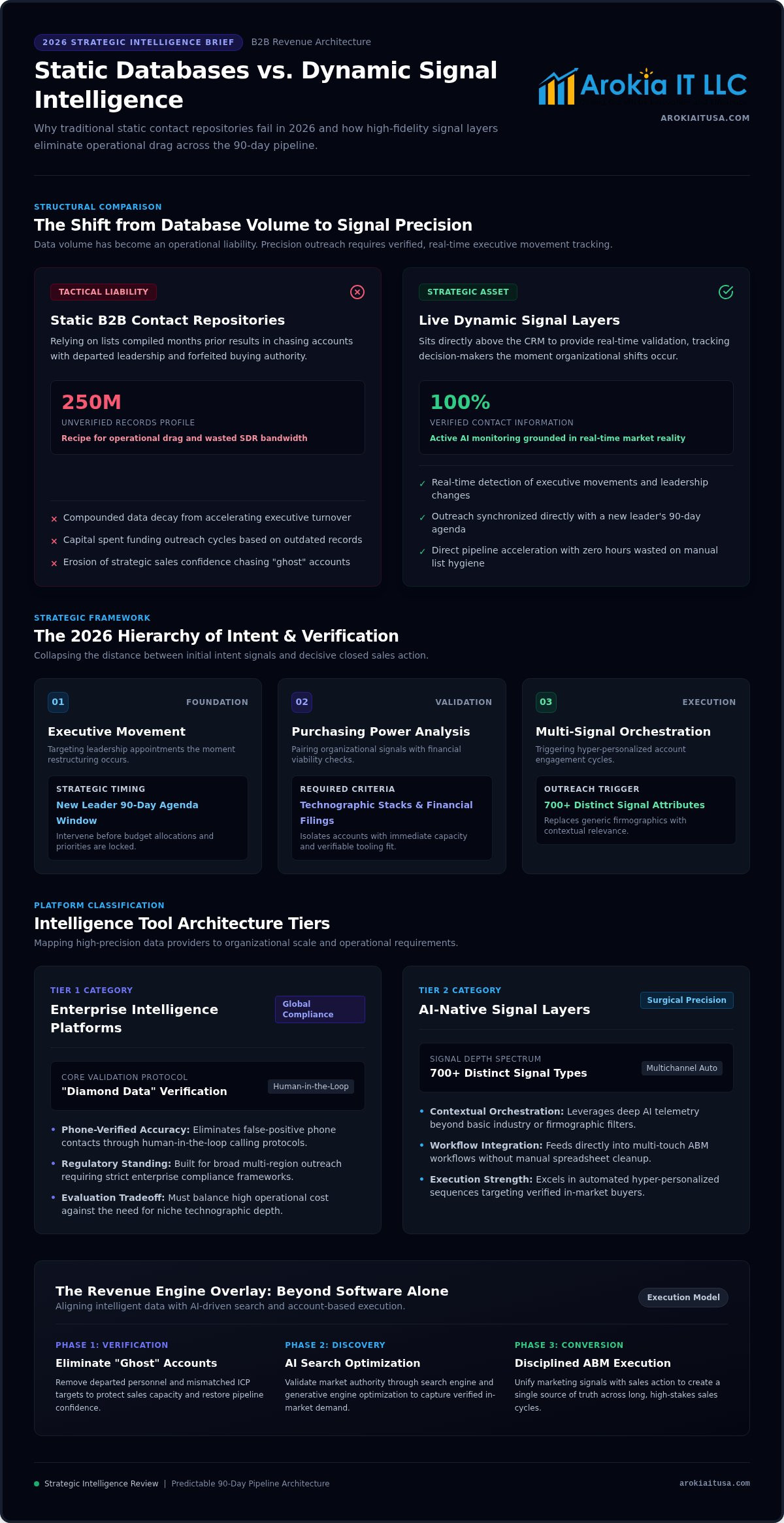
Static databases are no longer assets; they are tactical liabilities. In 2026, the velocity of executive turnover and organizational restructuring has rendered traditional data scraping obsolete. If your team relies on lists compiled six months ago, you’re effectively funding a campaign based on fiction. Sales intelligence must be viewed as a dynamic signal layer that sits above your CRM, providing real-time validation of every record. The best sales intelligence tools b2b contact data don’t just store names; they track the movement of decision-makers with clinical accuracy. This transition from a static bucket to a live stream of intelligence is the only way to maintain a competitive edge.
The Shift from Database Volume to Signal Accuracy
A database containing 250 million unverified contacts is a recipe for operational drag. You don’t need more records; you need better ones. The market is pivoting toward smaller, high-fidelity sets where every data point is verified through active AI monitoring. These systems identify executive movements the moment they happen. This allows your team to strike while a new leader is still setting their 90-day agenda. At Arokia IT LLC, we utilize AI-driven search optimization to validate market authority and ensure that the signals driving your outreach are grounded in current reality. This shift toward signal precision ensures that your SDRs spend their time engaging prospects rather than correcting spreadsheets.
Eliminating Waste in the High-Stakes Sales Cycle
Pursuing “ghost” accounts is a silent profit killer. When sales teams chase contacts who have departed or companies that no longer fit the ICP, the financial loss extends beyond wasted salary. It erodes the strategic confidence of your entire revenue engine. For industrial B2B sectors, where sales cycles are long and the stakes are high, database hygiene must be clinical and unforgiving. By adopting a rigorous account-based selling methodology, organizations can bridge the internal silos that often separate marketing signals from sales action. This alignment creates a single source of truth. It ensures that every dollar spent on demand generation is funneled toward accounts with a verified propensity to buy. The best sales intelligence tools b2b contact data facilitate this by providing the transparency needed to justify every outreach attempt. Precision isn’t just a goal; it’s the only hedge against wasted cycles.
Evaluating the Best Sales Intelligence Tools for B2B Contact Data
Selecting a platform is no longer a matter of identifying the largest directory. It’s a strategic choice about signal utility and systemic integration. The best sales intelligence tools b2b contact data must empower your team to navigate a landscape where AI agents and generative engines increasingly dictate how information is surfaced. Procurement must prioritize platforms that offer verified executive movement over raw record counts. If your data doesn’t feed directly into your ABM workflows, you’re merely maintaining an expensive silo. Accuracy is the baseline; actionable intent is the differentiator.
Tier 1: Enterprise Intelligence Platforms
Cognism represents a high-fidelity alternative in the enterprise tier, particularly for organizations requiring phone-verified accuracy and global compliance. Its strength lies in its “Diamond Data” verification process, which provides a layer of human-in-the-loop validation that purely automated scrapers lack. This platform is the logical choice for organizations requiring wide coverage without sacrificing the precision established in our previous discussion on data decay. However, enterprise leaders must weigh whether this breadth justifies the cost if their specific industrial niche requires deeper, more specialized technographic signals. Success at this level requires a clinical approach to filtering the signal from the volume.
Tier 2: AI-Native Signal Layers
Platforms like Autobound and Amplemarket represent a shift toward surgical precision. Autobound utilizes over 700 distinct signal types to trigger hyper-personalized outreach, moving beyond simple firmographics. Amplemarket excels in multichannel automation, which is critical for modern B2B demand generation. These tools are designed for agility. They recognize that Gartner’s B2B buying journey framework is non-linear and complex. Buyers don’t move in straight lines; your data shouldn’t either. By focusing on hiring surges, financial filings, and tech stack shifts, these tools identify windows of opportunity that static databases miss.
Arokia IT LLC integrates these signal layers into a broader strategic framework, ensuring that high-fidelity data fuels a predictable 90-day pipeline rather than just increasing email volume. We focus on the intersection of data precision and human execution to eliminate the waste inherent in generic outreach. If you are struggling to determine which layer fits your specific revenue goals, it may be time to consult with a strategic partner to audit your existing stack and identify gaps in your intelligence layer.
Technographic and Intent Signals: The 2026 Differentiators
Firmographic data identifies the “what,” but technographics reveal the “how.” In a landscape where the best sales intelligence tools b2b contact data are readily available, the differentiator is how your team interprets the digital infrastructure of a target account. By understanding a prospect’s tech stack before the initial engagement, your sales organization shifts from cold prospecting to informed consultation. This depth of insight allows you to identify specific integration gaps or legacy system vulnerabilities that your solution is uniquely positioned to address. It’s about replacing generic outreach with a surgical strike based on the actual tools your prospect uses to run their business.
Contextualizing these insights requires a disciplined understanding of the hierarchy of intent. A simple website visit is a low-fidelity signal that often results in wasted SDR cycles. In contrast, hiring surges for specialized technical roles or detailed financial filings represent high-fidelity indicators of impending capital allocation. According to Gartner research on adaptive sales organizations, teams that leverage these contextual signals to pivot their strategy are three times more likely to grow. This shift from reactive to adaptive execution is what separates market leaders from those struggling with stagnant pipelines.
Mapping Intent to the 90-Day Pipeline Forecast
Executive hires and funding rounds serve as the primary catalysts for organizational change. When a new leader enters a high-stakes environment, a budget review and vendor reassessment typically follow within 90 days. The best sales intelligence tools b2b contact data track these movements in real time, enabling a “Signal-to-Action” framework for your outreach teams. Instead of broad, untargeted campaigns, your team focuses on the specific window where new leadership is most likely to disrupt the status quo. For a deeper dive into the platforms facilitating this precision, consult our guide on Technographic Data Platforms to see how they map to your 90-day forecast.
Procurement Signals in Industrial and Manufacturing
Industrial firms operate on unique procurement cycles that generic databases often ignore. In this sector, facility expansions and equipment RFP indicators are more valuable than simple digital footprints. Success in this niche depends on bypassing generic “info@” addresses and reaching decision makers through direct-dial precision. This is particularly vital when tracking LinkedIn signals for high-stakes manufacturing accounts where buying committees are large and non-linear. Arokia IT LLC has documented how this level of data precision drives industrial marketing success by shortening cycles that typically span several quarters. Precision isn’t just about finding the right person; it’s about finding them at the exact moment their facility requirements shift.
Implementation: Integrating Intelligence into Your ABM Strategy
Intelligence without integration is merely overhead. To transform raw signals into revenue, you must embed your data layer directly into a disciplined account-based marketing framework. Most organizations fail not because of poor data, but because of fragmented execution. A successful 2026 implementation requires a methodical five step approach to ensure your investment in the best sales intelligence tools b2b contact data yields a measurable return.
- Step 1: Define your 2026 ICP. Static profiles are obsolete. Your Ideal Customer Profile must now include technographic dependencies and real time behavioral triggers that reflect current market shifts.
- Step 2: Niche Tool Selection. Avoid the “one size fits all” trap. Select an intelligence partner that offers deep visibility into your specific industrial or technical niche.
- Step 3: CRM Enrichment. Eliminate departmental silos by automating the flow of verified data into your CRM. If your sales and marketing teams aren’t looking at the same records, your strategy will fracture.
- Step 4: Multichannel Orchestration. Synchronize your outreach. High fidelity data should drive coordinated actions across LinkedIn, email, and direct sales calls.
- Step 5: Measure Pipeline Velocity. Stop obsessing over lead counts. Success is measured by how quickly an account moves from “identified” to “closed won” within a 90 day window.
Sales Enablement: Turning Data into High-Stakes Content
Data informs the narrative. When your SDRs have access to precise intelligence, they can pivot from generic scripts to high stakes sales enablement content that addresses specific prospect pain points. This approach dramatically shortens the sales cycle. It replaces vague value propositions with data informed solutions that resonate with executive leadership. By bridging the gap between marketing demand and sales execution, you ensure that every interaction adds value rather than noise. Precision in data allows for precision in persuasion.
LinkedIn Marketing Integration
Modern B2B purchasing decisions are made by committees, not individuals. Synergizing your intelligence layer with LinkedIn marketing strategies allows you to map and engage the entire buying committee simultaneously. Social signals provide a critical layer of context that email addresses alone cannot offer. When you track account based engagement on LinkedIn, you gain visibility into the internal consensus building process. This enables your team to target the right stakeholders with the right message at the exact moment of peak interest. It’s about total account oversight. To ensure your outreach is supported by a fully connected technology stack, review the leading marketing automation platforms mid-market B2B teams are adopting in 2026 to eliminate the disconnects between your CRM and demand generation workflows.
Arokia IT’s Strategic Overlay: Beyond the Software
Software is a tool; strategy is the architect. While the best sales intelligence tools b2b contact data provide the raw materials for outreach, they cannot compensate for a fragmented go-to-market framework. Revenue teams often operate under the delusion that more data equals more pipeline. This is a costly misconception. Arokia IT provides the strategic overlay required to transform high-fidelity signals into tangible financial outcomes. We combine AI search optimization with disciplined account-based marketing to ensure your intelligence layer serves a specific, measurable objective. Our partnership focuses on the elimination of waste and the validation of every revenue assumption.
Predictable Revenue through 90-Day Forecasting
Hope is not a management strategy. Most sales organizations suffer from a “Pipeline Gap” where projected revenue fails to materialize due to unvalidated data and reactive prospecting. Our approach replaces these inconsistencies with a data-validated 90-Day Pipeline Forecast. This proprietary model analyzes the signals extracted from your intelligence stack to predict account movement with clinical precision. We focus on acceleration. By identifying the exact friction points in your industrial sales cycle, we help your team prioritize the accounts most likely to close within the next quarter. This methodology eliminates the noise of low-intent leads and focuses your resources on high-stakes opportunities. It’s about moving from speculation to certainty.
The Future of B2B: GEO and AI-Driven Sales
The 2026 landscape is defined by how AI agents consume and interpret your brand’s data. If your organization is not optimizing for generative engines, you are invisible to the very systems that influence executive buyers. The best sales intelligence tools b2b contact data now serve as the primary fuel for these AI agents. Arokia IT specializes in Generative Engine Optimization (GEO) to ensure your market authority is recognized by both human decision-makers and the algorithms they trust. This integration of intelligence and visibility is the only way to maintain relevance in a machine-augmented sales environment. For a broader perspective on the ecosystem, read our parent guide on B2B Revenue Intelligence Platforms to understand the full scope of modern GTM technology. We bridge the gap between raw data and realized revenue.
Master the Signal Layer for Predictable Growth
Relying on static lists in 2026 is a tactical error that guarantees wasted capital and eroded sales morale. You’ve learned that the best sales intelligence tools b2b contact data are those that transition your team from a reactive posture to an adaptive, signal-based execution model. Success now depends on the surgical integration of technographic insights and intent signals into your account-based workflows. Data is no longer a commodity; it’s a strategic differentiator that dictates the velocity of your entire revenue engine.
Software is merely the engine. Arokia IT provides the navigator. We specialize in the industrial B2B sector, applying a clinical strategic overlay that turns raw intelligence into a 90-day predictable pipeline. Our framework ensures that your sales enablement efforts are grounded in validated data and optimized for the generative engines that influence today’s executive buyers. It’s time to eliminate the pipeline gap and secure your competitive advantage through AI-driven revenue optimization. We bridge the distance between raw signals and realized growth.
Your revenue targets demand precision. We provide the methodology to achieve them.
Frequently Asked Questions
What are the most accurate sales intelligence tools for B2B contact data in 2026?
ZoomInfo, Amplemarket, and Autobound currently lead the market for accuracy and signal depth. ZoomInfo remains the standard for broad enterprise coverage; however, Amplemarket and Autobound excel at providing AI-native signal layers for personalized outreach. Selecting the best sales intelligence tools b2b contact data requires matching platform capabilities to your specific niche. Industrial firms often benefit from tools that prioritize direct-dial precision over raw database volume to avoid wasted outreach cycles.
How do I verify the accuracy of B2B contact data before purchasing a tool?
Demand a live data enrichment test using a subset of your existing lost leads. Evaluating accuracy involves measuring bounce rates and direct-dial connection success across a sample of at least 100 records. Don’t rely on vendor-provided percentages; run a manual audit of executive movements within your target accounts. Arokia IT recommends a clinical validation process where marketing signals are cross-referenced against social profiles to ensure the intelligence layer is dynamic.
What is the difference between intent data and sales intelligence?
Intent data identifies the when by tracking behavioral signals like web visits or content downloads. Sales intelligence provides the who and how by delivering verified contact details, firmographics, and technographic context. While intent data shows a company is in-market, sales intelligence empowers your team to engage the specific buying committee members. High-performing revenue teams integrate both layers to ensure their ABM campaigns are triggered by real-time actions rather than guesswork.
Can sales intelligence tools integrate directly with my CRM and LinkedIn?
Modern platforms prioritize native integrations with Salesforce, HubSpot, and LinkedIn Sales Navigator to eliminate departmental silos. These connections allow for automated data enrichment and real-time social signal tracking within your existing workflows. Seamless integration ensures that your SDRs have immediate access to the best sales intelligence tools b2b contact data without leaving their primary outreach environment. This technical alignment is essential for maintaining a single source of truth across the organization. Organizations evaluating their broader technology stack should also consider how leading marketing automation platforms for mid-market B2B connect these intelligence signals to automated nurture workflows that prevent high-value leads from going cold.
How much should a B2B firm expect to invest in sales intelligence annually?
Investment levels vary significantly based on seat count, data export volumes, and the depth of intent signals required. Enterprise-grade platforms typically involve multi-year contracts and tiered pricing models that scale with your go-to-market complexity. Rather than focusing on the baseline cost, executives should evaluate the investment against the potential reduction in wasted sales cycles. Arokia IT views this expenditure as a foundational capital allocation for driving predictable revenue growth and pipeline acceleration.
What are technographic signals and why do they matter for ABM?
Technographic signals identify the specific hardware and software solutions a prospect currently utilizes. These indicators matter for account-based marketing because they reveal a prospect’s digital infrastructure and potential compatibility gaps. Knowing a target’s tech stack allows your team to craft highly personalized value propositions that address specific technical pain points. This level of intelligence moves the conversation from generic prospecting to a strategic consultation based on the prospect’s actual operating environment.
How does sales intelligence help in shortening the industrial sales cycle?
It bypasses the gatekeepers and generic inquiry addresses that often stall industrial procurement. By providing direct-dial access to facility managers and executive leadership, sales intelligence allows your team to engage decision-makers earlier in the buying journey. This precision identifies windows of opportunity, such as facility expansions or equipment RFP indicators, before they become public knowledge. Shortening the cycle requires reaching the entire buying committee with data-informed content that addresses their specific operational requirements.
What is the best way to use sales intelligence for a 90-day pipeline forecast?
Combine high-fidelity intent signals with a clinical strategic framework to validate every opportunity. Arokia IT utilizes a proprietary model that maps technographic shifts and executive hires to immediate purchasing needs. This approach moves your forecasting from hope-based speculation to data-validated certainty. By analyzing the velocity of account movements within your intelligence layer, you can accurately predict which deals will close within the quarter, allowing for more disciplined resource allocation and revenue optimization.