
Data platforms don’t generate pipeline; disciplined account-based orchestration of validated buying signals does. When evaluating ZoomInfo MarketingOS vs Apollo.io for account pipeline generation, enterprise revenue leaders often fixate on raw contact numbers while overlooking the operational friction that stalls revenue. You already understand the frustration firsthand: heavy platform commitments without predictable pipeline returns, database decay that sabotages SDR deliverability, and disconnected tech stacks that let high-value accounts slip through the cracks.
Software alone cannot resolve misaligned execution. This comparative analysis demonstrates whether ZoomInfo MarketingOS or Apollo.io delivers superior account pipeline generation for your specific enterprise revenue architecture. We dissect buying committee coverage, intent data accuracy, and multi-channel workflow synchronization so RevOps and marketing leadership can eliminate wasted outbound effort, unify go-to-market teams around verified demand, and maximize qualified pipeline velocity.
Key Takeaways
- Comparing ZoomInfo MarketingOS vs Apollo.io for account pipeline generation requires evaluating whether your revenue engine needs deep enterprise intelligence or a consolidated outbound execution platform.
- Intent signals produce pipeline only when paired with verified buying committee coverage; discover how each platform separates true in-market demand from operational noise.
- Examine how native digital ad syndication, sequencing capabilities, and data accuracy directly impact pipeline velocity from cold account discovery to qualified pipeline.
- Total platform value depends heavily on credit burn dynamics, export caps, and hidden governance overhead rather than sticker-price subscription tiers.
- Technology investments become costly shelfware without cross-functional orchestration that systematically connects marketing intent triggers to outbound sales execution.
ZoomInfo MarketingOS vs Apollo.io: The Executive Pipeline Architecture Framework
Enterprise growth stalls when technology stacks prioritize raw activity over validated pipeline quality. When revenue leaders evaluate zoominfo marketingos vs apollo io for account pipeline generation, they face a structural choice: deploy an enterprise-grade data intelligence engine or an all-in-one outbound sales engagement stack. Scaling sustainable revenue requires aligning your platform with your go-to-market motion rather than forcing teams into ill-fitting workflows. For organizations engineering modern demand generation programs, platform architecture dictates whether SDRs spend hours chasing phantom contacts or executing precision plays against active buying groups.
| Capability | ZoomInfo MarketingOS | Apollo.io |
|---|---|---|
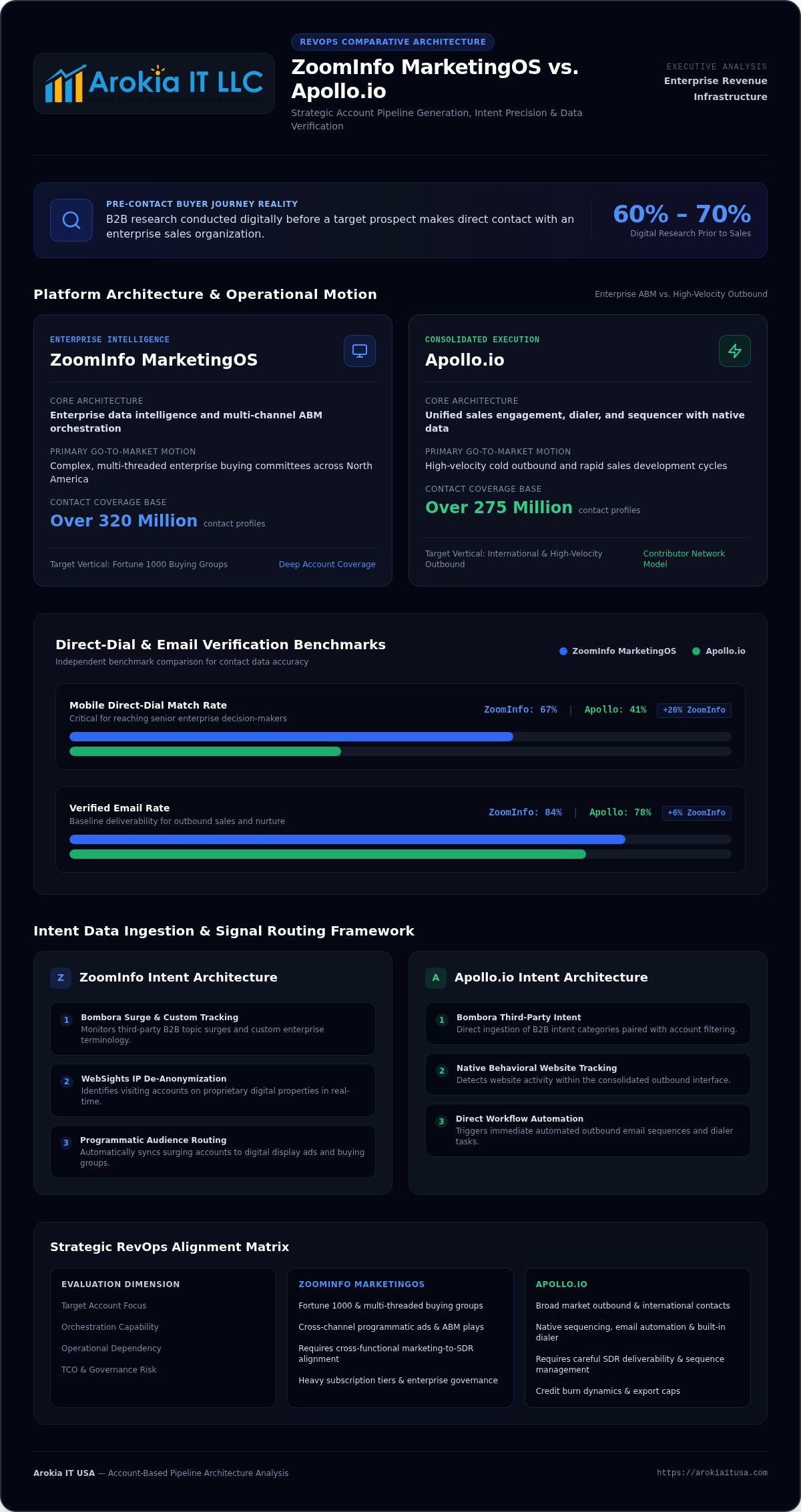
| Core Architecture | Enterprise data intelligence and multi-channel ABM orchestration | Unified sales engagement, dialer, and sequencer with native data |
| Database Scale | Over 320 million contact profiles | Over 275 million contact profiles |
| Intent Signals | Bombora third-party intent, WebSights, and custom intent tracking | Bombora third-party intent and native behavioral website tracking |
| Primary Motion | Complex, multi-threaded enterprise buying committees | High-velocity cold outbound and rapid sales development cycles |
Database Depth and Direct-Dial Verification Accuracy
Data decay erodes sales productivity rapidly across technology and manufacturing verticals. ZoomInfo maintains deep coverage across Fortune 1000 buying groups, offering verified direct-dial mobile phone numbers that outpace alternatives. An independent benchmark found ZoomInfo delivered a 67% mobile number match rate compared to Apollo’s 41%, though verified email rates were closer at 84% versus 78%. Apollo leverages a contributor network model to expand international reach, but enterprise teams targeting North American buying centers often find ZoomInfo direct dials critical for connecting with senior decision-makers.
Strategic Alignment: Enterprise ABM vs High-Velocity Outbound
Choosing between these systems depends entirely on deal complexity. MarketingOS excels in formal Account-Based Marketing (ABM) environments where revenue teams must coordinate digital ad display, email nurture, and sales outreach across large buying groups. Apollo serves teams running broad outbound motions that require high-velocity email sequences and built-in dialing. Ultimately, selecting zoominfo marketingos vs apollo io for account pipeline generation requires auditing whether your pipeline bottlenecks around data fidelity or SDR execution speed.
Account-Based Targeting and Intent Signal Precision Compared
Intent data without contextual verification produces expensive false positives. An estimated 60-70% of B2B research occurs before a prospect contacts a sales team, meaning revenue architectures must accurately decode digital consumption patterns early. In the contest of zoominfo marketingos vs apollo io for account pipeline generation, each platform ingests and surfaces intent through contrasting technical frameworks. Choosing the right mechanism determines whether your SDRs engage accounts actively shopping or squander cycles on casual web traffic.
ZoomInfo MarketingOS Intent Infrastructure and Cross-Channel Triggers
MarketingOS relies on streaming Bombora topic surges paired with its proprietary WebSights IP de-anonymization engine. It allows teams to create custom intent topics, tracking niche enterprise terminology across specific web properties. When an enterprise account crosses designated surge thresholds, MarketingOS automatically routes that account into targeted programmatic ad audiences. The challenge lies in translation; if marketing triggers paid media impressions while sales development runs disconnected outreach, intent spikes decay without generating opportunities.
Apollo.io Intent Scoring and Immediate Sequence Automation
Apollo takes an operational approach by binding third-party Bombora intent topics directly to workflow automation triggers. Users configure rules where an intent spike, recent funding round, or hiring trend automatically enrolls verified personas into multi-step outreach cadences. While this minimizes latency between detection and outbound execution, Apollo’s signal filtering offers less structural customization for enterprise accounts than ZoomInfo’s layered tracking models.
Buying Committee Identification and Org Chart Penetration
Single-threaded outreach ruins enterprise deal conversion. Complex sales require engaging economic buyers, technical evaluators, and internal champions simultaneously. Understanding the new rules of strategy means treating target accounts as multi-layered networks rather than isolated leads. ZoomInfo provides deep hierarchical org charts, detailing reporting lines and department structures across enterprise organizations. Apollo relies primarily on granular job title search filters, requiring reps to manually assemble the committee matrix.
- Economic Buyers: Identified via executive tier filtering in both platforms, though ZoomInfo maps direct reporting trees more cleanly.
- Technical Evaluators: Uncovered using technographic filters that isolate specific software deployments across cloud stacks.
- Operational Champions: Sourced through functional role segmentation to ensure multi-threaded account penetration.
Scaling predictable revenue requires orchestrating these data inputs through a structured account-based marketing motion. If your internal team struggles to translate platform signals into qualified pipeline, you can talk with an ABM strategist to build a unified revenue architecture.
Pipeline Velocity and Multi-Channel Orchestration Capabilities
Speed alone does not create qualified pipeline; synchronized execution across buyer touchpoints does. Accelerating sales cycles requires coordinating outbound sales development with paid digital air cover. As industry research outlines in The Rise of Revenue Marketing Platforms, the consolidation of disparate outreach systems into integrated revenue engines represents a major operational shift. Assessing zoominfo marketingos vs apollo io for account pipeline generation demands an honest look at how each platform handles execution across media channels and outbound touchpoints.
Programmatic Advertising and Digital Audience Syndication
MarketingOS functions as an account-based media engine. It syndicates audience lists directly to Google, LinkedIn, and major display networks while using native IP matching to serve targeted impressions to in-market buying accounts. This capability allows marketing teams to warm target committees with relevant messaging before SDR outreach begins. Apollo takes an export-first approach, requiring teams to extract static audience CSVs or rely on third-party integration connectors to populate ad platforms. The operational difference is striking: MarketingOS dynamically adjusts ad audiences based on real-time intent surges, whereas Apollo treats digital advertising as a disconnected manual export.
Sales Engagement Engines: Sequencing, Dialers, and Deliverability
When the operational focus shifts to outbound sales rep activity, platform strengths reverse. Apollo delivers a comprehensive, out-of-the-box sales engagement infrastructure that includes native multi-step email cadences, automated A/B testing, integrated dialers, and automated inbox warmup tools. MarketingOS concentrates primarily on data intelligence and audience syndication; executing cold email cadences and phone calls requires buying separate add-ons like ZoomInfo Engage or connecting external enterprise sales engagement software. This separation forces RevOps teams to manage additional vendor integrations.
Protecting domain reputation requires rigorous compliance safeguards. In modern outbound motions, mailbox warming, automated SPF/DKIM verification, and controlled sending volumes protect SDR deliverability. Apollo builds these safeguards directly into user seats, enabling high-velocity outreach without immediate domain damage. MarketingOS offloads mailbox reputation controls to whatever third-party engagement platform your organization connects downstream.
Aligning multi-touch sales sequences with comprehensive demand generation ensures that SDRs follow up on pre-warmed, highly engaged target accounts. High-performing revenue teams link paid media air cover with precision cold outreach, reducing sales friction and accelerating deal velocity across the complete buyer journey.
Total Cost of Ownership and Enterprise Stack Integration Criteria
Licensing software without calculating downstream operational costs guarantees budget waste. While platform selection often centers on feature checklists, the actual investment includes credit consumption limits, API access tiers, and governance overhead. When analyzing zoominfo marketingos vs apollo io for account pipeline generation, RevOps executives must evaluate whether a tool offers sustainable unit economics or forces unpredictable billing spikes as outbound activity scales.
Platform Economics: Credit Consumption vs Unlimited Outbound Models
ZoomInfo operates on an enterprise quote model requiring multi-seat minimums and rigid annual agreements. Core functionalities like advanced intent data feeds, CRM export allowances, and developer API endpoints frequently sit behind tiered paywalls or separate add-on contracts. In contrast, Apollo employs a transparent, credit-based structure spanning free to organizational tiers with monthly or annual billing options. While Apollo makes prospecting cost-efficient for high-velocity teams, credit consumption accelerates quickly when revealing mobile numbers or pushing records en masse to external systems. More details on ecosystem architectures are available in our analysis of enterprise search frameworks and revenue operations.
Bidirectional CRM Integration and Data Governance Integrity
Dirty data breaks pipeline attribution and ruins sales workflows. Deploying either platform into Salesforce or HubSpot environments requires rigorous field-level governance:
- Field-Level Overwrite Controls: Ensuring platform enrichment updates stale fields without wiping out proprietary rep notes or custom lifecycle stages.
- Automated Deduplication: Establishing strict domain and email matching rules to prevent creating duplicate account shells inside your CRM.
- API Call Throttling: Managing high-frequency synchronization to prevent hitting daily CRM API request limits during major database updates.
ZoomInfo provides enterprise-tested data management capabilities, offering reliable native connectors that handle intricate multi-subsidiary hierarchies. Apollo features accessible standard integrations, but managing custom field logic across large RevOps architectures often requires strict administrative guardrails to avoid polluting database records.
Before committing to an annual agreement, revenue operations teams should execute a concise 5-step validation framework: audit direct-dial match rates against target accounts, test CRM deduplication logic, calculate year-one credit consumption based on SDR headcount, verify API bandwidth for marketing automation, and ensure intent data feeds directly trigger sales sequences rather than sitting idle.
Selecting zoominfo marketingos vs apollo io for account pipeline generation ultimately hinges on balancing direct platform investment against the true operational overhead required to turn intelligence into closed business.
Beyond the Software: Building a Predictable Account Pipeline Engine
Software cannot fix broken operational strategy. The debate over zoominfo marketingos vs apollo io for account pipeline generation often obscures a fundamental truth: contact records and automated cadences are useless if marketing and sales operate in silos. Without strategic orchestration, enterprise data platforms quickly become expensive shelfware. Sustainable pipeline generation demands an integrated framework where marketing warms in-market buying accounts, specialized content equips SDRs for targeted conversations, and leadership monitors progress through disciplined 90-day pipeline forecasting models.
Eliminating the Marketing-to-Sales Handoff Bottleneck
Most pipeline breakdowns happen at the handoff. When marketing classifies a minor intent surge as a qualified opportunity, SDRs waste hours chasing cold accounts. Organizations must establish strict Service Level Agreements that define genuine account engagement based on verified buying committee actions rather than casual page visits. Equipping outbound reps with tailored sales enablement content aligned with active research topics turns generic cold calls into consultative briefings. Continuous feedback loops from sales conversations must directly inform paid media parameters, ensuring targeting becomes sharper over time.
Orchestrating High-Stakes Account Acquisition with Arokia IT
Arokia IT bridges the gap between raw data platforms and predictable revenue execution. As a specialized B2B digital marketing agency serving national enterprises, Arokia IT transforms platform data into predictable revenue engines. Rather than treating databases as isolated contact dumps, we architect multi-channel Account-Based Marketing (ABM) programs, integrate AI search optimization, and synchronize sales enablement content across the entire buyer journey. Our proprietary 90-day pipeline forecasting methodology gives executive leadership complete visibility into pipeline velocity and acquisition efficiency.
Whether your enterprise selects ZoomInfo MarketingOS or Apollo.io for account pipeline generation, tools alone cannot generate enterprise revenue. Partnering with a dedicated orchestration team ensures your data investment drives qualified sales pipeline rather than unread outbound sequences.
Orchestrating Pipeline Predictability for Sustainable Enterprise Growth
Selecting between ZoomInfo MarketingOS vs Apollo.io for account pipeline generation hinges on your core go-to-market architecture. ZoomInfo delivers unmatched enterprise data depth and native ad syndication for complex, multi-stakeholder committees. Apollo provides an integrated, cost-efficient sales engagement engine built for rapid outbound cadences. Both platforms offer substantial leverage, but neither can replace strategic execution.
Software alone won’t fix structural revenue misalignment. Converting target accounts into closed-won business requires end-to-end multi-channel account-based marketing orchestration paired with national B2B demand generation expertise. By anchoring your go-to-market motion in our proprietary 90-day pipeline forecasting methodology, you eliminate wasted outbound cycles and unite sales with marketing around validated buying intent.
Equip your revenue teams with the strategic clarity needed to transform raw account data into predictable, compounding pipeline velocity.
Frequently Asked Questions
Is ZoomInfo MarketingOS or Apollo.io better for mid-market B2B companies?
Mid-market B2B companies typically gain faster operational traction with Apollo.io due to its unified sales engagement features and accessible seat licensing. However, if the mid-market revenue model targets complex enterprise committees with multi-channel digital ad air cover, ZoomInfo MarketingOS provides superior orchestration. Evaluating zoominfo marketingos vs apollo io for account pipeline generation comes down to whether your primary bottleneck is outbound sales rep execution speed or complex account-level coordination.
How do ZoomInfo and Apollo.io compare in phone number and email data accuracy?
Independent benchmarks show ZoomInfo holds a substantial edge in phone verification, delivering roughly a 67% mobile direct-dial match rate compared to Apollo’s 41%. Email deliverability is substantially closer, with ZoomInfo achieving approximately 84% accuracy against Apollo’s 78%. Enterprise sales teams targeting North American executive leadership often justify ZoomInfo’s premium for direct dials, whereas high-volume email programs operate effectively on Apollo’s verified contact repository.
Can Apollo.io completely replace a dedicated ABM platform like MarketingOS?
No, Apollo.io cannot fully replace a dedicated ABM platform for complex enterprise motions. While Apollo excels at automated outbound email sequences and dialer cadences, it lacks the native programmatic ad syndication, dynamic IP targeting, and deep account hierarchy mapping foundational to MarketingOS. Teams attempting enterprise ABM inside Apollo must export static lists to third-party ad networks manually, sacrificing real-time intent-triggered display campaigns that warm buying accounts before sales outreach.
What are the hidden costs associated with ZoomInfo MarketingOS contracts?
Hidden costs in ZoomInfo contracts typically stem from mandatory multi-seat minimums, rigid annual billing commitments, and modular add-on pricing structures. Key functionalities such as advanced streaming intent feeds, API integrations, and CRM export credits frequently incur additional licensing fees beyond the base software contract. Organizations must also factor in annual renewal rate adjustments and the internal RevOps resources needed to govern data hygiene and configure custom workflow integrations.
How does intent data accuracy differ between Bombora and Apollo native signals?
Bombora relies on a cooperative network of business web properties to track cross-web content consumption surges, whereas Apollo blends third-party Bombora feeds with proprietary platform interactions and website tracking scripts. MarketingOS layers custom intent tracking and IP de-anonymization on top of Bombora, isolating niche vertical terms. In the evaluation of zoominfo marketingos vs apollo io for account pipeline generation, ZoomInfo yields higher signal precision for enterprise buying committees, while Apollo focuses on immediate sequence triggering.
What technical prerequisites are needed before integrating these platforms with Salesforce or HubSpot?
Successful CRM integration requires standardizing account deduplication rules, establishing strict field-level overwrite permissions, and auditing API rate limits. Revenue operations teams must configure custom lead routing triggers and map intent scoring attributes directly to active contact and opportunity objects. Without pre-configured data governance rules, continuous bi-directional syncing between either platform and your CRM can cause massive data duplication, overwrite proprietary rep notes, and distort executive pipeline reporting.