
A six- or seven-figure B2B deal doesn’t need more leads. It needs the right buying group, a credible reason to engage, and a clear path from first signal to sales conversation. The strongest lead generation examples in 2026 reflect that shift: focused programs designed to create qualified pipeline, not inflate activity reports.
If sales ignores marketing leads, broad advertising burns budget, or your expertise is missing from answers in ChatGPT and Perplexity, the problem may be the connection between targeting, buyer intent, visibility, and revenue accountability.
This article shows how high-stakes B2B firms use account-based marketing, AI-driven search, and sales enablement to focus investment on accounts with a credible path to purchase. You’ll find practical frameworks for improving lead quality, coordinating marketing and sales, and building a more useful 90-day pipeline forecast.
Key Takeaways
- Evaluate lead quality by its contribution to qualified pipeline, not by MQL volume alone.
- Use one-to-one and one-to-few ABM to tailor outreach to priority accounts and industrial buying groups.
- Use GEO to make expertise easier to discover when executives research questions in AI answer engines.
- Replace generic downloads with useful interactive tools, such as an ROI calculator or diagnostic scorecard, to capture more specific buying signals.
- Start by tracing pipeline leakage, then align sales and marketing on your ideal customer profile and Tier 1 account list.
The Strategic Shift: Why Traditional Lead Generation Fails in 2026
Broad reach can generate activity without creating a credible path to revenue. In high-value B2B markets, a form fill or content download doesn’t show whether an organization fits your ideal customer profile (ICP), has a relevant business need, or is ready to speak with sales. Marketing may attract attention while sales spends time sorting through contacts that are unlikely to become viable opportunities.
Lead generation still matters, but the work goes beyond collecting names. The foundational concept includes identifying and developing potential buyers, as outlined in this overview of lead generation. In practice, revenue teams need to connect demand creation with account acquisition: build awareness and trust, then coordinate action around organizations with a strong fit and meaningful buying signals. A demand generation strategy can support that shift by tying campaigns to buyer needs instead of treating every response as equal.
MQLs can help teams organize early engagement, but they become a vanity metric when scores reflect clicks and downloads without accounting for account fit, buying context, or sales acceptance. Marketing may report more leads while sales sees little usable pipeline. Better lead generation examples start with a more useful question: which accounts have a credible reason to talk, and what evidence supports that judgment?
The Reality of the 2026 B2B Buyer Journey
An enterprise industrial purchase can involve 10 or more stakeholders, from technical evaluators and operations leaders to finance and executive decision-makers. Each may research separately, compare risks, and influence the eventual decision. Buyers need information that helps them assess trade-offs and build internal agreement, not another unsupported product claim.
Some discovery happens beyond trackable clicks. Dark social includes private sharing and conversations, such as colleagues forwarding an article or discussing a vendor in an industry group. Peer recommendations can shape consideration before a buyer fills out a form, so campaign measurement should not mistake an untracked journey for an absent one.
Precision vs. Volume: A Revenue-First Framework
Define lead quality through ICP fit and evidence of buying progress: the organization’s relevance, the problem it is trying to solve, and whether the right stakeholders are engaging. A 90-day pipeline forecast shifts attention from maximizing monthly lead counts to identifying accounts and opportunities that could meaningfully advance within the forecast window. It gives marketing and sales a shared basis for prioritizing effort.
That alignment depends on common definitions and regular feedback. Marketing needs to know which sources produce sales-accepted opportunities; sales needs account engagement and the context behind each inquiry. When both teams review progression and stalled opportunities together, they can redirect spend, improve follow-up, and address friction in the sales cycle.
Account-Based Marketing (ABM) Examples for Enterprise Growth
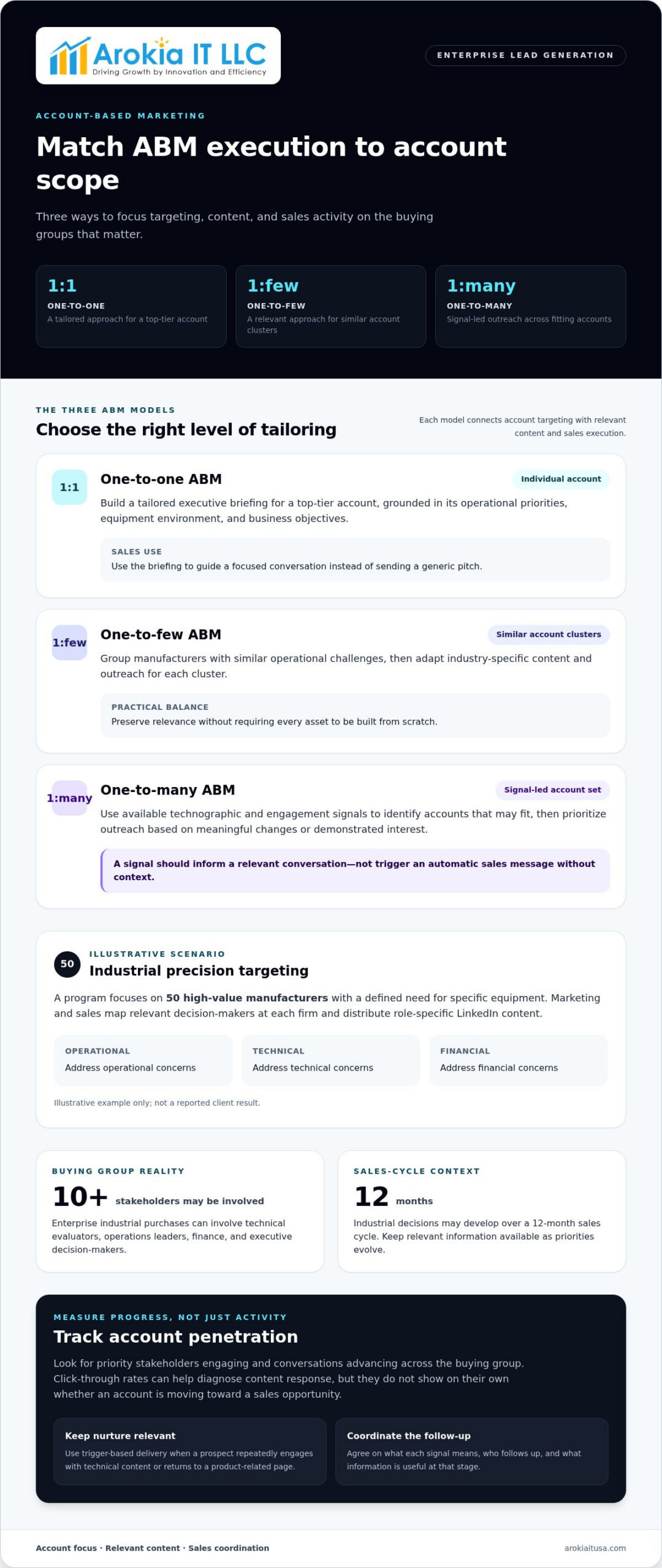
Enterprise account acquisition takes more than targeting a job title with an ad. Effective account-based marketing coordinates relevant information across an organization, giving decision-makers consistent reasons to consider a solution. The approach can be tailored by account value and shared needs, with Account-Based Marketing (ABM) connecting targeting, content, and sales execution around specific buying groups.
- One-to-one ABM: Build a tailored executive briefing for a top-tier account, grounded in its operational priorities, equipment environment, and business objectives. Sales can use the briefing to guide a focused conversation instead of sending a generic pitch.
- One-to-few ABM: Group manufacturers with similar operational challenges, then adapt industry-specific content and outreach for each cluster. This preserves relevance without requiring every asset to be built from scratch.
- One-to-many ABM: Use available technographic and engagement signals to identify accounts that may fit, then prioritize outreach based on meaningful changes or demonstrated interest. A signal should inform a relevant conversation, not trigger an automatic sales message without context.
Illustrative Example: Industrial Precision Targeting
Consider a program focused on 50 high-value manufacturers with a defined need for specific equipment. Marketing and sales can map relevant decision-makers at each firm, then distribute role-specific LinkedIn content addressing operational, technical, and financial concerns. This is an illustrative scenario, not a reported client result.
Measure progress by account penetration: whether priority stakeholders are engaging and conversations are advancing across the buying group. Click-through rates can help diagnose content response, but they don’t show on their own whether an account is moving toward a sales opportunity.
Keep Priority Accounts Engaged Between Buying Milestones
Industrial decisions may develop over a 12-month sales cycle. An always-on nurture program keeps relevant information available as priorities evolve instead of treating a quiet period as a reason to abandon an account. Trigger-based delivery can respond to signals such as repeat engagement with technical content or a return visit to a product-related page. Follow-up should match the topic that prompted interest.
Lead nurturing works best when sales and marketing agree on what each signal means, who follows up, and what information is useful at that stage. This coordination can reduce avoidable delays, though ABM alone can’t guarantee a shorter sales cycle. For a broader evaluation framework, align account selection, measurement, and team responsibilities with the principles in an executive guide to choosing a B2B ABM agency for 2026.
Arokia IT develops ABM and demand generation strategies for industrial and B2B teams. Learn more about how to discuss an ABM strategy around your revenue priorities.
AI-Driven Search and GEO: The New Lead Generation Frontier
Industrial buyers can use Gemini, Claude, and Perplexity to summarize vendors, compare technical options, and shape early procurement research before visiting a company website. That changes the visibility objective: useful content should rank in traditional search and give answer engines clear, reliable material to reference. A citation can introduce a supplier during research, but it doesn’t guarantee a qualified lead or sales conversation.
Generative Engine Optimization (GEO) is the alignment of content, structure, and evidence to improve discovery and citation in generative AI answers. For B2B companies, GEO can support lead generation by making expertise visible when a buyer evaluates a problem, requirement, or solution. Useful lead generation examples in AI search answer a specific decision-stage question rather than repeating broad product claims.
Become a Credible Source for AI Answer Engines
Answer engines need content that is understandable, specific, and supported by clear context. Structure industrial information so people and language models can interpret it accurately:
- Use descriptive headings that match buyer questions, such as how a specification affects equipment selection.
- Define technical terms and identify the product, application, and conditions associated with each specification.
- Present comparable details in readable tables or labeled sections, and keep claims consistent across relevant pages.
For example, a manufacturer could publish a detailed explanation of equipment specifications, including the operating context and trade-offs procurement teams need to assess. If an answer engine cites that material in a generated procurement summary, the company has earned visibility during research. Whether an engine selects and cites the content is outside the company’s control.
Information gain matters. A page that restates common descriptions gives buyers little reason to trust it over competing sources. Original technical explanations, clear comparisons, and useful decision criteria provide stronger value for complex B2B queries. Explore how AI search optimization can complement B2B SEO by supporting conventional search visibility and generative discovery.
Measure Visibility Beyond Rankings
Keyword rankings remain useful, but they don’t show the full picture when an answer engine summarizes information without a click. Track share of model by monitoring whether your brand appears for a defined set of buyer prompts, how it is described, and whether cited sources include your content. Pair those observations with referral traffic, qualified inquiries, and account-level engagement. AI visibility is an awareness signal; measure pipeline impact separately.
GEO-driven prospects may arrive with a more specific question because they have already used an AI answer to frame their research. Traditional organic visitors may enter through a broader search query. Treat either source as a starting signal, then qualify the account, need, and buying context. For a deeper strategic framework, see B2B Generative Engine Optimization: The 2026 Strategic Evolution of Search.
Arokia IT provides AI search and GEO as part of its B2B growth services. Discuss your B2B search strategy in the context of your broader demand generation goals.
Sales Enablement Content as a Lead Generation Catalyst
A lead magnet should do more than earn an email address. In high-stakes B2B sales, useful content helps buyers clarify a problem, assess options, or make a decision. A general whitepaper can introduce a topic, but interactive tools such as ROI calculators and diagnostic assessments invite prospects to apply information to their own situation.
An AI Scorecard illustrates this diagnostic approach. A prospect who uses a scorecard to assess an AI-related opportunity provides a more specific signal than a basic content download. Marketing and sales can use that context to tailor follow-up to the prospect’s priorities instead of sending a standard sequence that ignores what prompted the interaction.
Content becomes a bridge between demand generation and closed revenue when sales can use it at important decision points. For example, a technical comparison guide can map differences between solution approaches against criteria the buying team cares about, such as integration requirements, operating conditions, and evaluation priorities. A sales representative can share the guide to address a competitor objection with clear evidence and relevant questions, not a broad claim that their product is better.
Connect Content Engagement to a 90-Day Pipeline Forecast
A 90-day pipeline forecast is more useful when marketing activity is connected to account progression. Content can reveal which topics attract engagement, which stakeholders are involved, and whether interest advances toward a sales conversation. These signals inform forecasting, but they don’t establish an opportunity on their own. Sales must validate fit, need, and next steps before an engaged lead becomes a qualified opportunity.
To make the data actionable, align campaign and CRM definitions. Record the content or topic that prompted engagement, capture relevant account context, and have sales report whether the interaction advanced a real buying discussion. The Executive Guide to B2B Sales Enablement Strategy in 2026 can provide a framework for connecting content, sales activity, and pipeline goals. This is how lead generation examples move beyond downloads and support decisions that can be tracked through the revenue process.
Coordinate Email and LinkedIn Around Buyer Needs
Email and LinkedIn outreach work best when each message adds context. Share a specific insight or useful asset to explain why you’re reaching out, then offer a relevant next step. Social media marketing can reinforce that outreach by making expert perspectives and useful content visible between direct sales interactions. In high-stakes sales, authority comes from relevance and clarity, not repeated follow-ups without new value.
Implementing Your Lead Generation Engine: A Step-by-Step Framework
Turn strategy into an operating system for pipeline growth. These lead generation examples are useful when teams can trace the work from target account to qualified opportunity and revenue.
- Audit pipeline leakage. Review lead sources, conversion stages, sales acceptance, and closed-won outcomes. Identify channels that generate activity but rarely produce qualified opportunities. Then investigate where promising accounts stall or go untouched.
- Define the ICP and Tier 1 accounts with sales. Agree on the firmographic, operational, and buying-context signals that indicate fit. Build a focused account list with sales leadership, and document why each account merits investment so prioritization rests on shared criteria.
- Deploy coordinated ABM and GEO. Match account-specific outreach with useful content for the questions buyers ask during research. Combine channels such as LinkedIn, email, and search visibility while keeping claims consistent and relevant to each buying group.
- Connect attribution to the 90-day revenue forecast. Track meaningful progression, including sales acceptance, stakeholder engagement, opportunity creation, and stage movement. Use attribution to understand contribution, not to claim that one touchpoint alone caused a complex B2B sale.
- Optimize with evidence. Review performance with sales on a regular cadence, identify friction in the buyer journey, and refine messaging and assets through strategic content marketing.
Eliminate Waste Through Transparent Reporting
A channel shouldn’t earn continued investment simply because it produces leads. Compare activity by source with account fit, sales feedback, opportunity progression, and revenue outcomes. Some channels may play an assistive role earlier in the journey, so assess them in context rather than cutting them based on last-click attribution alone. Transparent reporting makes trade-offs visible and shifts marketing from a cost-center mindset toward accountable contribution to growth.
Give Executive Leadership a Focused Pilot
Start an industrial ABM pilot with a clearly defined account segment, agreed success measures, and sales ownership for follow-up. Establish a baseline, choose content and channels that address the segment’s buying questions, and review account engagement and pipeline movement against the forecast. Arokia IT helps B2B teams coordinate ABM, GEO, and measurement. No tactic can guarantee a shorter sales cycle. The objective is to remove avoidable friction and give the revenue team clearer evidence for its next decision.
Build a More Predictable B2B Pipeline
The strongest lead generation examples share a common principle: they prioritize account fit, buyer intent, and useful information over raw lead volume. ABM focuses resources on organizations aligned with your offer, while AI-driven GEO helps make your expertise discoverable during early research. Sales enablement content then gives your team practical ways to support buyer decisions and move qualified opportunities forward.
For industrial B2B companies, connect those activities to measurable pipeline movement. A 90-day pipeline forecast gives marketing and sales a shared view of progress, while industrial marketing and AI-driven GEO help shape a strategy around complex buying journeys. The goal is to tie investment more closely to account engagement and opportunity development.
Arokia IT provides Account-Based Marketing, demand generation, AI search and GEO, LinkedIn marketing, and sales enablement content for B2B growth. Talk with Arokia IT about building a focused B2B pipeline strategy.
Frequently Asked Questions
What are the most effective lead generation examples for B2B manufacturing?
Effective B2B manufacturing lead generation connects technical relevance with account fit and sales follow-up. Examples include ABM campaigns for manufacturers with a specific equipment need, LinkedIn content tailored to decision-makers, and GEO-focused technical pages that answer procurement questions. An ROI calculator or diagnostic tool can reveal a prospect’s priorities. Track whether target accounts engage and progress toward sales conversations, not just whether individuals download content.
How does Account-Based Marketing (ABM) differ from traditional lead generation?
ABM organizes marketing and sales around selected accounts and their buying groups, while traditional lead generation often prioritizes attracting and scoring individual contacts. An ABM program might tailor executive briefings for priority companies, then coordinate relevant content and sales outreach across several stakeholders. This can improve focus and coordination, but it doesn’t automatically shorten a sales cycle or guarantee revenue. Teams still need clear account criteria and shared measures of progress.
Is Generative Engine Optimization (GEO) a viable source for B2B leads?
GEO can support B2B lead generation by improving the chance that useful company content is discovered or cited in AI-generated answers. For example, a manufacturer can structure technical specifications and explain their application clearly, helping buyers researching procurement options find relevant expertise. A citation is a visibility signal, not a lead by itself. Measure AI visibility alongside qualified inquiries, account engagement, and sales pipeline progression to assess its contribution.
Why is my sales team ignoring the leads generated by marketing?
Sales may ignore marketing leads when the handoff doesn’t provide enough evidence of fit, need, or buying intent. A high MQL count can include contacts who engaged with content but lack authority or a relevant project. Review lead acceptance and opportunity outcomes by source, then agree on qualification criteria, follow-up ownership, and feedback. Include account context and the content that prompted the inquiry so sales can make outreach relevant.
What is a 90-day pipeline forecast, and why does it matter for lead generation?
A 90-day pipeline forecast is a forward-looking view of expected pipeline activity and opportunity progression over a 90-day period. For lead generation, it helps marketing and sales focus on accounts with credible fit and signals of movement, rather than treating every new contact as equal. Use shared stage definitions and review sales-accepted opportunities, account engagement, and stalled deals. A forecast guides decisions, but it isn’t a guarantee of future revenue.
How can I shorten my B2B sales cycle through lead generation strategy?
Lead generation can reduce avoidable delays by reaching the right accounts with useful information and involving sales at the appropriate point. Align campaigns to buyer questions, share technical comparisons that address evaluation concerns, and coordinate follow-up across relevant stakeholders. Use sales feedback to find where prospects pause or need more clarity. These steps can remove friction, but no marketing strategy can guarantee a shorter cycle, especially when decisions depend on multiple stakeholders.
What role does LinkedIn play in high-stakes B2B lead generation?
LinkedIn can support high-stakes B2B lead generation by distributing relevant expertise to professional audiences and reinforcing direct account outreach. An industrial company might share technical insights or buying guidance that sales representatives can use in conversations with decision-makers. Treat engagement as a signal to interpret, not proof of purchase intent. Coordinate LinkedIn activity with account priorities, email outreach, and sales follow-up to create a coherent buyer experience.
Are whitepapers still effective for B2B lead generation in 2026?
Whitepapers can support B2B lead generation when they offer original, specific insight that helps buyers evaluate a real business or technical problem. A generic overview is less useful than a guide with clear decision criteria, practical comparisons, or analysis relevant to an industrial use case. Sales should be able to use the asset during evaluation. Consider pairing a whitepaper with an interactive diagnostic or calculator, then assess engagement and opportunity progression.